
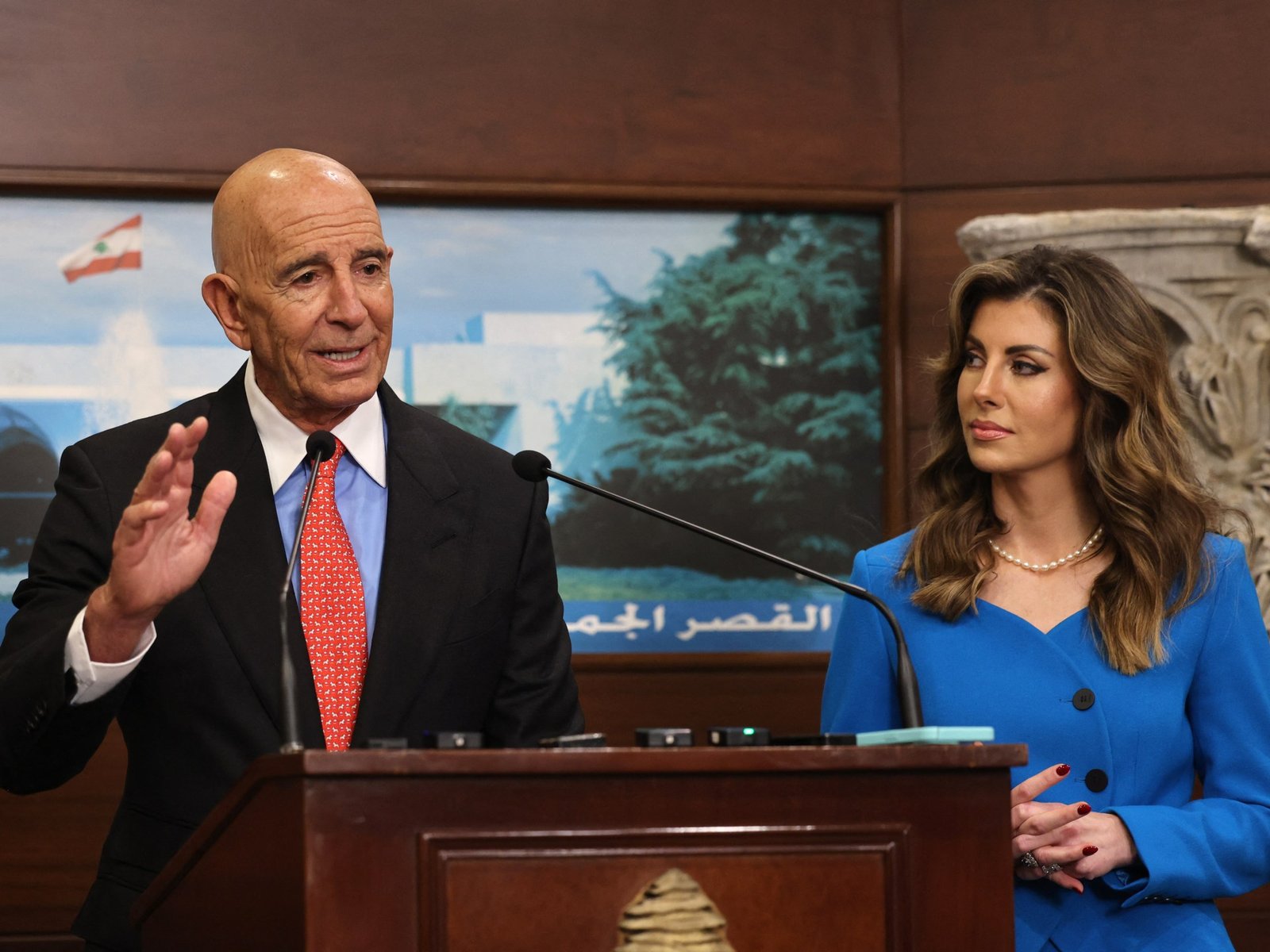
US envoy Barrack proposed the zone, but analysts say locals don’t trust Israel or the US’s ability to control it.
The United States has floated a proposal for an economic zone in southern Lebanon in what analysts tell media is a far-fetched and poorly thought-out plan to incentivise the Lebanese government to push on with disarming Hezbollah.
The US envoy to the Middle East, Thomas Barrack, floated the economic zone during a visit to Lebanon on Tuesday but provided few details other than hints at financing.
“We, all of us – the Gulf, the US, the Lebanese – are all going to act together to create an economic forum that is going to produce a livelihood,” Barrack told journalists.
Experts said the idea could be based on similar zones in Jordan and Egypt, two countries with peace deals with Israel that Lebanon would be hard-pressed to replicate after last year’s Israeli war on Lebanon.
After the war, fought primarily against Hezbollah, a regional and domestic push to disarm the Lebanese group has grown, and the relatively new Lebanese government, which took office in January and is under US and Israeli pressure, has declared the intention to disarm the group.
The pressure to disarm Hezbollah
Israel and Hezbollah fought a war that started on October 8, 2023, but intensified in September last year until a ceasefire on November 27, which Israel has repeatedly broken with no repercussions.
Hezbollah’s military capabilities took a hit during the war, and Israel succeeded in assassinating many of its leaders.
The Iran-backed “axis of resistance”, of which Hezbollah is a member, suffered other serious blows with the fall of President Bashar al-Assad in Syria in December and US-backed Israeli attacks on Iran in June, leaving Hezbollah with weakened regional support.
Domestically, Hezbollah has seen its popularity outside its core constituency plummet over the past 20 years – from its status as the only Lebanese force able to repel Israel – as a result of its takeover of Beirut in 2008, its intervention in Syria on behalf of al-Assad’s regime and its backing of counterrevolutionary forces during the 2019 Lebanese uprising.
Many of its political allies, including the Free Patriotic Movement and one-time presidential candidate Sleiman Frangieh, have shifted their tone towards Hezbollah, expressing support for its disarmament.
The domestic opposition to Hezbollah said it supports its disarmament because that would concentrate power in the hands of the Lebanese state.
And now, removed from its perch as Lebanon’s hegemon and with its opponents demanding disarmament, Hezbollah is on the back foot.
Until now, Hezbollah has rejected the idea of disarmament and has heaped criticism on the government.
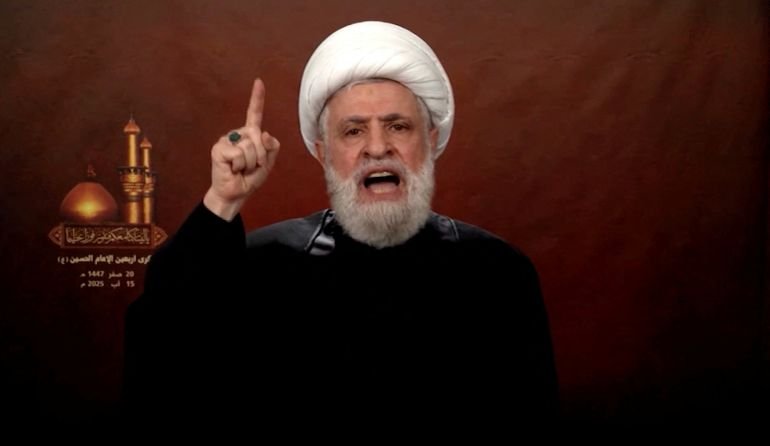
“We will not abandon the weapons that honour us nor the weapons that protect us from our enemy,” Hezbollah Secretary-General Naim Qassem said in a speech on August 25.
“If this government continues in its current form, it cannot be trusted to safeguard Lebanon’s sovereignty,” he added.
Trauma left behind by war
Israel killed more than 4,000 people in Lebanon and displaced more than a million in a war in which it attacked Lebanon more than five times for every attack Hezbollah or an ally launched at Israel.
Despite the ceasefire stipulating that it withdraw from southern Lebanon, Israel has continued to occupy at least five points there and persists in destroying villages in the area.
During the fighting, Israel invaded southern Lebanon, sending people fleeing for their lives, thousands of whom still cannot go home after Israel turned the area into an uninhabitable buffer zone using intensive bombing and white phosphorus.
“People in south Lebanon are still traumatised by the recent war,” Lebanese political analyst Karim Emile Bitar said, indicating that this trauma will impede any acceptance of the US economic zone proposal.
“Many Arabs, Muslims and people in the Global South do not view the US as an honest broker,” he continued.
Analysts told media that Barrack was likely trying to incentivise the people of Lebanon, particularly those who support or are part of Hezbollah, to further pressure the government to carry on with the group’s disarmament.
“We have 40,000 people that are being paid by Iran to fight,” Barrack said. “What are you going to do with them? Take their weapon and say: ‘By the way, good luck planting olive trees’?”
Some media reports indicated the idea of an economic zone in southern Lebanon was first proposed in meetings between Israeli Strategic Affairs Minister Ron Dermer and Barrack in Paris, the idea being that Lebanese state-owned factories would be built in the area adjacent to the border with Israel.
Other details are sparse. Each analyst media spoke with said the lack of details makes it hard to imagine what such an economic zone would entail.
Joseph Daher, the author of Hezbollah: Political Economy of the Party of God, pointed out that Jordan and Egypt have something called qualifying industrial zones (QIZs), which house manufacturing operations and were built after the 1993 Oslo Agreement with Israel.
To qualify for a QIZ, goods produced must have a portion of Israeli input. But both Jordan and Egypt also have normalised relations with Israel, something that many Lebanese would still vehemently reject.
Such economic zones face heavy criticism from experts too.
“They operate as isolated enclaves, disconnected from local communities, sometimes resulting in the displacement of communities and can, through their sheer presence as they require large amounts of land, lead to serious environmental consequences,” Yasser Elsheshtawy, an adjunct professor of architecture at Columbia University in New York and author of Temporary Cities: Resisting Transience in Arabia, told media.
“In many instances, they play a role in the abuse of workers’ rights as the right for forming unions is typically prohibited,” he added.
No buy-in
Even if such an economic project were enabled, many analysts are sceptical that it would receive support or trust from local workers or residents.
“I don’t see any desire or buy-in,” Michael Young, a Lebanese analyst and writer, told media. “If it ever takes off, there will be buy-in, but all this is very premature.”
Residents of southern Lebanon do not see the US as an honest actor or one that works in Lebanon’s interests, analysts said.
“The idea is rejected because there is no trust in America,” said Qassem Kassir, a Lebanese political analyst believed to be close to Hezbollah.
After a brutal war with Israel, a close US ally and largest recipient of US military aid, many Lebanese will also struggle to believe the US is acting in their best interests.
“[The economic zone] could offer oxygen and help a struggling economy,” Bitar said. “[However] it still needs to overcome a series of obstacles, and the major obstacle today is psychological. There is a lack of trust.”
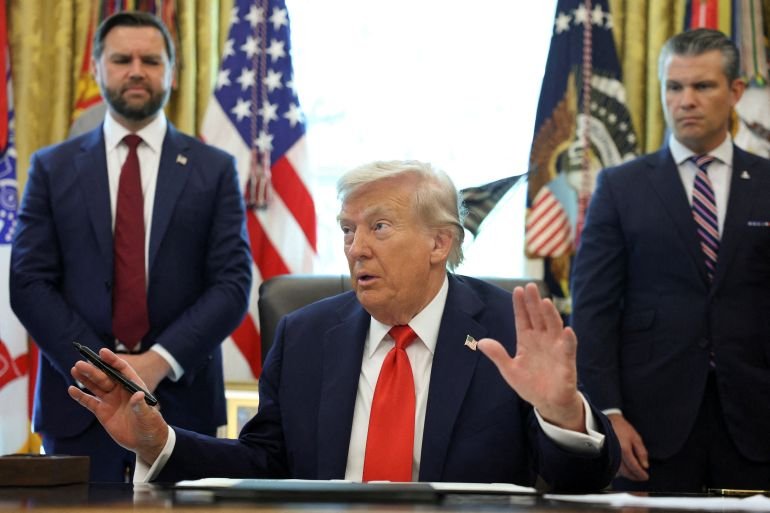
The US has stood idly by for the most part as Israel has attacked its neighbours on multiple fronts in the past 23 months, including in Gaza, the occupied West Bank, Lebanon and Syria.
“The US has not been, especially in the past year and a half, pressuring Israel to stop its violation of human rights either in the genocide in Palestine, the occupation of Lebanon or in Syria,” Daher said.
“Quite the opposite – it has been supporting them.”
Lebanese supporters of Hezbollah, many of whom live in the area where the economic zone is being proposed, have shared their severe distrust of US intentions publicly on social media and other platforms.
Some have expressed disappointment with the Lebanese government and accused it of acting on behalf of US and Israeli interests.
Still, analysts said, regardless of a lack of trust in US plans for the region, there are few other political alternatives than to accept what the US and Israel are proposing.
“As a result of the aftermath of October 7 [2023 Hamas-led attack on Israel] and its destructive regional consequences, wide sectors of the population are having this total US-Israeli hegemony imposed upon them,” Daher said.
“The process of normalisation will take time to be imposed but is moving forward de facto, … so it is more about dealing with the situation as it is and the lack of political alternatives.”
