
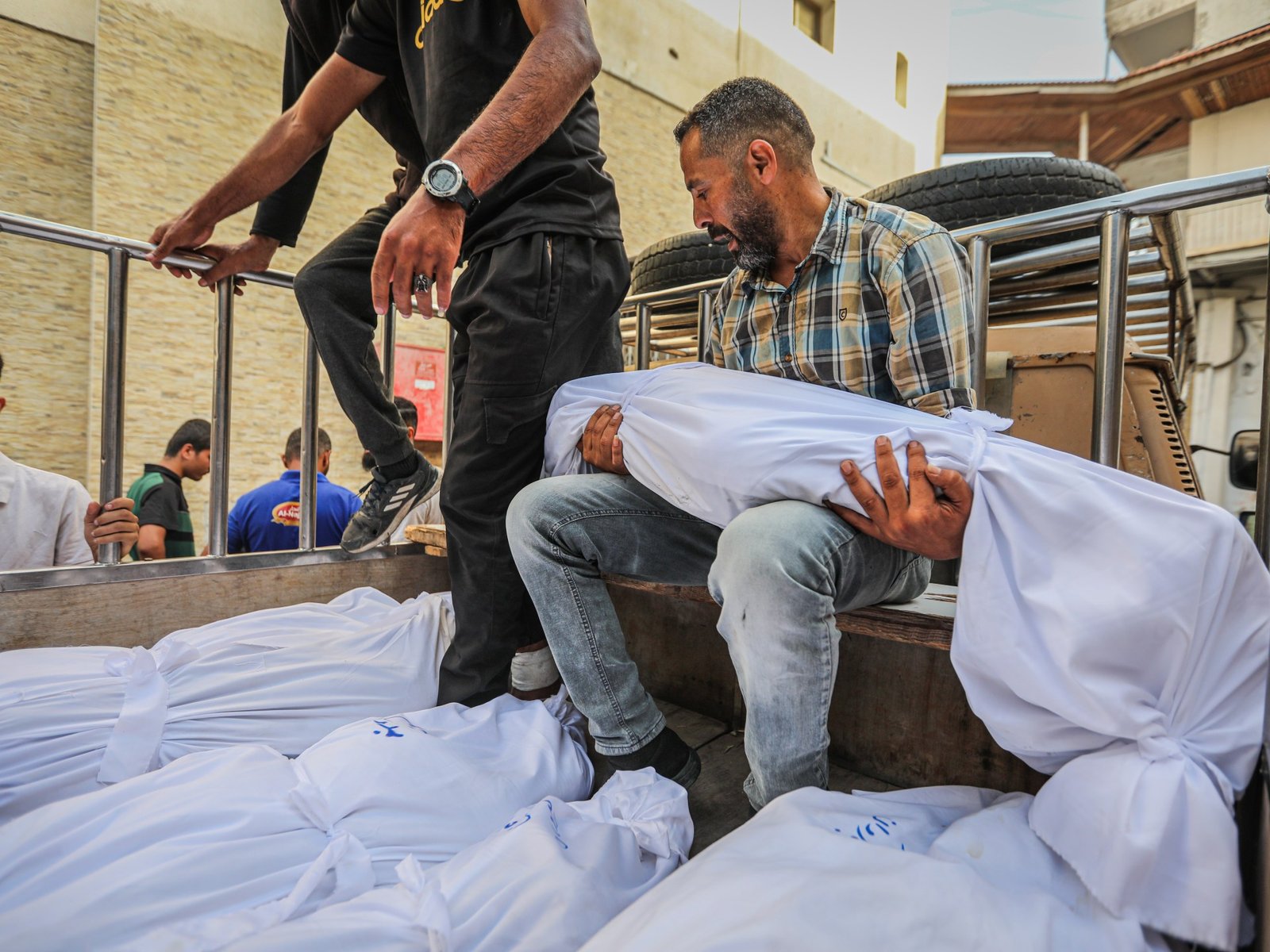
Israel got creative with new methods of mass torture and murder, giving us a choice of how we die.
When Israel started its attack on October 7, 2023, nearly all of us in Gaza had the sense that this was going to be brutal.
Yet, no one thought it would continue for two long years. No one thought that the world would allow this to happen for so long.
I was 16 years old when Israel launched the 2014 attack on Gaza. The aggression lasted 51 days, and it felt like a lifetime then. Now, the 2014 assault feels like a blink of an eye.
I don’t remember at what point I felt like there was no escape from this genocidal onslaught, that I could not even imagine its end. Was it when the Israelis massacred hundreds at the al-Ahli Hospital, or when they invaded al-Shifa Hospital, or when I was displaced to Rafah the first time, or when they invaded and destroyed Rafah, sending us fleeing for our lives, or when northern Gaza was wiped out, or when Israel breached the ceasefire agreement and resumed the genocide, or when famine took hold in Gaza?
Last year, we marked the first anniversary of the genocide on the road. That day, the Israeli army issued another forced displacement order for eastern Khan Younis, and we had to flee to al-Mawasi along with thousands of other people.
This year, we haven’t gone far. We are still displaced, living in a tent in al-Mawasi and starving.
We are still in the same circle of death and destruction, only the brutality has escalated. The list of martyrs has grown longer, the spectrum of misery has broadened, and the Israeli methods of torture have diversified.
The Israelis now don’t just want to kill us. They have gotten creative about it. They have designed various death traps, giving us a choice in how to die.
When Israel halted all aid entry to Gaza on March 2, launching another wave of starvation, while already massacring civilians around the clock, I thought that was the ultimate level of evil. I was wrong. Starvation was just the beginning.
In late May, the so-called Gaza Humanitarian Foundation opened its food distribution points, where Palestinians got to participate in real-life “hunger games”. They would be made to compete for a few boxes of food before getting shot by Israeli soldiers and foreign mercenaries.
When children started dying of malnutrition, Israel started allowing commercial trucks in so markets would get full of food that no one could afford.
When the Israeli government pressed for the conquest of Gaza City, the army deployed explosive robots to help wreak total destruction. These military vehicles packed with tonnes of explosives would pulverise not only whole blocks, but also the families living in them.
T S Eliot once wrote, “Humankind cannot bear very much reality.” And yet, we, the humans of Gaza, have had to bear an unbearable reality every day for two years now.
It has been a horror after a horror. Israel has committed more massacres than I can mention. Yet, I can’t forget when Israel killed my friend Mohammad Hamo, a young Palestinian writer, alongside 200 members of his family and relatives. Or when Israel killed 112 starving people, as they waited for flour, in what is now known as the Flour Massacre. Or when, on March 18, the Israeli army resumed the genocide, killing 400 people, 100 of them children, in a couple of hours. Or when Israeli soldiers executed 15 Palestinian paramedics in Rafah.
Gaza has become a place where there is no distinction between a civilian and a combatant, between places and people protected under humanitarian law and military targets allowed under the laws of war. Here, the doctor and the patient are murdered; the journalist and the witness; the teacher and the pupil; the mother and the unborn child.
The concept of life has lost its meaning in Gaza. We are not living, we are surviving; we are in a constant battle to escape death.
My family and I have been displaced nine times. Each time, we have struggled to set up our tent, to build a toilet, to create shade to fight the sun, then to cover up to fight the wind, then to isolate to protect from the cold and rain.
In July, I sneaked out to my neighbourhood in east Khan Younis after a partial withdrawal of the Israeli army. All the way, I was walking over rubble that littered every inch of the razed streets. As I arrived on my street, I couldn’t tell where my house was, at first. The Israeli army had scrambled my entire neighbourhood. The scene was apocalyptic. Everything looked grey; there was no colour, no life, no standing building.
When I returned to our tent, I showed my mother the pictures I took. “Who do they think we are? China? Russia?” she shouted as she sobbed. “We didn’t even pick up a fork to defend ourselves”.
The next day, I went to Deir el-Balah, in central Gaza, the least damaged area in the enclave. I went there because I genuinely feared for my sanity. I felt I was losing my mind. I needed to see some buildings, paved roads, and trees; the scenes of my neighbourhood were haunting me. I wanted to prove to myself that I can recognise colours other than grey.
Gaza is small and densely populated, but it has always been incredibly diverse in its landscape, each part of it having its own distinctive history, culture and rhythm.
Gaza City was the most vibrant part, where many of the famous markets, universities, and high-rise buildings were. It was also where the old city was, with its historical sites, mosques and churches. Beit Hanoon and Beit Lahiya, in the far north, were more laid back, quieter. There, the urban landscape mixed with the rural; a lot of our food was grown there. Khan Younis and Rafah in the south were also distinct; their eastern parts morphed into farmland.
The refugee camps in the north, centre and south – from Jabalia through Bureij, to Khan Younis camp, were the most densely built, but also most resilient and diverse. They were a miniature of historic Palestine, as most of their population were descendants of the 1948 Nakba’s refugees, from Jaffa to Bir as-Sab’.
The Israeli army razed all of that, creating the same landscape of destruction all around Gaza. Rafah is a reflection of Beit Hanoon; Khan Younis, a copy of Gaza City. It is like holding a mirror against another mirror, generating endless reflections of the same picture.
These are the same images that people around the world see every day, feel sickened by, and find too much to stomach. Many would look away or scroll down. Indeed, humans cannot bear very much reality.
And yet, we, the humans of Gaza, cannot look away or scroll down. We have been stuck in this reality for what feels like an eternity. And whenever we thought we had seen the worst, worse would happen.
I wish I could just check out and escape this genocidal reality to somewhere I could live and not just exist, somewhere I could chase dreams and not be haunted by nightmares, somewhere I could get food or water without fearing death. Somewhere I can hope again, where I can be free. That is all I wish for.
The views expressed in this article are the author’s own and do not necessarily reflect media’s editorial stance.
