
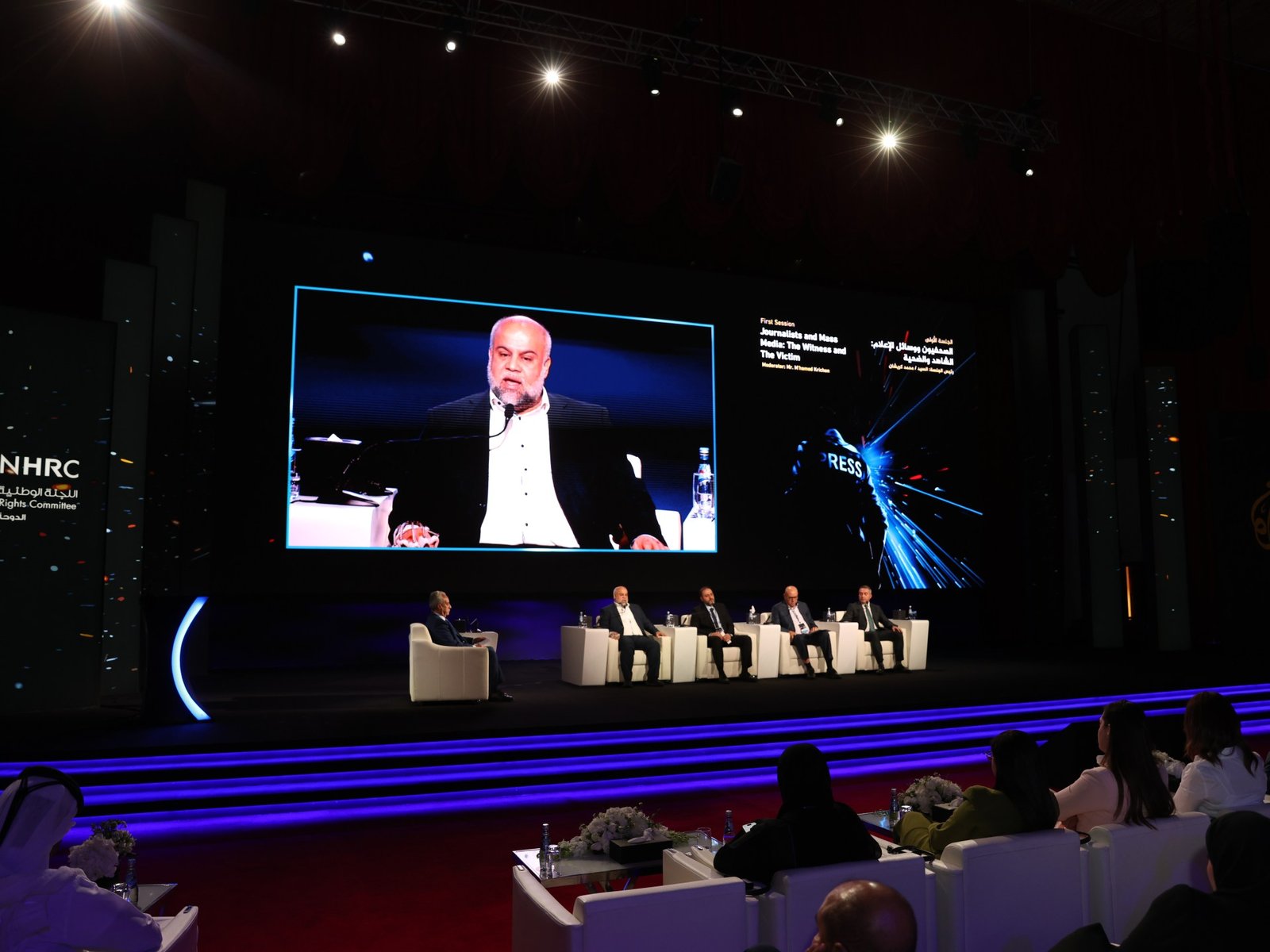
Journalists have been experiencing a ‘total genocide’ in Gaza, media’s conference on wartime safety for journalists is told.
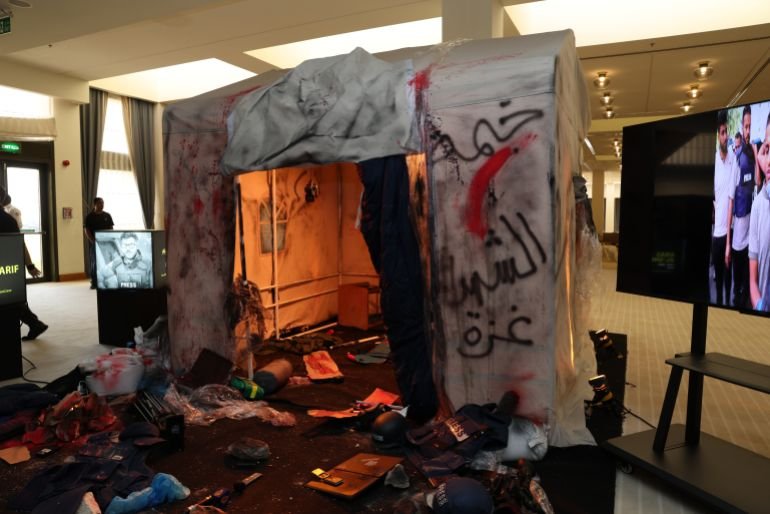
A small tent held up by flimsy tarpaulin stands alone, surrounded by bloodied and tattered blue helmets and vests with the word “PRESS” marked across them. Smashed cellphones, laptops and camcorders, and debris lie scattered around it in what could be a scene from a warzone.
But this is not a warzone. It is an installation setting the scene for a two-day conference organised by media, which began on Wednesday to highlight the terrible dangers faced by journalists working in armed conflicts.
The installation has been positioned in front of the angular conference hall of the Sheraton Grand hotel, a brutalist building that stands in Doha’s upscale West Bay neighbourhood.
Inside, an LCD screen is playing footage of media’s journalists wearing those blue vests and jackets, reporting in Gaza. It then cuts to Israeli Prime Minister Benjamin Netanyahu patting an Israeli military soldier on the back before footage of protesters carrying Palestine flags and posters calling Netanyahu a war criminal.
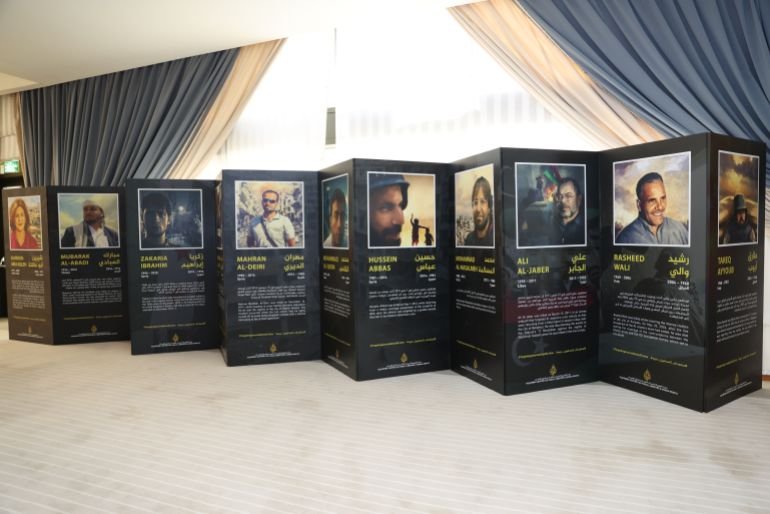
To the side of the hall, a panel listing the names and pictures of media’s journalists who have been injured or killed while reporting on Israel’s war in Gaza, over which Hamas and Israel have now agreed to the first stage of a peace process, appears. The panel is horrifyingly long, spanning the entire length of the hall.
Most recently, media journalist Anas al-Sharif was deliberately killed by an Israeli attack on a tent housing journalists in Gaza City on August 10. That assault also killed an media correspondent, two media camera operators, a freelance cameraman and a freelance journalist.
Opposite, on the other side of the hall, another panel displays the names and pictures of media’s journalists who have been killed while reporting on conflict all over the world, including Rasheed Wali, who was killed in Iraq in 2004 while covering clashes in the city of Karbala; and Mohammad al-Masalmeh, killed in Deraa, Syria in 2013 while covering the civil war.
It is a painful reminder that the war on Gaza, in which nearly 300 journalists and media workers have been killed, according to the Shireen Abu Akleh Observatory – including 10 from media – is no isolated case of journalists losing their lives while reporting in conflict zones.
Gaza has marked a turning point for journalists, however, Louise Alluin Bichet, director of projects and emergency response at Reporters Without Borders (RSF), told the conference on Wednesday.
While reporters once relied on the sorts of bulletproof vests seen strewn at the entrance to the conference to shield them from accidental injury, as they performed their jobs amidst and on the sidelines of conflict, she said, they are now being deliberately targeted.
“It does not matter what kind of body armour you’re wearing.”
As Maryam bint Abdullah Al-Attiyah, chairperson of the National Human Rights Commission (NHRC), highlighted, international law has been flouted in the Gaza war and “journalists have been targeted and killed.”
Journalists under fire
media Arabic anchor M’hamed Krichen opened the conference on Wednesday with a video of smoke billowing in Gaza as journalists come under attack.
“The journalists became news themselves,” Krichen said as an image of media’s Gaza bureau chief, Wael Dahdouh, writhing in pain after an attack played out on the screen. Dahdouh has lost many family members in Gaza, including his wife and several of his children.
The video then cut to footage of Samer Abudaqa, an media cameraman killed in an Israeli attack in December 2023 in southern Gaza’s Khan Younis. Krichen told the audience that Abu Daqqa had bled for six hours while Israeli forces prevented an ambulance from reaching him.
“media has said goodbye to many of its sons,” Krichen said.
As journalists come increasingly under fire, the newly appointed director general of media Media Network, Sheikh Nasser bin Faisal Al Thani, told the conference their safety must be the overriding priority for all news organisations.
“Otherwise, war crimes will remain unwritten,” he said. “Protecting journalists is protection of the truth itself.”
A witness and a victim
Wael Dahdouh was one of media’s most prominent correspondents during the earlier stages of the war. He has been seriously injured and has lost close relatives during the course of the war, and was evacuated to Qatar in December 2023 to receive treatment for an injury.
He describes what has been taking place in Gaza as a “total genocide”.
On October 25, 2023, an Israeli air strike targeted a house in the central Gaza Strip where Dahdouh’s family had taken shelter while he was reporting on the war. Several close family members, including his wife, son, daughter and grandson, were killed.
“Journalists are being killed and genocide is being committed against them,” Dahdouh told the conference, gesticulating heavily with his left hand, as his right hand is still recovering from a serious injury.
Dahdouh told the audience that reporting on a war which has had such devastating personal consequences has been a major challenge for all journalists in Gaza.
“When your family is dead, cut into pieces before you … there is a volcano inside of you. You want to fight, but you remain professional and you continue your work,” he said.
After he buried his wife and children, he told his son and daughter, who had been injured: “I am going back to Gaza (City) to continue my work. What do you want to do?”
“We will come with you. Either we die together or live together,” they said.
Then tragedy struck again. Dahdouh’s eldest son, Hamza Dahdouh, 27, also a journalist, was killed by an Israeli missile strike in western Khan Younis in January 2024.
Journalists in Lebanon, where Israel launched major attacks during the second half of 2024 – to target members of Hezbollah, it said – and killed at least 1,000 people, have also faced this dilemma.
Nakhle Odaime, news correspondent and presenter at MTV Lebanon, also chose to continue reporting despite coming under fire.
“I recorded a video because I thought it might be the last video I’ll record. The voice of the truth should reach the audiences,” he told the conference.
‘If we don’t move now, tomorrow will be worse’
While journalists are treated the same as civilians under international law – they are never legitimate targets in a war – there is one main difference between the two.
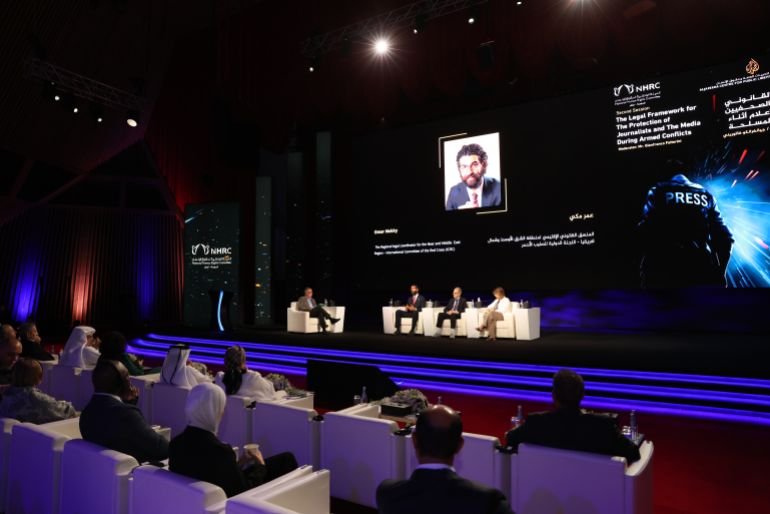
“The civilian can go away from the combat field, but the journalist has to stay,” said Omar Mekky, the regional legal coordinator for the Near and Middle East region for the International Committee of the Red Cross (ICRC). “To assimilate the war journalist with the civilian is not right.”
The protection of journalists in war zones must be specifically enshrined in international law, therefore, he and others – including Fadi El Abdallah, head of public affairs at the International Criminal Court (ICC) – told the conference.
It is also necessary to expand the definition of “journalist” in the era of social media, Mekky said. “Anyone who has access to these resources is a journalist,” he added, referring to those using phones and social media to broadcast news of the war.
Female journalists, who endure different forms of violence while reporting in conflict zones, must also be afforded special protections, said Renaud Gaudin de Villaine, a human rights officer at the United Nations High Commissioner for Human Rights (OHCHR)
Ultimately, however, none of this will be possible without the political will of states, said Bichet from RSF. “The backup needs to come from all the states that have the power to put pressure.”
Time is of the essence, said Doja Daoud, regional programme coordinator at the Committee to Protect Journalists (CPJ).
“If we don’t move now, tomorrow will be even worse.”
