
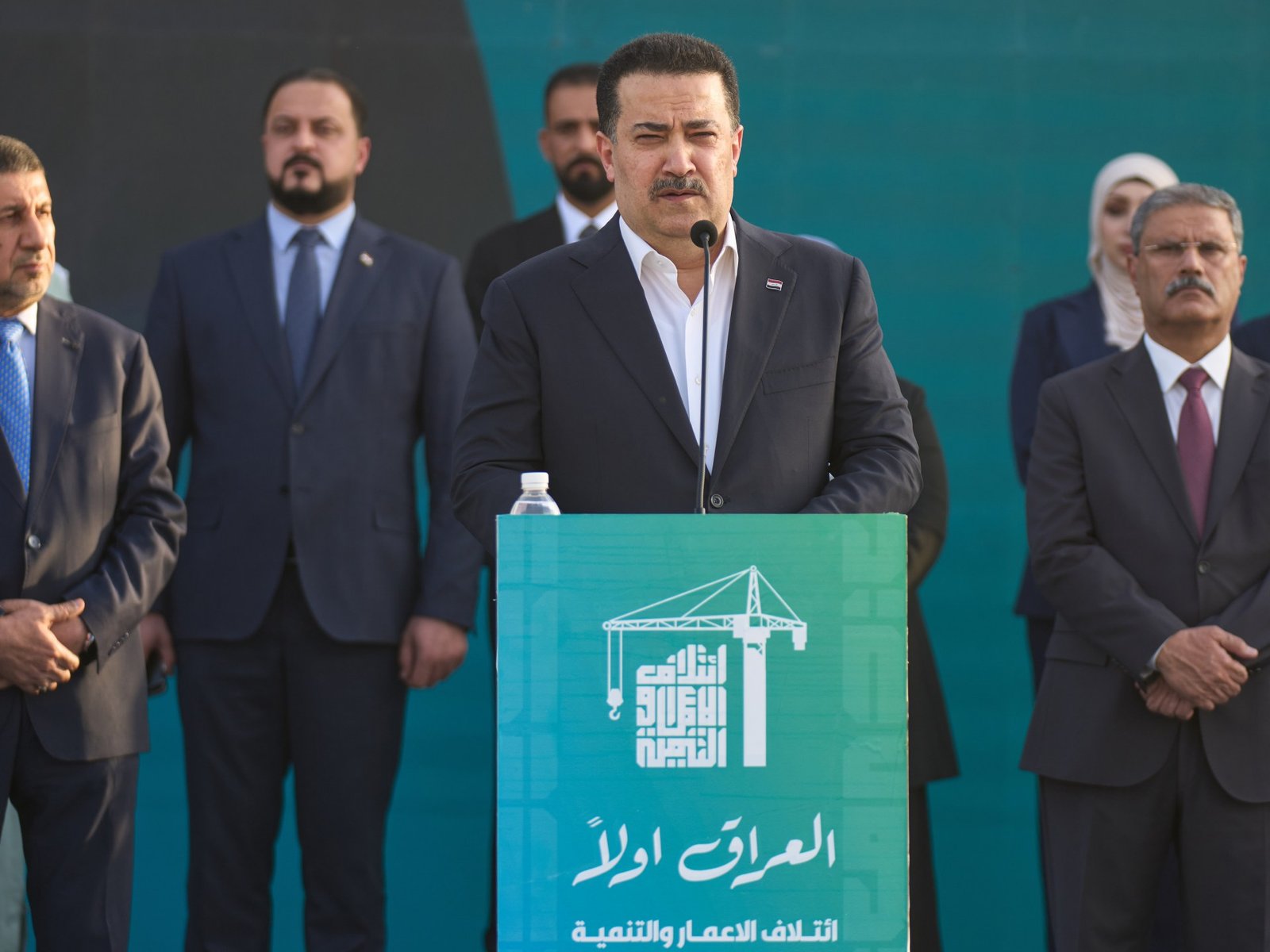
Al-Sudani will navigate the challenges of his fragile electoral bloc and post-election negotiations with Shia rivals.
Iraqi Prime Minister Mohammed Shia al-Sudani is bidding for a second term, a goal that requires his electoral bloc, the Construction and Development Coalition, to win a commanding number of seats in the November 11 parliamentary elections and back his selection for the role.
Al-Sudani’s campaign is built on his government’s successes in improving services, maintaining balanced relations between Tehran and Washington, and steering Iraq clear of regional conflict since October 7, 2023.
However, while analysts predict al-Sudani’s coalition may win the highest number of seats, it may well disintegrate after the election results are announced.
A broad, not unified, coalition
Al-Sudani’s coalition, announced in May 2025, includes seven political forces.
The most prominent are Popular Mobilisation Forces (PMF) Chairman Faleh al-Fayyad; Minister of Labour Ahmed al-Asadi; and Karbala Governor Nassif al-Khattabi.
It also includes influential tribal leaders (sheikhs) and some 53 incumbent MPs, most of whom won as independents in 2021 or defected from parties within the Shia Coordination Framework (SCF), the main Shia parliamentary bloc that nominated al-Sudani four years ago.
The coalition also contains the Al-Furratain Current, the party al-Sudani founded after resigning from the Dawa Party following the 2019 Tishreen protests. However, his is the smallest faction in this broad alliance.
Local observers in central and southern Iraq note that al-Sudani’s success in getting other candidates to run with him masks the weakness of Al-Furratain and may actually be the driver of his coalition’s post-election collapse.
The coalition’s tickets are dominated by the tribal sheikhs and other candidates, while Al-Furratain’s cadres, those closest and most loyal to al-Sudani, are the least likely to win seats.
These partners are happy to leverage the prime minister’s current power to further their own popularity, but past elections indicate that their loyalty will be transactional and is not expected to outlast his full prime ministerial authority.
Take al-Fayyad, who al-Sudani protected when Asa’ib Ahl al-Haq (AAH), an SCF party led by Qais al-Khazali, pushed a law that would have forced him into retirement to make way for AAH to rise to more power in the PMF.
When al-Sudani becomes a caretaker prime minister after the election and SCF rivals resume their push to remove al-Fayyad, he will seek new alliances to protect himself.
The tribal sheikhs and MPs use being on al-Sudani’s list to leverage state resources to deliver services in their electoral districts and fast-track government approvals for their constituents.
MP Dhiaa Hindi, a Sudani candidate in Karbala, boasts on Facebook of processing 16,000 official transactions during his three nd a half years in parliament.
These same MPs may well jump ship when rival blocs, intent on blocking al-Sudani’s second term, offer them financial incentives and influence in the next government.
Former Prime Minister Mustafa al-Kadhimi tried building a loyal bloc to secure a second term by supporting independent candidates in the 2021 elections, hoping that loyal MPs would strengthen his negotiating position.
“Twenty-three of those we supported won,” recalled a senior official who served in al-Kadhimi’s office, speaking on condition of anonymity.
“But … when we needed their votes as a bloc to support Kadhimi’s nomination during the government formation talks, they all abandoned [him]. They demanded huge sums of money, luxury cars, and government staff for their personal service. We couldn’t provide these things, even if we wanted to; we were a caretaker government with no legal authority.”
As a soon-to-be caretaker PM, al-Sudani likely has al-Kadhimi’s experience top of mind.
‘Construction’
The coalition’s “Construction and Development” rhetoric, symbolised by its construction crane logo, centres on al-Sudani’s performance in delivering services.
However, most projects are concentrated in Baghdad, while provincial allocations have decreased significantly.
This is a high-risk political calculation on al-Sudani’s part, a strategy Iraqi political analysts interpret as trying to build a visible legacy in the capital, which holds 69 of parliament’s 329 seats and where he is running as a candidate.
According to parliamentary finance committee documents, funds allocated to local governments shrank by 60 percent, from 8.783 trillion dinars ($6.7bn) in previous years to 2.767 trillion ($2.1bn) in 2024 – the federal government holding most of that money to spend in Baghdad.
“What should have been spent on infrastructure, schools, and hospitals in the provinces was spent on roads and bridges in Baghdad,” said MP Adnan al-Zurfi, parliamentary finance committee member for the past 8 years.
Najaf Governor Yousef Kannawi noted that only 60 billion of the 500 billion dinars allocated to his province had arrived.
A Ministry of Finance document from the first half of 2025 shows projects in Baghdad received 822 billion dinars ($629m), while the rest of the central and southern provinces, the main electoral base for Shia parties, received only 600 billion dinars ($459m) combined.
The notable exception is Karbala, whose Governor al-Khattabi is in al-Sudani’s coalition and received 318 billion dinars ($243m), separate from other governorates.
These sidelined southern provinces that are paying for al-Sudani’s electoral strategy are traditional strongholds for the SCF.
What comes next for al-Sudani?
In a televised interview on Saturday, AAH’s al-Khazali said a second term for al-Sudani would be “the decision of the Coordination Framework [SCF]”, emphasising that the post is subject to the “Shia consensus”.
He was referring to the Muhasasa system, in place since the first elected government in 2006, that grants Shia parties the right to name the prime minister, while Kurds name the president and Sunni the speaker of parliament.
Nouri al-Maliki, former prime minister and leader of the State of Law coalition, echoed this in a separate interview, saying becoming prime minister “is not related to the number of seats won”.
These statements are a response to al-Sudani’s attempts to build an independent power base, which SCF leaders like al-Maliki and al-Khazali see as their appointee trying to challenge their long-term control of Shia politics.
This view was aired by al-Khazali as far back as 2022, when he publicly stated that the prime minister is merely a “director-general”- an administrative, apolitical role. The PM, he insisted, “should not monopolise state decisions … He must return to the Framework for all decisions, whether political, security, or economic.”
They are publicly reminding him, and his new allies, that he is dispensable and that the path to a second term runs through, not around, them.
This puts al-Sudani in a bind, with his second term depending on navigating two challenges: First, holding his fragile electoral bloc together and, second, undertaking post-election negotiations with Shia rivals who are already signalling he is dispensable.
