
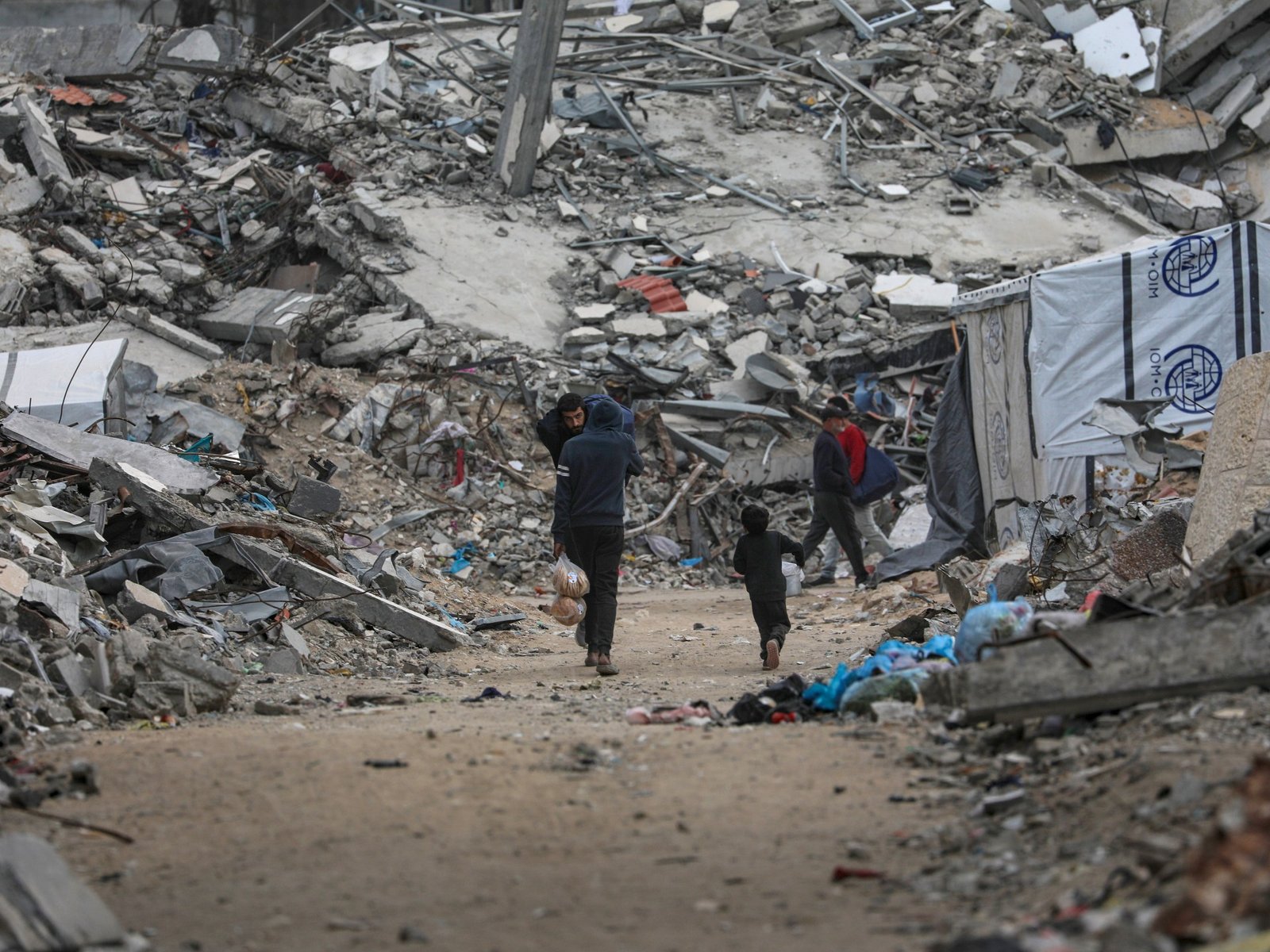
The tragedy in Gaza lays bare the contradictions of a world order built to manage power, not deliver justice or enforce its legal commitments.
The catastrophic violence in Gaza has unfolded within an international system that was never designed to restrain the geopolitical ambitions of powerful states. Understanding why the United Nations has proved so limited in responding to what many regard as a genocidal assault requires returning to the foundations of the post–World War II order and examining how its structure has long enabled impunity rather than accountability.
After World War II, the architecture for a new international order based on respect for the UN Charter and international law was agreed upon as the normative foundation of a peaceful future. Above all, it was intended to prevent a third world war. These commitments emerged from the carnage of global conflict, the debasement of human dignity through the Nazi Holocaust, and public anxieties about nuclear weaponry.
Yet, the political imperative to accommodate the victorious states compromised these arrangements from the outset. Tensions over priorities for world order were papered over by granting the Security Council exclusive decisional authority and further limiting UN autonomy. Five states were made permanent members, each with veto power: the United States, the Soviet Union, France, the United Kingdom, and China.
In practice, this left global security largely in the hands of these states, preserving their dominance. It meant removing the strategic interests of geopolitical actors from any obligatory respect for legal constraints, with a corresponding weakening of UN capability. The Soviet Union had some justification for defending itself against a West-dominated voting majority, yet it too used the veto pragmatically and displayed a dismissive approach to international law and human rights, as did the three liberal democracies.
In 1945, these governments were understood as simply retaining the traditional freedoms of manoeuvre exercised by the so-called Great Powers. The UK and France, leading NATO members in a Euro-American alliance, interpreted the future through the lens of an emerging rivalry with the Soviet Union. China, meanwhile, was preoccupied with a civil war that continued until 1949.
Three aspects of this post-war arrangement shape our present understanding.
First, the historical aspect: Learning from the failures of the League of Nations, where the absence of influential states undermined the organisation’s relevance to questions of war and peace. In 1945, it was deemed better to acknowledge power differentials within the UN than to construct a global body based on democratic equality among sovereign states or population size.
Second, the ideological aspect: Political leaders of the more affluent and powerful states placed far greater trust in hard-power militarism than in soft-power legalism. Even nuclear weaponry was absorbed into the logic of deterrence rather than compliance with Article VI of the Non-Proliferation Treaty, which required good-faith pursuit of disarmament. International law was set aside whenever it conflicted with geopolitical interests.
Third, the economistic aspect: The profitability of arms races and wars reinforced a pre–World War II pattern of lawless global politics, sustained by an alliance of geopolitical realism, corporate media, and private-sector militarism.
Why the UN could not protect Gaza
Against this background, it is unsurprising that the UN performed in a disappointing manner during the two-plus years of genocidal assault on Gaza.
In many respects, the UN did what it was designed to do in the turmoil after October 7, and only fundamental reforms driven by the Global South and transnational civil society can alter this structural limitation. What makes these events so disturbing is the extremes of Israeli disregard for international law, the Charter, and even basic morality.
At the same time, the UN did act more constructively than is often acknowledged in exposing Israel’s flagrant violations of international law and human rights. Yet, it fell short of what was legally possible, particularly when the General Assembly failed to explore its potential self-empowerment through the Uniting for Peace resolution or the Responsibility to Protect norm.
Among the UN’s strongest contributions were the near-unanimous judicial outcomes at the International Court of Justice (ICJ) on genocide and occupation. On genocide, the ICJ granted South Africa’s request for provisional measures concerning genocidal violence and the obstruction of humanitarian aid in Gaza. A final decision is expected after further arguments in 2026.
On occupation, responding to a General Assembly request for clarification, the Court issued a historic advisory opinion on July 19, 2024, finding Israel in severe violation of its duties under international humanitarian law in administering Gaza, the West Bank, and East Jerusalem. It ordered Israel’s withdrawal within a year. The General Assembly affirmed the opinion by a large majority.
Israel responded by repudiating or ignoring the Court’s authority, backed by the US government’s extraordinary claim that recourse to the ICJ lacked legal merit.
The UN also provided far more reliable coverage of the Gaza genocide than was available in corporate media, which tended to amplify Israeli rationalisations and suppress Palestinian perspectives. For those seeking a credible analysis of genocide allegations, the Human Rights Council offered the most convincing counter to pro-Israeli distortions. A Moon Will Arise from this Darkness: Reports on Genocide in Palestine, containing the publicly submitted reports of the special rapporteur, Francesca Albanese, documents and strongly supports the genocide findings.
A further unheralded contribution came from UNRWA, the UN agency for Palestinian refugees, whose services were essential to a civilian population facing acute insecurity, devastation, starvation, disease, and cruel combat tactics. Some 281 staff members were killed while providing shelter, education, healthcare, and psychological support to beleaguered Palestinians during the course of Israel’s actions over the past two years.
UNRWA, instead of receiving deserved praise, was irresponsibly condemned by Israel and accused, without credible evidence, of allowing staff participation in the October 7 attack. Liberal democracies compounded this by cutting funding, while Israel barred international staff from entering Gaza. Nevertheless, UNRWA has sought to continue its relief work to the best of its ability and with great courage.
In light of these institutional shortcomings and partial successes, the implications for global governance become even more stark, setting the stage for a broader assessment of legitimacy and accountability.
The moral and political costs of UN paralysis
The foregoing needs to be read in light of the continuing Palestinian ordeal, which persists despite numerous Israeli violations, resulting in more than 350 Palestinian deaths since the ceasefire was agreed upon on October 10, 2025.
International law seems to have no direct impact on the behaviour of the main governmental actors, but it does influence perceptions of legitimacy. In this sense, the ICJ outcomes and the reports of the special rapporteur that take the international law dimensions seriously have the indirect effect of legitimising various forms of civil society activism in support of true and just peace, which presupposes the realisation of Palestinian basic rights – above all, the inalienable right of self-determination.
The exclusion of Palestinian participation in the US-imposed Trump Plan for shaping Gaza’s political future is a sign that liberal democracies stubbornly adhere to their unsupportable positions of complicity with Israel.
Finally, the unanimous adoption of Security Council Resolution 2803 in unacceptably endorsing the Trump Plan aligns the UN fully with the US and Israel, a demoralising evasion and repudiation of its own truth-telling procedures. It also establishes a most unfortunate precedent for the enforcement of international law and the accountability of perpetrators of international crimes.
In doing so, it deepens the crisis of confidence in global governance and underscores the urgent need for meaningful UN reform if genuine peace and justice are ever to be realised.
The views expressed in this article are the author’s own and do not necessarily reflect media’s editorial stance.
