
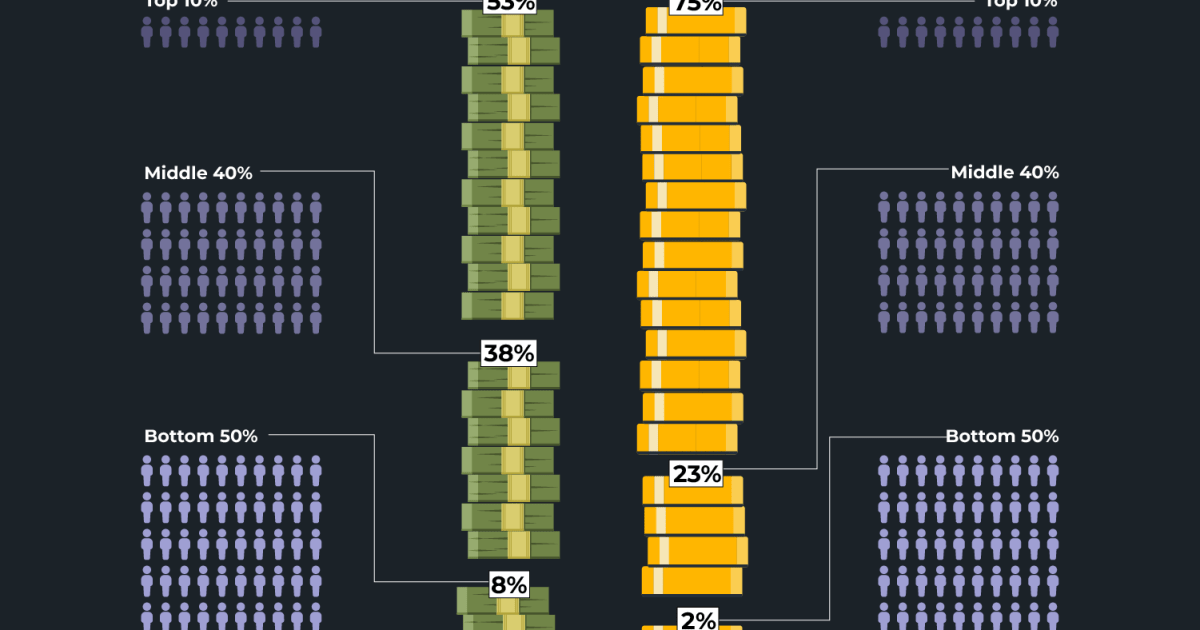
The richest 10 percent of the world’s population owns three-quarters of all personal wealth.
The richest 10 percent of the world’s population now owns three-quarters of all personal wealth, according to the newly released World Inequality Report 2026.
Income is not much different, where the top 50 percent of earners take home more than 90 percent, while the poorest half of the world receives less than 10 percent of total income.
The report, which has been published annually since 2018, notes that the 2026 edition arrives at a critical time. Worldwide, living standards are stagnating for many, while wealth and power are increasingly concentrated at the top.
The differences between wealth and income inequality
Wealth and income levels do not always go hand in hand. The wealthiest are not necessarily the highest earners, highlighting the persistent divide between what people earn and what they own.
Wealth includes the total value of a person’s assets-such as savings, investments or property, after subtracting their debts.
In 2025, the wealthiest 10 percent of the world’s population owned 75 percent of global wealth, the middle 40 percent held 23 percent, and the bottom half controlled only 2 percent.
Since the 1990s, the wealth of billionaires and centi-millionaires has grown by about 8 percent each year, almost twice the rate of the bottom half of the world’s population.
The wealthiest 0.001 percent – fewer than 60,000 multimillionaires – now control three times more wealth than half of humanity. Their share has climbed from almost 4 percent in 1995 to more than 6 percent today.
The poorest have made small gains, but these are overshadowed by the rapid accumulation at the very top, resulting in a world where a tiny minority holds extraordinary financial power, while billions still struggle for basic economic security.
Income is measured using pre-tax earnings, after accounting for pension and unemployment insurance contributions.
In 2025, the richest 10 percent of the world received 53 percent of global income, the middle 40 percent received 38 percent, and the bottom 50 percent earned just 8 percent.
For example, if the world comprised 10 people and total global income was $100, then the richest person would receive $53, the next four people would collectively earn $38, and the remaining five people would divide $8 among them.
How is wealth and income divided regionally?
Inequality looks very different around the world. A person’s birthplace remains one of the strongest factors in determining how much they earn and the wealth they can build. However, the regions also include poor and wealthy countries, and figures in the report are averages.
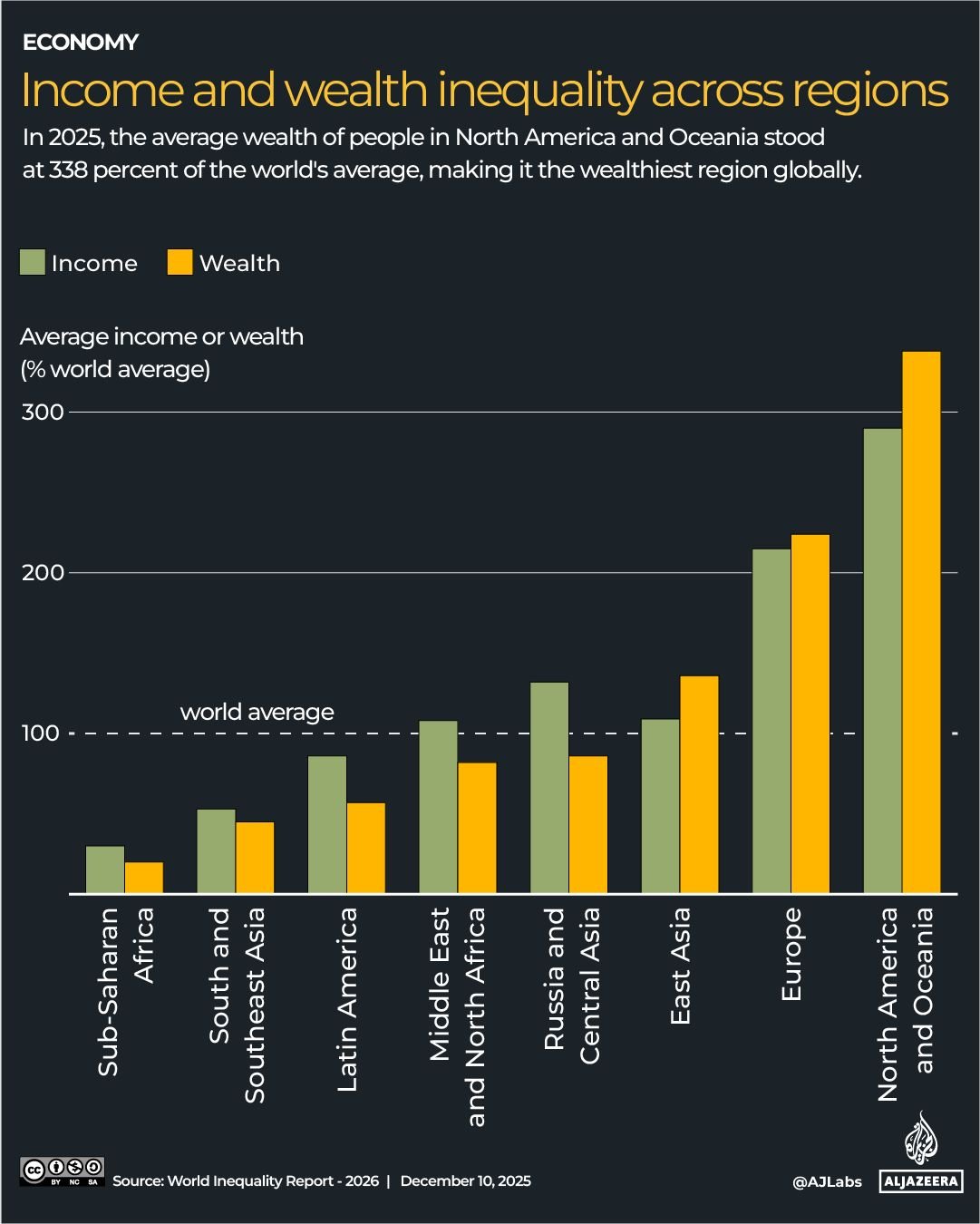
In 2025, the average wealth of people in North America and Oceania, which the report has grouped together, stood at 338 percent of the world’s average, making it the wealthiest region globally. Income share stood at 290 percent of the world’s average, also the highest in the world.
Europe and East Asia followed, remaining above the world average, while vast parts of sub-Saharan Africa, South Asia, Latin America and the Middle East remained far below the global average.
Global inequality paints a stark picture, but the scale of wealth and income gaps can vary widely from one country to another. While some nations show slightly more balanced distributions, others reveal extreme concentration of wealth in the hands of a few.
Which countries have the highest income inequality?
South Africa has the highest levels of income inequality in the world. The top 10 percent earn 66 percent of total income, while the bottom half receives only 6 percent.
Latin American countries such as Brazil, Mexico, Chile and Colombia show a similar trend, where the richest 10 percent receive nearly 60 percent of earnings.
European countries offer a more balanced picture. In Sweden and Norway, the bottom 50 percent earn about 25 percent of total income, while the top 10 percent receive less than 30 percent.
Many developed economies, including Australia, Canada, Germany, Japan and the United Kingdom, fall in the middle. The top 10 percent earn roughly 33-47 percent of total income, while the bottom half takes 16-21 percent.
In Asia, income distribution is mixed. Countries like Bangladesh and China have a more balanced structure, whereas India, Thailand, and Turkiye remain top-heavy, with the richest 10 percent earning more than half of all income.
The table below shows where income is divided most unequally.
Which countries have the highest wealth inequality?
When it comes to wealth inequality, once again, South Africa tops the list. The top 10 percent control 85 percent of personal wealth, leaving the bottom 50 percent with negative shares – meaning their debt exceeds assets.
Russia, Mexico, Brazil and Colombia show a similar pattern, with the richest grabbing 70 percent or more, while the poorest receive barely 2–3 percent.
European countries such as Italy, Denmark, Norway and the Netherlands are relatively more balanced. Here, the middle 40 percent capture about 45 percent, and the bottom half takes a slightly larger share, though the top 10 percent still dominate. However, Sweden and Poland’s bottom 50 percent have negative shares in wealth.
Even wealthy nations like the United States, UK, Australia, and Japan are far from equal. The top 10 percent earn more than half of the total income, while the bottom half is left with just 1–5 percent.
Emerging economies in Asia – including China, India and Thailand – also show stark inequalities. The richest 10 percent control roughly 65 – 68 percent of wealth, highlighting a persistent concentration at the top.
