
The uprisings did not collapse into irrelevance. They transformed how millions understood dignity, citizenship and political possibility.
For more than a decade, the Arab Spring has been widely dismissed as a failure, often portrayed as a brief eruption of idealism that collapsed into repression, war and authoritarian restoration. Tunisia’s uprising, which started on December 17, 2010, with the self-immolation of street vendor Mohamed Bouazizi in Sidi Bouzid, is often remembered in this register: as a tragic prelude to dashed hopes rather than a transformative political moment.
This reading is incomplete and, in important ways, misleading.
Bouazizi’s act was not merely a reaction to police brutality, corruption or economic exclusion, although all three were real. It was a moral rupture that shattered the quiet normalisation of humiliation and laid bare the ethical foundations of authoritarian rule. What followed in Tunisia, and soon across much of the Arab world, was not simply protest, but an awakening: a collective realisation about dignity, belonging and the limits of obedience.
The Arab Spring should therefore be understood less as a failed transition than as a lasting transformation of political consciousness. Its most consequential effects were not institutional but experiential, reshaping how people understood citizenship, legitimacy and their own capacity to act. Even where regimes survived or reasserted control, that shift did not disappear. It altered the terrain on which power is contested to this day.
For this reason, the uprisings cannot be understood as isolated national revolts. From Tunis to Cairo, Sanaa to Benghazi, different societies moved in parallel, shaped by distinct histories but animated by a shared emotional and political grammar. Protesters were not only demanding material change; they were asserting themselves as political subjects, rejecting the idea that power could indefinitely deny them visibility, voice and equal citizenship.
The uprisings were enactments of this shift. They redefined what legitimacy meant and who could claim it. In occupying public space, people were not merely opposing regimes but rehearsing alternative ways of living together. The Arab Spring was less a programme than a practice, shaped through action rather than design: a lived reimagining of political possibility.
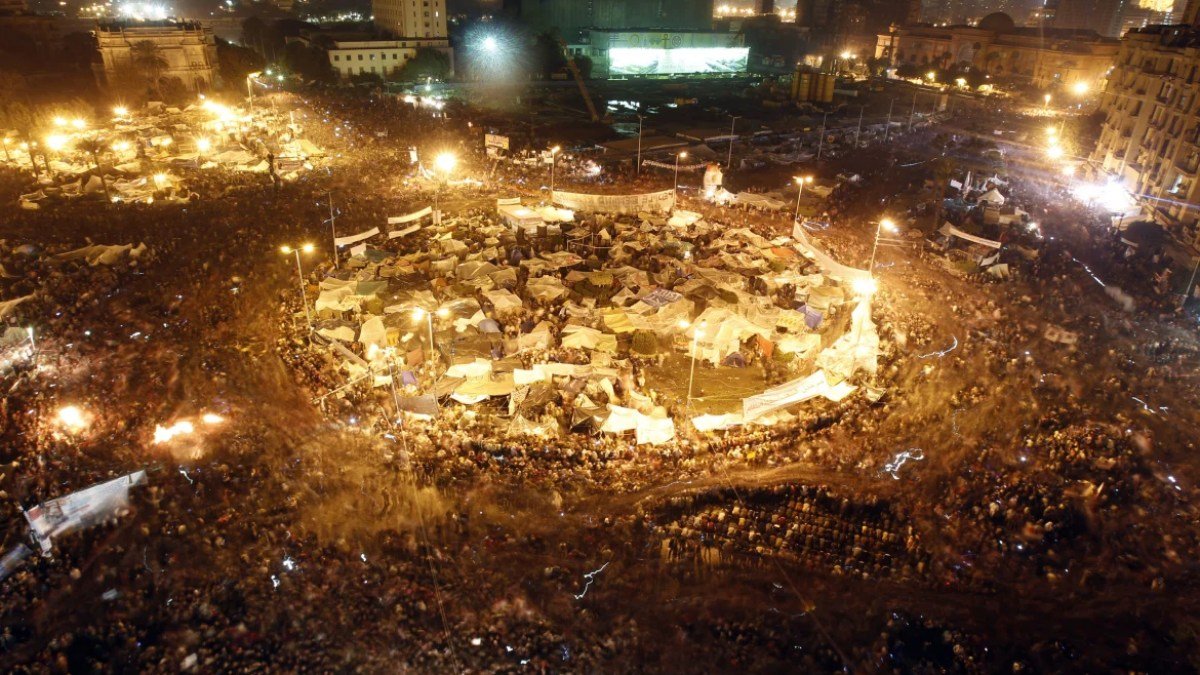
One of its most consequential dimensions was the transformation of streets and squares into sites of collective learning. Places long monopolised by the state’s coercive and symbolic power were reclaimed as arenas of participation and mutual recognition. In Cairo’s Tahrir Square, Tunis’s Bourguiba Avenue and Sanaa’s Change Square, common citizens organised security, cleaned streets, debated demands and negotiated differences. Public space became a school of politics.
These moments mattered for a simple reason: they showed that democracy is not only a constitutional arrangement but a social practice learned through action. Protesters did not simply demand rights; they enacted responsibility. Even when these spaces were later cleared or violently reclaimed, the experience of inhabiting them left a lasting imprint. Once people have lived democracy, however briefly, they carry its memory forward.
The Arab uprisings also revealed why cities matter. Revolts are often ignited in peripheral and marginal spaces, with Sidi Bouzid being the most powerful example, but they are sustained or defeated in urban centres. This is not a claim about virtue but about structure. Cities concentrate institutions, social networks and historical memory. They bring people into direct confrontation with the machinery of power, including ministries, courts and security services, and make authority tangible rather than abstract.
Urban life fosters dense repertoires of sociability: trust, cooperation, debate and solidarity forged in markets, neighbourhoods, mosques and universities. These networks enable collective action to persist beyond the initial moment of rupture. Without them, uprisings risk remaining episodic. With them, they acquire durability, even under repression.
Repression, of course, came swiftly and brutally. The exhilaration of those early months was followed by counter-revolution, militarisation and war. In many Arab cities, regimes responded by reasserting control over bodies, spaces and memory. It would be dishonest to romanticise what followed.
Yet repression did not erase the symbolic struggle unleashed in 2011. Across the region, protesters targeted not only rulers but the imagery and rituals that sustained authoritarian power. Portraits were torn down, slogans scrawled over symbols of dominance, and statues defaced. These acts were not theatrical excesses. They were attempts to dismantle the emotional architecture of fear and submission.
Such moments leave traces even when they are followed by defeat. The experience of collective transgression, of crossing lines once deemed inviolable, alters how authority is seen and felt. People learn that power can be confronted, mocked and undone, even if temporarily. That knowledge does not disappear with repression.
This is why the Arab Spring is not dead, despite sustained efforts to portray it as a historical error or a cautionary tale. What survived was not a set of institutions but a pedagogy of liberty. Learned through action and reflection in public space, this pedagogy reshaped how people understood agency, responsibility and resistance.
Its effects are visible today in quieter, more fragmented struggles. Across the region, younger generations mobilise around social justice, environmental degradation and public accountability. They may not invoke 2011, but they operate with an inherited refusal of fatalism. A graffiti in Hay Ettadhamen, a marginalised suburb of Tunis, captures this enduring scepticism: “Is Tunisia a republic, a monarchy, an animal farm, or a prison?”
The Arab Spring’s most enduring contribution lies here. It demonstrated that even acts originating in marginal spaces can reshape collective imagination and expand the horizon of the possible. Bouazizi’s defiance did not produce instant democracy. But it ignited a critical consciousness that continues to animate struggles against injustice and exclusion.
The uprisings did not fail. They changed form, but not meaning.
The views expressed in this article are the author’s own and do not necessarily reflect media’s editorial stance.
