
Analysts believe Hezbollah will not accept the second phase of disarmament as long as Israel continues attacking Lebanon.
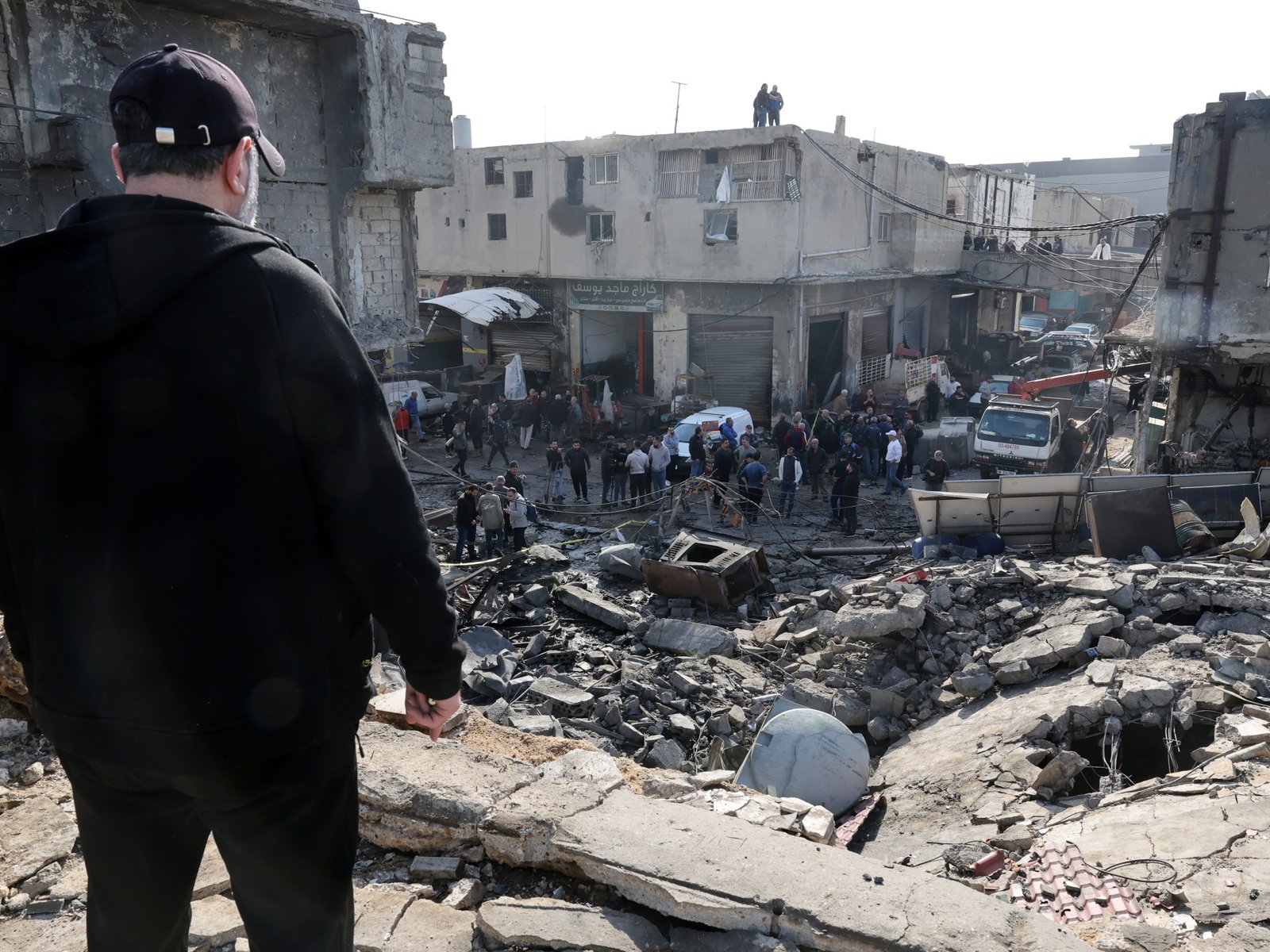
Beirut, Lebanon – The strikes on Lebanon this week were the latest attacks conducted by Israel on its northern neighbour.
Israel has consistently bombed Lebanon and conducted drone strikes despite a United States-brokered ceasefire in November 2024. The United Nations Interim Force in Lebanon (UNIFIL) has documented more than 10,000 ceasefire violations by the Israelis, including 7,500 airspace violations and 2,500 ground violations.
Recommended Stories
list of 3 items
- list 1 of 3Who decides what’s true in the digital age?
- list 2 of 3Israeli FM visits Somaliland after world-first recognition storm
- list 3 of 3Congress’s role questioned as Democrats vow to rein in Trump on Venezuela
end of list
The Israeli military also continues to occupy five points in Lebanon, despite agreeing to withdraw all its troops.
On Monday, Israel issued forced evacuation orders for four villages in Lebanon’s south and the Bekaa Valley, in eastern Lebanon, before bombing the areas. The Israeli military said that the attacks had hit targets associated with the Lebanese group Hezbollah and the Palestinian group Hamas.
Then, on Tuesday, Israel conducted more attacks in southern Lebanon, saying that it was targeting Hezbollah operatives.
Weakened Hezbollah
Israel has killed more than 4,000 people in Lebanon since October 2023, as part of its war with Hezbollah.
Most of the dead were killed between September and November 2024, when more than 1.2 million people were displaced by Israel’s evacuation warnings.
The World Bank estimates that Israel left Lebanon with approximately $11bn in needs for reconstruction and recovery.
The war also deeply diminished Hezbollah’s power in the country. Much of its military leadership was killed during the intensification, including its longtime leader Hassan Nasrallah. In the war’s aftermath, the group is being pressured to give up the weapons that have long defined its identity as a “resistance” group to Israel.
In August 2025, the Lebanese government approved a plan to have the Lebanese Armed Forces (LAF) disarm Hezbollah. The decision was domestically popular outside of Hezbollah’s support base as a way of strengthening the Lebanese state, but also came as a result of increasing pressure from the US and Israel.
For its part, Hezbollah has repeatedly rejected calls for disarmament. The group says that Israel has not abided by its side of the ceasefire.
“To demand exclusive arms control while Israel is committing aggression and the United States is imposing its will on Lebanon…means that you are not working in Lebanon’s interest but rather in the interest of what Israel wants,” Nasrallah’s successor, Naim Qassem, said in a speech on January 3, 2026.
“We call for equipping the Lebanese Army to enable it to be an army for the country that protects against enemies, in addition to the other tasks it is doing in the face of drug and theft gangs, all spies and those who tamper with the country’s security.”
Internal confrontation in Lebanon?
Still, Hezbollah has largely been disarmed south of the Litani River, according to Lebanese Army and government officials. Lebanese military officials have said the only places they were unable to operate in removing Hezbollah weapons and infrastructure were near the Israeli-occupied five points.
The deadline to disarm below the Litani was the end of 2025. Lebanon’s cabinet is set to meet on Thursday to discuss “phase two” of the disarmament plan, which would entail disarming Hezbollah and Palestinian militias from the area between the Litani River, situated about 30km (19 miles) from the Israeli border and running along southern Lebanon, to the Awali River, which runs just north of Sidon. There are about 40km (25 miles) of territory between the Litani and Awali.
Lebanon’s Prime Minister Nawaf Salam wrote on social media that his government was focused on ending Israeli attacks, removing Israeli troops from the five points in south Lebanon and returning Lebanese detainees held by Israel.
“We promise to continue together the path of reform and the extension of state authority,” he wrote.
Salam and others in the Lebanese government admit that the LAF are not strong enough to confront Israel directly. In turn, they have tried to appeal to regional allies and the international community.
“Appealing to the international community to pressure Israel is a necessary but limited strategy,” Imad Salamey, a political scientist at Lebanese American University, told media.
“While diplomatic engagement can help restrain the scale of Israeli operations and preserve space for negotiations, it is unlikely on its own to halt attacks unless paired with clear, verifiable progress on disarmament and credible security guarantees. In practice, international actors tend to place greater pressure on Lebanon to deliver results on the ground than on Israel to exercise restraint, which reduces the effectiveness of this approach unless Lebanon can anchor it to a concrete bargain linking implementation to measurable Israeli de-escalation.”
The Lebanese government is in a difficult position, without many cards to play. Hezbollah has largely not impeded the Lebanese Army’s work south of the Litani. But should Israeli attacks continue, analysts believe the group won’t be as accommodating going forward.
Qassem Kassir, a Lebanese political analyst close to Hezbollah, told media that for the group to begin discussions of disarmament, Israel must first stop attacking Lebanon and release prisoners, and the Lebanese state must begin reconstructing the damage done by Israel during and since the war.
“Only then can the future of weapons be discussed,” he said.
Kassir warned that failure to address those issues before implementing the second phase of the disarmament plan will spark tensions.
“Otherwise, we will face a confrontation.”
Hezbollah battered but not defeated
The Lebanese government, meanwhile, is caught between increasing pressure from the US and Israel, and Hezbollah’s refusal to disarm.
“As long as Israeli strikes continue, Hezbollah and its constituency can plausibly argue that disarmament beyond the south exposes them to greater vulnerability,” Salamey said.
“Israeli strikes function not only as military actions, but also as strategic messaging, aimed at undermining Lebanon’s claim that it has restored state authority and completed disarmament south of the Litani.”
Israel has meanwhile tried to argue that Hezbollah is regrouping in the south, despite counterclaims by the UN peacekeeping force UNIFIL, and has said the Lebanese Army is moving too slowly in its disarmament mission.
“If Israel continues its attacks while the LAF proceeds with phase two disarmament north of the Litani River, the repercussions could be severe,” Salamey said. “Israel may interpret any disruption or delay as justification to broaden its target set, thereby deepening instability and raising the risk of a wider confrontation at a moment when Lebanon is least able to absorb it.”
Should the Lebanese Army proceed with the second phase while Israel continues striking targets in Lebanon, analysts believe Hezbollah could feel threatened and respond aggressively.
And while foreign diplomats and analysts say that Hezbollah was greatly weakened by Israel’s war on Lebanon in 2024, they still believe the group is strong enough to confront any domestic challenges.
“Consequently, phase two risks evolving from a technical security measure into a broader political confrontation over sequencing, guarantees, and internal stability in Lebanon,” Salamey said.
“The LAF may face internal friction and localized resistance, placing strain on civil–military relations and national cohesion,” Salamey added. “Hezbollah, even if avoiding direct confrontation with the army, could respond through political obstruction or calibrated escalation with Israel, increasing the risk of miscalculation.”
