
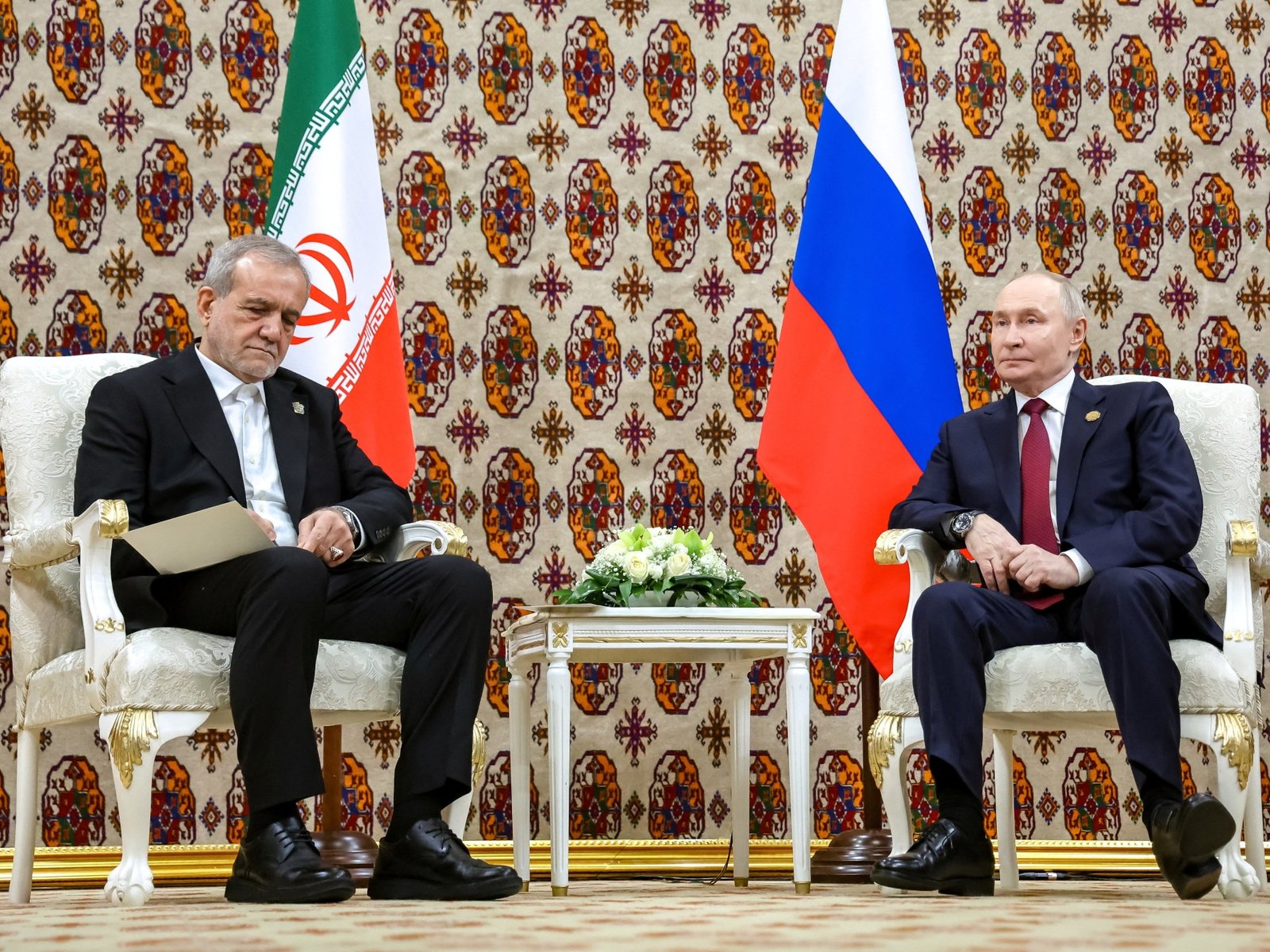
Moscow is focused on winning in Ukraine; all else is a means to that end.
The abduction of Venezuelan President Nicolas Maduro by the United States military and the subsequent threats by Washington to intervene in Iran during its recent upheaval have generated a tide of enthusiasm in hawkish pro-Ukraine circles in the West. If Moscow’s allies are weakened, then Russia also gets weaker, the simplistic logic goes.
Although he criticised US interventionism in the past, US President Donald Trump is newly infected with the regime change fever once spread by his Democratic predecessors.
What it reminds one of most is the export of revolution – a short-lived policy of Soviet Russia spearheaded by the father of the Red Army, Leon Trotsky. It resulted in several pro-Bolshevik governments emerging across Europe – in Hungary, Bavaria and Latvia. None of them lasted long.
One of the Bolsheviks’ lesser-known revolutionary projects was the Persian Soviet Socialist Republic, which existed in 1920-21 in Iran’s Gilan province on the Caspian Sea. The idea was to try to spread the proletarian revolution all the way to India, but eventually the Red Army had to retreat, and its local allies were quickly overthrown.
Fast-forward a century, and Iran again finds itself as a destination for revolutionary export, only now with American and Israeli hawks behind the attempt to foment something along the lines of Ukraine’s Maidan. Iran’s theocratic regime is hardly palatable, and resistance to it is organic, but the constant threat of US and Israeli intervention appears to be its strongest pillar and the source of immunity against domestic unrest. Iranians know better than to risk having their country transformed into another Syria or Libya.
Iran’s entire 20th-century history is that of constant resistance to subjugation by outside powers, including Russia or the USSR. Iran was also the place where Soviet and Western interests often converged – as in the 1953 coup d’etat against Prime Minister Mohammed Mossadegh, in their shared opposition to the Iranian revolution of 1979 and in their support for the Iraqi side in the Iran-Iraq War.
It is only in the later years of Russian President Vladimir Putin’s rule that Tehran and Moscow formed a tentative alliance, which grew much tighter when Iran helped Russia with crucial drone technology at the beginning of the Russian all-out invasion of Ukraine.
There is an important similarity in the historical trajectories of Iran, Russia, as well as China. These are three of the very few long-existing states that Western powers tried but failed to colonise at various stages in history. The authoritarian instincts in all three could be fairly explained by the constant need to mobilise against the Western threat.
But Russia’s role in this triad is the most ambiguous, given that – despite its conflict with the West – it was also one of those European powers which tried to colonise chunks of both Iran and China.
That explains Moscow’s extremely Europe-centric attitude to Iran’s current predicament. Putin’s government is single-mindedly focused on one project – winning the war in Ukraine, which it sees as a proxy conflict with the West. Russian military expeditions in the Middle East and Africa are only important for Putin insofar as they help to stretch the West’s resources, creating additional leverage and trade-offs for the Kremlin. Russia’s situational alliances with regimes in Iran, Venezuela and North Korea fall into the same category.
Regime ideologues in Moscow like to repeat the apocryphal phrase attributed to Tsar Aleksandr III: “Russia has only two allies – the army and the navy”. In this worldview, Russia’s allies and client regimes are little more than expendable chess pieces in the nuclear superpowers’ global game.
All of Putin’s military adventures outside the former Soviet space began after the start of the war in Ukraine in 2014 and as a reaction to Western support of the Ukrainian authorities, which he sees as a puppet government installed through a “coup”, as he describes the Maidan revolution.
Russia intervened in Syria as well as in Libya and went on to expand its zone of influence in Central and Western Africa, mostly at the expense of the French.
Did it help Russia to set up a global neo-empire? No, a few initial successes were often followed by setbacks, most prominently when the regime of Moscow’s Syrian ally, Bashar al-Assad, fell in 2024. But a global empire has never been the point. The point is that Putin is very close to ending the war in Ukraine on his terms, and his efforts in other regions helped to bring about what most Russians will see as an outright victory in a conflict with the West’s mighty war machine.
Russia’s brutally inhumane air strikes on Ukraine’s energy infrastructure are gradually rendering large population centres, like Kyiv, uninhabitable in midwinter. Ukraine’s European allies appear powerless to change that predicament.
But while Putin is entirely focused on a single chessboard, Trump is performing a simultaneous match with a plethora of players, bizarrely including the US’s traditional European NATO allies.
The Trump administration’s obsession with regime change in Iran, Venezuela, and especially in Greenland does not undermine Putin – it is a godsend. The situation, when the US is bogged down in several absurd and dangerous geopolitical projects while attempting to play a quasi-neutral peacemaker in the Russo-Ukrainian conflict, is ideal for Moscow.
But despite outward absurdity, there might be a logic behind what Trump is doing. It is about the natural human tendency to choose an easier path. A painstaking chess match with Putin, which Trump indeed did not start himself, is infinitely harder and fraught with embarrassing defeat. Venezuela and Iran are both easier targets.
But as the latest events show, even in these countries, the goal of proper regime change might appear a bit too arduous for the current US leader to follow through. All Trump cares about is an instant, cost-free PR boost, so he needs the softest of targets to achieve that. Maduro proved to be one, but who could be next?
Iran and Greenland interventions are risky, Cuba not so much. But – as far as regime change efforts go – there is also one leader who annoys Trump to no end, who can be removed without military intervention and who stands in the way of the US president’s goal of being seen as the world’s greatest peacekeeper: Ukrainian President Volodymyr Zelenskyy.
It is no wonder that on Wednesday, Trump abruptly returned to undermining Ukraine by saying its leader, rather than Putin, was the main obstacle to peace.
Mired in a huge corruption scandal, deadlocked politically and militarily, Zelenskyy comes across as the softest of potential targets, the very opposite of his archrival Putin. It is not hard to predict how the US president’s political instincts might play out.
The views expressed in this article are the author’s own and do not necessarily reflect media’s editorial stance.
