
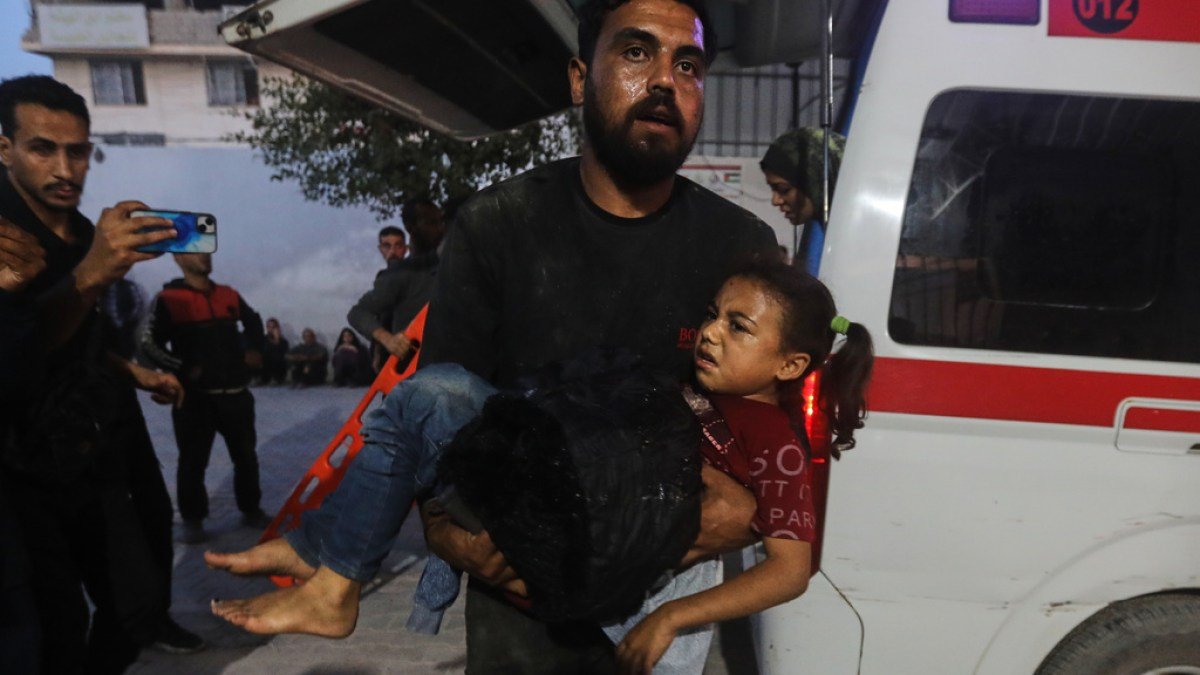
Despite ‘ceasefire’, the health sector in Gaza continues to suffer from shortages, destruction and lack of equipment.
After the partial reopening of the Rafah crossing between Gaza and Egypt this week, the world’s attention turned to the process of allowing a small number of wounded and sick Palestinians out of the besieged territory.
But while these medical evacuations are necessary, advocates say, the core priority must be to rebuild the health system in Gaza, which has been ravaged by Israel’s genocidal war against Palestinians in the Strip.
Recommended Stories
list of 3 items
- list 1 of 3Palestinian women recount ‘journey of horror’ at Gaza’s Rafah crossing
- list 2 of 3UN chief urges Gaza aid as Israel blocks most medical evacuees at Rafah
- list 3 of 3Global conflicts pushing humanitarian law to breaking point, report warns
end of list
“The Israeli occupation has deliberately and methodically destroyed the health system,” Gaza Ministry of Health spokesperson Zaher al-Wahidi told media in a phone interview.
He outlined five key challenges the health system is facing after 28 months of blockade, bombardment and mass killings, which have not stopped after a United States-brokered “ceasefire” came into force in October: near absence of patient evacuations, lack of medical equipment, shortage of medication, destruction of facilities and need for medical workers.
He called on the “people of the free world and anyone who can lend a helping hand” to pressure Israel to fully open the Rafah crossing and allow medication and medical equipment into Gaza, as well as specialised teams to help healthcare workers.
Yara Asi, a Palestinian-American public health expert at the University of Central Florida, said the needs of the devastated health system in Gaza have not changed since the “ceasefire” took effect.
“The problem is just not in the news as much now,” she told media, describing how Gaza’s health and humanitarian sector is a “victim” of the “short attention spans” of donors and international actors.
“The ceasefire took the throttle off,” Asi said.
“A lot of the same needs and conditions still exist. All those tens of thousands of people with injuries still have injuries.”
Lack of medicine
The devastation and lack of access to medical care have killed thousands of Palestinians, experts say.
For example, there were 1,244 kidney patients in Gaza before the start of the war in October 2023. Now that number stands at 622, al-Wahidi said.
While 30 were documented to have been killed in direct Israeli attacks, al-Wahidi estimated that hundreds of others died from lack of access to dialysis services.
And the crisis is ongoing.
Despite the “ceasefire”, al-Wahidi said, thousands of people in Gaza are also at risk of dying due to shortages in medication.
“With medicine, the deficit has grown after the ‘ceasefire’. Although the number of injuries has gone down relatively, the lack of medicine has gotten worse, reaching 52 percent. This is a rate that we did not reach throughout the war,” al-Wahidi told media.
The medicine deficit for chronic illnesses is at 62 percent, he added.
“That means 62 percent of people with chronic conditions are not able to take their medication regularly, which leads to deterioration in health, which leads to death,” al-Wahidi said.
There are 350,000 patients with chronic illnesses in Gaza, according to the Health Ministry.
Al-Wahidi said people with long-term illnesses need regular medical attention, tests and visits with physicians – services that were inaccessible throughout the war due to repeated displacement and Israeli attacks on medical centres.
“I don’t think any hypertension patient has been able to see a doctor regularly since the war started. And if they managed to get medical attention, we don’t have enough medication for everyone,” he said.
According to the Gaza Government Media Office, Israeli attacks have put 22 hospitals in Gaza out of service and damaged 211 ambulances.
So, beyond equipment and doctors, the physical medical buildings in Gaza have also been severely damaged.
Al-Wahidi said there are no functioning hospitals left in northern Gaza. “People have to come to Gaza City, often on foot, walking several kilometres to reach al-Shifa Hospital or al-Ahli Hospital,” he said.
Medical evacuations crucial
Amid this widespread destruction, health advocates say restoring Gaza’s health system should go hand-in-hand with evacuating patients who need urgent care.
Mohammed Tahir, a trauma surgeon who volunteered in Gaza during the war, described the situation of the health sector in the territory as “dire”.
“The hospitals in Gaza have been destroyed. Its doctors, its nurses have been killed, imprisoned, forced to flee,” he told media.
“The facilities are in squalor, really. There is a huge gap in terms of the surgical equipment required – the ICU facilities, the dialysis machines, the diagnostic devices there, the provision of medicines from antibiotics to painkillers to those required for managing chronic conditions.”
Israeli officials and US President Donald Trump have repeatedly expressed plans for removing all Palestinians from Gaza.
Tahir said while concerns about ethnic cleansing in Gaza are valid, medical evacuations are necessary to treat people who need specialised care and lessen the burden on the medical system.
“What we want to do is to take these patients that need evacuation out of Gaza into other healthcare systems and create a method to repatriate them to Gaza,” he said.
Tahir stressed that transferring people with complex injuries and conditions would free up medical resources for routine healthcare services in the territory.
“That allows the people of Gaza to treat the normal, regular conditions,” he said. “People still walk in the streets. They fall over; they break their hip; they break their ankle; that needs treatment, and we need to empower them to manage these day-to-day conditions as well.”
Tarik Jasarevic, a spokesperson for the World Health Organization (WHO), said beyond Rafah, referral pathways must open from Gaza to Jerusalem, the occupied West Bank and across the world.
“What the focus should be now is to rebuild the health system inside Gaza, so we don’t rely so much on evacuations,” Jasarevic told media in a TV interview.
‘De-healthification’ of Gaza
In addition to attacking hospitals across Gaza, Israeli forces regularly ordered the evacuation of medical centres and raided them under the unfounded claim that they were used as command centres by the Palestinian group Hamas.
Public health experts say a functioning medical system is more than a place where people can get treatment; it is a tenet of a viable society – and that is exactly what Israel tried to dismantle.
One of the acts that constitute a genocide, according to the 1948 United Nations Convention on the Prevention and Punishment of the Crime of Genocide, is deliberately inflicting on the targeted group “conditions of life calculated to bring about its physical destruction in whole or in part”.
Asi, the public health expert, pointed to footage of Israeli soldiers filming themselves smashing hospital equipment as further evidence that the systemic targeting of the health sector in Gaza was deliberate.
She said the Israeli campaign against the health system “should be, in and of itself, seen as part of the perpetuation of creating” conditions to destroy the Palestinian people.
Asi added that researchers know from past conflicts that many people are pushed to leave their homes and neighbourhoods when the last clinic or hospital is closed.
“People know that they cannot live without healthcare. So it’s a tool of displacement. It’s a tool of ensuring that reconstruction, rebuilding people going back to certain areas is, if not impossible, much more difficult,” Asi said.
The Health Ministry’s al-Wahidi said the medical system in the territory served as a “safety valve” for the people throughout the war.
“In any area, people were finding safety in the functioning hospitals. The medical workers would remain until the last minute in the hospitals until they are forcibly removed or detained by Israeli forces,” he told media.
“So, attacking the hospitals and raiding them was a recipe for displacing people. The resilience of the hospitals became the resilience of the people. As long as the hospitals remained standing, the people remained in their land.”
Layth Malhis, a Georgetown University graduate student, recently wrote a report for Al-Shabaka think tank on what he termed the “de-healthification” of Palestine – a longstanding Israeli policy intended to “render Palestinian life unhealable and perishable”.
Malhis told media the Israeli assault on healthcare workers – as symbols of knowledge and social mobility – aimed to psychologically and physically harm Palestinians in Gaza.
“What we saw in the genocide is that the Israelis have treated doctors and nurses and their institutions as combatants – because they understand that if you really want to eviscerate the Palestinians and remove them from their land, you have to get rid of the people that are keeping them alive and resistant and resilient,” he said.
Rebuilding
Despite the enormous challenges, al-Wahidi said, the health sector in Gaza is trying to recover.
“Under the current standards and data and circumstances, it all seems unmanageable, but we are still providing services to the best of our ability,” he said.
Al-Wahidi said the Health Ministry is starting to restore medical buildings with local efforts and materials available on the market.
He added that officials are launching vaccination campaigns and opening new clinics while expanding services at the still-functioning hospitals daily.
“For the first time since the start of the war, we resumed open-heart surgeries at al-Quds Hospital. This is an achievement under these difficult conditions,” al-Wahidi said.
“We also activated childbirth services at 19 medical centres throughout the Gaza Strip. Humble efforts, but we are trying to rebuild the healthcare system with the resources available.”
Asi said Palestinian health workers embody the best of the profession, voicing disappointment that people in the global medical community have largely overlooked the plight of their peers in Gaza.
“The health sector is such a microcosm of Palestinian resilience,” she said.
“It is beyond comprehension for most of us that we could ever go through those conditions and have the motivation to rebuild as they have when so many of their comrades have been killed, and the threat to them is still existent. I think it’s astounding. I think it’s incredible.”
