
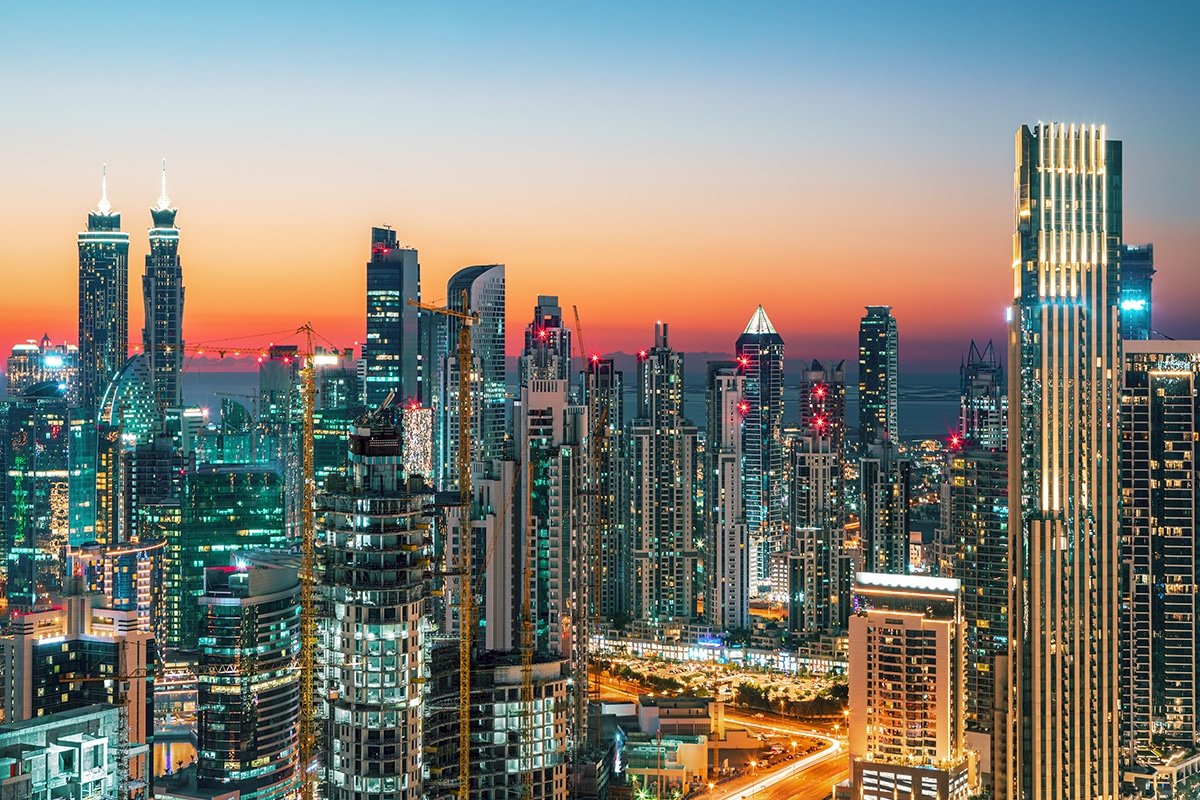
Buoyed by population growth and economic diversification, the UAE market leads the region with double-digit transaction jumps, while analysts predict a shift toward sustainable growth.
Gulf property markets are charging into 2026 with remarkable momentum, powered by resilient economic growth and a wave of international investment, with Dubai once again cementing its status as a world leader in rental yields.
According to a new outlook from Kuwait Financial Centre (Markaz), the non-oil sector across the GCC is accelerating following a robust second half of 2025. Increased government spending on infrastructure, combined with expectations of looser monetary policy, is expected to improve credit flow and sustain demand across residential, commercial, and industrial segments.
The UAE Engine: Record Transactions and Global Appeal
The United Arab Emirates remains the undisputed regional leader, with its two main emirates shattering transaction records. Dubai registered approximately Dh554.1 billion in real estate deals in 2025, marking a 28.3% increase year-on-year. Abu Dhabi witnessed an even more dramatic surge, with sales leaping 75.8% to hit Dh58 billion, while transaction volumes in the capital climbed over 40%.
This influx of capital is driven by a steady stream of high-net-worth individuals, global investors, and skilled professionals attracted to the region’s stability and long-term residency incentives.
Yield Spotlight: Where Investors Are Cashing In
Dubai’s rental market continues to be the star attraction for global portfolios. While average residential yields in London, New York, and Singapore hover between 3% and 5%, Dubai is currently offering average returns between 6% and 8% in 2026.
However, specific high-demand districts are outperforming the market significantly:
- Jumeirah Village Circle (JVC), Business Bay, and Dubai South are generating gross yields of 7% to 9% .
- In contrast, prime established locations like Dubai Marina offer more stable, but still impressive, net returns of approximately 5.5% to 6.5% .
Industry experts note that smaller units, such as studios and one-bedroom apartments in well-connected, master-planned communities, remain the top performers for landlords.
Expert Insight: A Market Maturing, Not Cooling
Global consultancies remain bullish on the UAE’s fundamentals. Faisal Durrani, Partner and Head of Research for Mena at Knight Frank, emphasized the market’s unique position, stating that “Dubai remains one of the most liquid and transparent markets globally.”
This view is echoed by CBRE. Taimur Khan, Head of Research for Mena at the firm, noted that while the market shows signs of moderation after years of rapid expansion, the core drivers remain solid. “Population growth and economic expansion will continue to drive housing demand,” Khan said, adding that new supply is being quickly absorbed by genuine end-users and investors.
The Demand Drivers: People and Policy
Dubai’s population, projected to exceed 4 million soon, is the bedrock of rental demand. A combination of rising purchase prices and strict mortgage requirements keeps a large segment of the population in the rental pool, ensuring high occupancy and steady income for investors.
While rental increases are expected to moderate to a healthier pace of around 6% in 2026—following years of sharp gains—the Markaz report suggests the market is simply maturing. Although the UAE may be approaching a cyclical peak, the solid fundamentals make a sharp correction unlikely, pointing instead to a gradual moderation towards a more sustainable equilibrium.
Regional Momentum: Saudi and Kuwait in the Race
The positive trajectory extends beyond the UAE. In Saudi Arabia, the real estate sector is expanding rapidly, fueled by Vision 2030 megaprojects, a young population, and strong corporate activity. Meanwhile, Kuwait’s market is showing steady gains supported by demographics and infrastructure spending.
As financing conditions improve across the Gulf, analysts at Markaz conclude that the region’s property markets are well-positioned to offer attractive opportunities for investors seeking both stable income and long-term value throughout 2026.
