
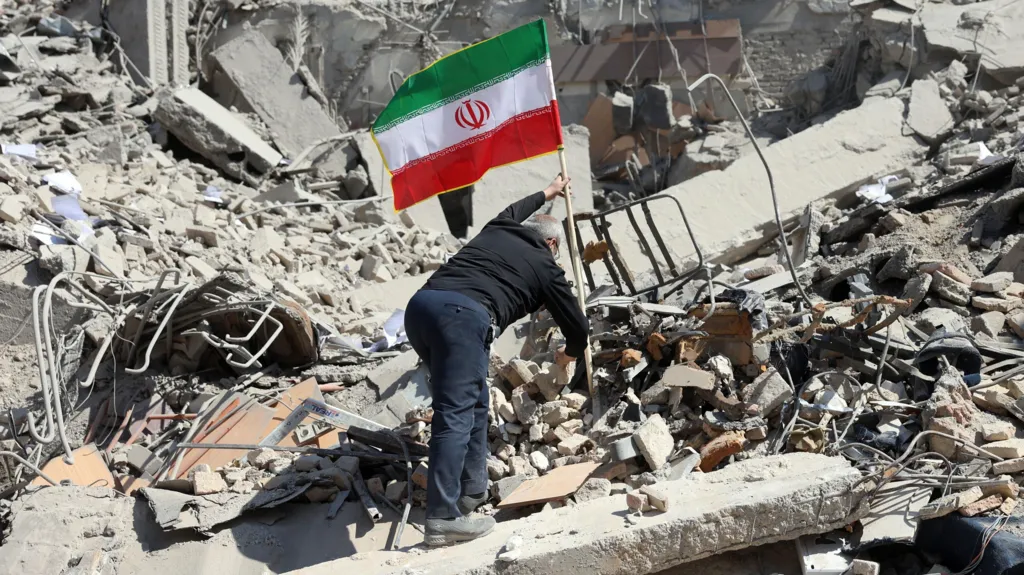
Iran war today.
War Widens Across Gulf as Oil Jumps, Flights Halt and Evacuations Accelerate
Missiles, Market Shock and Mass Evacuations Mark a Dangerous New Phase
Dubai | March 6, 2026
The war involving the United States, Israel and Iran entered a more dangerous phase on Friday, with missile and drone strikes spreading across the Gulf, oil prices surging, commercial aviation disrupted and humanitarian agencies warning of a fast-worsening regional emergency. Here are the 20 biggest developments shaping the conflict today:
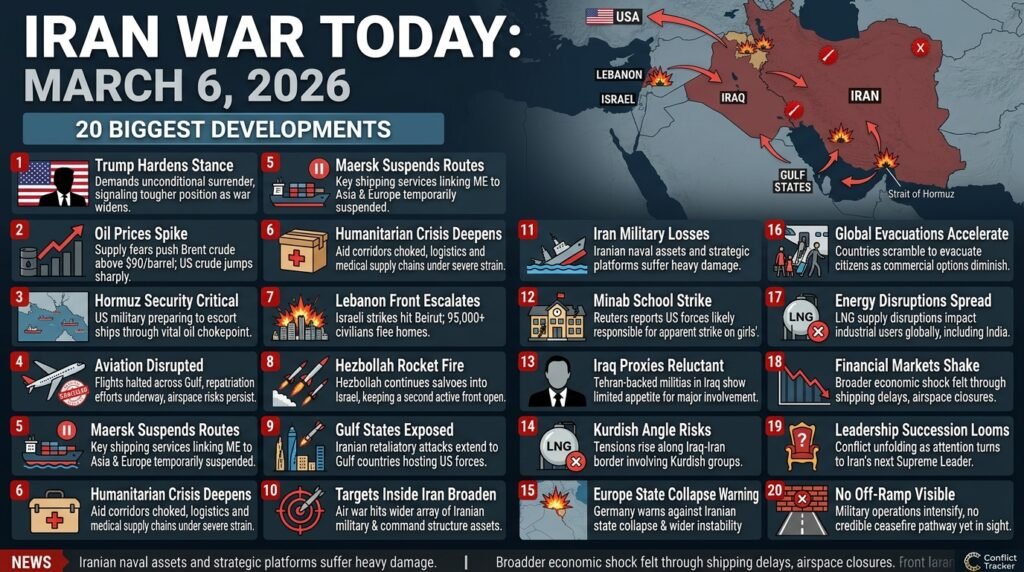
- Trump hardens stance on Iran
US President Donald Trump said there would be no deal with Iran except “unconditional surrender”, signalling a harder US position even as the war widens.
AP News +1 - Oil prices spike on supply fears
Crude prices surged sharply as traders priced in the risk of prolonged disruption to Gulf energy flows. Brent climbed above $90 a barrel, while US crude also jumped strongly, underlining fears over supply security.
AP News +1 - Strait of Hormuz security becomes critical
US officials said the military is preparing to help move ships through the Strait of Hormuz, a sign of how seriously Washington is treating the threat to one of the world’s most vital oil chokepoints.
AP News +1 - Dubai and Gulf aviation remain under pressure
Air travel across the Gulf remains disrupted, with emergency alerts, cancellations and limited resumption of services adding to pressure on airlines, airports and stranded passengers. Governments worldwide are continuing repatriation efforts as regional airspace risks persist.
AP News +1 - Maersk suspends key shipping routes
Maersk has temporarily suspended two major shipping services linking the Middle East with Asia and Europe, highlighting the growing supply-chain fallout from the conflict.
Reuters - Humanitarian emergency intensifies
The war is now choking aid corridors and obstructing relief operations, with humanitarian agencies warning that access, logistics and medical supply chains are under severe strain.
Reuters - Lebanon front escalates sharply
Israeli strikes pounded Beirut and other parts of Lebanon, while displacement continued to mount. AP reported that more than 95,000 Lebanese civilians have fled their homes as the conflict spills more deeply into Lebanon.
AP News +1 - Hezbollah keeps up rocket fire
Hezbollah fired fresh salvos into Israel, keeping a second active front open and raising the risk that the Israel-Lebanon theatre will outlast the immediate Iran campaign. Reuters has reported Israeli assessments that operations against Hezbollah may continue even after the Iran phase eases.
AP News +1 - Gulf states remain exposed to retaliation
Iranian retaliatory attacks have extended beyond Israel into Gulf countries hosting US forces, underscoring how the conflict has spread across multiple states in the region. AP reported that attacks on Gulf partners have become a central part of Iran’s response.
AP News +1 - US and Israeli campaign broadens inside Iran
The current air war is hitting a much wider set of targets inside Iran than previous rounds of fighting, suggesting a strategy aimed not only at military assets but also at weakening the state’s command structure.
AP News +1 - Iran’s military losses are mounting
US officials have said Iranian naval and military assets have suffered heavy losses, including multiple vessels and strategic platforms, while AP says the wider campaign has inflicted serious damage on Iran’s military and leadership structure.
AP News +1 - Questions grow over the Minab school strike
A Reuters report said US investigators believe it is likely that US forces were responsible for the apparent strike on an Iranian girls’ school in Minab, though the investigation is not yet complete. The incident has intensified scrutiny of civilian casualties.
Reuters - Iraq’s proxy network is not fully mobilised
Despite years of Iranian investment in Iraqi armed groups, Reuters reports that many Tehran-backed militias in Iraq have so far shown limited appetite for entering the war in a major way, partly reflecting fragmentation and self-preservation.
Reuters - Kurdish angle adds another layer of risk
The conflict’s northern flank is becoming more volatile, with renewed focus on Iranian Kurdish groups along the Iraq-Iran border and the possibility that these forces could be drawn deeper into the war. Reuters’ crisis maps and reporting suggest this remains a sensitive escalation point.
Reuters +1 - Europe warns against collapse of the Iranian state
German Chancellor Friedrich Merz said preserving Iran’s territorial integrity is essential and warned that a collapse of Iranian statehood or proxy war on Iranian soil would carry serious consequences for Europe, including migration and wider instability.
Reuters - Global evacuations are accelerating
Countries across Europe, North America and Asia are scrambling to get citizens out of the region, with AP reporting a worldwide rush to organise charter flights and overland exits as commercial options remain limited.
AP News - Energy disruptions are spreading beyond oil
The fallout is not limited to crude. Reuters reported that LNG supply disruptions are already affecting industrial users, with India among the countries feeling the strain from interrupted Gulf shipments.
Reuters - Financial markets remain highly sensitive
Beyond oil, the conflict is rattling broader markets through shipping delays, airspace closures, risk-off sentiment and concerns over inflation, especially in import-dependent economies. That broader economic shock is now becoming a central part of the war story.
Reuters +1 - Leadership succession in Iran looms over the war
The conflict is unfolding as attention turns to Iran’s next supreme leader. AP reported that Trump wants a say in the post-Khamenei order, adding a volatile political dimension to an already expanding military conflict. - No clear off-ramp is yet visible
Despite references to mediation efforts and calls for restraint, the latest reporting points to a war that is still broadening rather than narrowing. Military operations remain intense, the humanitarian toll is rising, and the economic shock is deepening, with no credible ceasefire pathway yet in sight.
AP News +2
This seventh day of war is no longer just about airstrikes over Iran. It is now a region-wide crisis touching oil markets, shipping lanes, airlines, refugee flows, proxy networks and the political future of the Islamic Republic itself. What began as a direct US-Israel assault on Iran is rapidly turning into a conflict with consequences stretching from Beirut to Dubai, from Basra to Berlin.
