
The real threat lies not in blocking the waterway, but in quietly turning its approaches into a zone of uncertainty that global shipping cannot ignore.
The world still speaks about the Strait of Hormuz as if the central question were whether Iran will try to close it. That is now the wrong question.
Iran’s most effective military option is not to mine the Strait of Hormuz itself, nor the narrow, internationally scrutinised traffic corridor inside the strait proper, but to mine the approaches to the strait, especially the entrance zones where commercial traffic converges before entering the constrained transit system. That is where disruption can be generated most efficiently, over the widest possible maritime area, while remaining under Iranian surveillance and command-and-control coverage.
This distinction matters. It is the difference between a crude blockade and a technically sophisticated interdiction strategy.
Operationally, the Strait of Hormuz is not simply a broad expanse of water. Commercial shipping moves through a traffic separation scheme, a regulated two-lane transit structure with inbound and outbound channels separated by a buffer zone. Large crude carriers and very large crude carriers are in effect canalised by draft, navigational rules and safety requirements into a highly predictable transit pattern. Their routes, speeds and timings are known in advance. In military terms, this is a forced maritime funnel.
But the key battlespace is not only the funnel itself. It is the wider approach geometry leading into it.
Before tankers enter the strait proper, traffic compresses through the Gulf of Oman approaches towards the entrance corridor. This is where Iran gains its greatest advantage. If mines are seeded in the entrance zones rather than inside the marked shipping lanes, the effect can extend across a broader manoeuvre space while avoiding the political and operational signature of overtly mining the strait itself. Tehran does not need to place mines directly under the keel line of every tanker. It only needs to create sufficient uncertainty in the approach battlespace that mariners, insurers and naval escorts assume contamination.
That logic is reinforced by hydrography. Surface circulation flows from the Gulf of Oman into the Gulf, while denser saline outflow moves at depth in the opposite direction. Floating, semimoored or near-surface devices deployed in the entrance zones can therefore drift naturally towards commercial traffic patterns without being laid directly in the formal transit lanes. A limited number of mines placed in the right location can create a disproportionate effect over a much wider maritime area. This is precisely why the entrance is the optimal interdiction zone: it enlarges the danger area, complicates clearance operations and magnifies uncertainty.
The relevant Iranian concept is not closure. It is selective, controlled disruption.
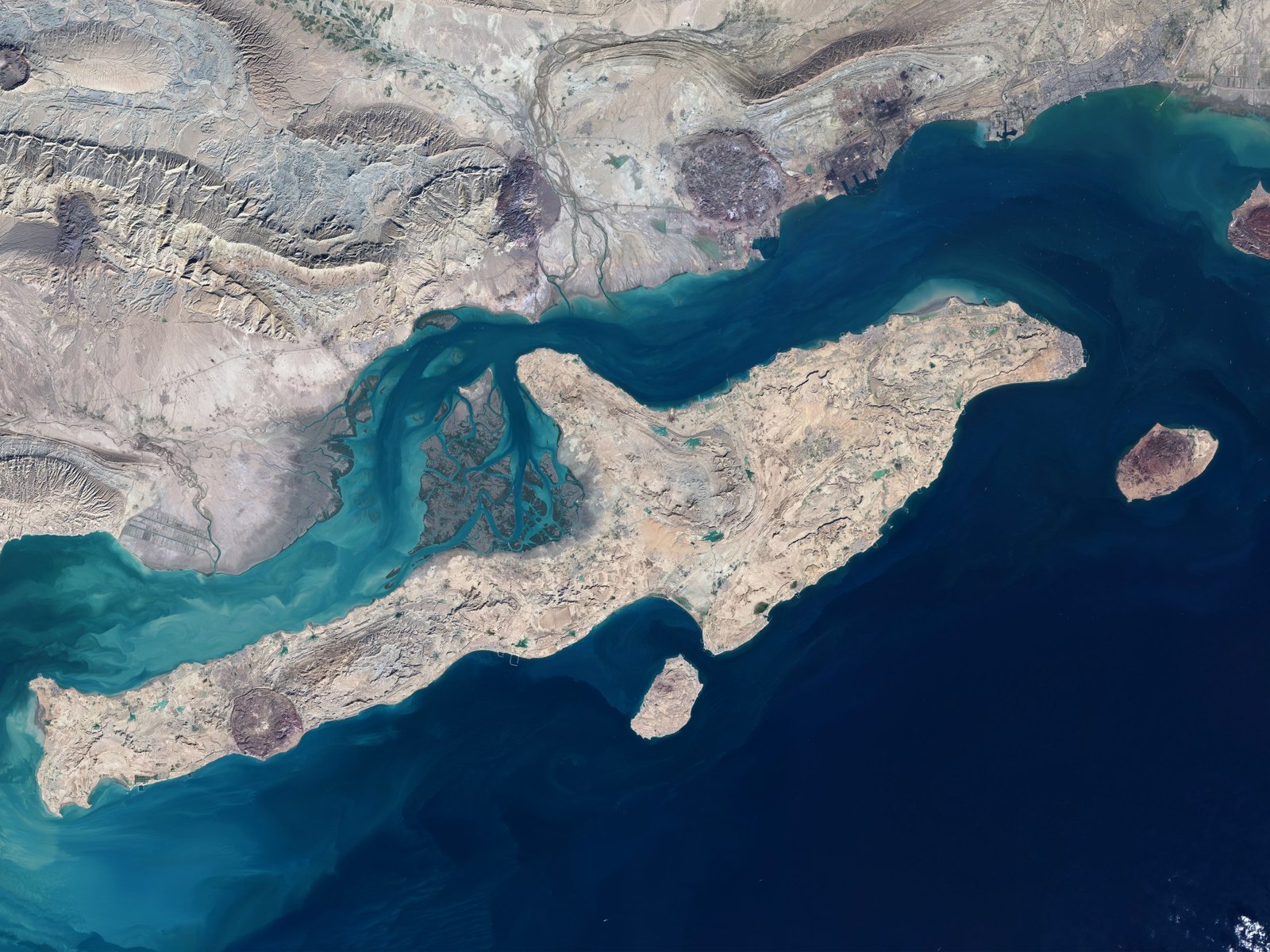
That concept depends on surveillance, and here Iran retains a meaningful advantage. From Bandar Abbas to Qeshm, Larak, Abu Musa, Sirri and the Jask–Kooh Mobarak sector, Iran’s northern littoral provides overlapping observation angles across the tanker lanes and their approaches. Coastal radar, UAV reconnaissance, patrol craft reporting, electronic emissions tracking and civilian maritime observation all contribute to a layered maritime picture. Even where parts of this network have been degraded, the architecture does not collapse easily because it is redundant by design.
That maritime picture is now deepened by space-based ISR. Iran’s Khayyam electro-optical satellite, developed with Russian support, provides high-resolution imagery that can be tasked over the Gulf and the approaches to Hormuz. It is not a constellation, but it does not need to be one to matter. When fused with Russian optical, electronic and maritime surveillance assets and integrated into Iranian coastal command networks, it strengthens Tehran’s ability to identify shipping concentrations, observe escorts, monitor port activity and select the most effective timing and location for asymmetric action.
This is what makes entrance-zone mining viable. Iran can observe the battlespace continuously enough to avoid indiscriminate use of force and instead apply pressure with precision.
Modern mine warfare further strengthens that option. Naval mines are no longer limited to simple drifting contact devices. Iran’s inventory is believed to include influence mines triggered by magnetic, acoustic or pressure signatures, bottom mines placed on the seabed, moored mines set at selected depths and command-detonated or controlled mines that can remain dormant until activated remotely or by preset criteria. Some systems can be delayed, some can self-neutralise, and some deployed close to friendly coastlines can be recovered or repositioned.
This is the crucial point: a controlled minefield in the approaches does not need to be permanently active to be strategically effective.
Mines can be emplaced early, left inert, repositioned if necessary and activated only at a chosen moment. If laid near Iranian-controlled coastlines and within the surveillance envelope of Iranian coastal forces, they can be managed as a reversible instrument of coercion. That gives Tehran escalation control. It also gives it deniability. The absence of an explosion is not proof of the absence of mines. Dormant influence mines or controlled devices can exist in the entrance battlespace without immediate kinetic effect while still forcing commercial actors to behave as though the area is contaminated.
That is how maritime disruption works today, not through dramatic closure, but through calibrated navigational insecurity.
Once shipping companies believe the approaches may contain selective mine threats, the economic effect begins immediately. War risk premiums rise. Transit slows. Clearance operations become necessary. Naval escorts are stretched. Traffic management turns defensive. The shipping corridor may remain technically open, but operationally it becomes degraded. In energy markets, that is enough.
This is why debate over whether the strait itself has been mined misses the point. The more plausible scenario is that limited, controlled deployment in the approaches has already created the conditions Iran seeks. With the geometry of the transit lanes, the hydrography of the entrance, the persistence of Iranian surveillance and the availability of modern controlled mines, the threshold for disruption is now extremely low.
The Strait of Hormuz does not need to be visibly mined to function as if it were.
In strategic terms, it already is.
The views expressed in this article are the authors’ own and do not necessarily reflect media’s editorial stance.
