
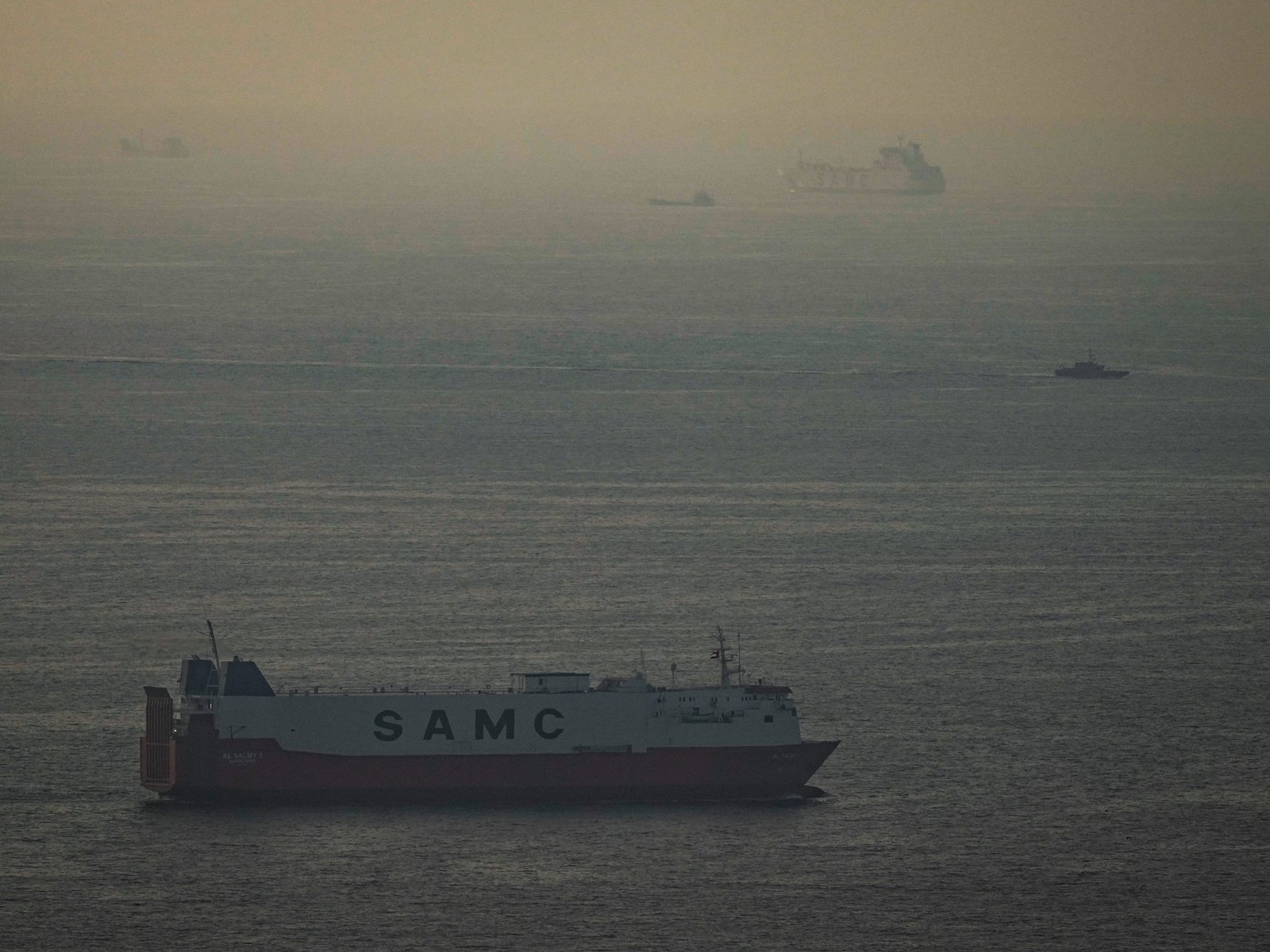
It is the single point of failure of globalised production.
The Strait of Hormuz is the only major commercial artery on earth named after a god. The name derives from Hormoz, the Middle Persian rendering of Ahura Mazda – the Zoroastrian deity of wisdom, light, and cosmic order. This is not poetic licence; it is an etymological fact. The ancient Persians did not simply build a trade route here. They consecrated it.
A place named after the god of order has become the single point where global order faces its greatest vulnerability. Through these waters – 167km (104 miles) long, 39km (24 miles) wide at their narrowest point – pass an estimated 30,000 vessels per year.
They carry not only a fifth of the world’s seaborne oil and liquified natural gas but also the urea needed for the fertilisers that grow its food, the aluminium that constructs its infrastructure, the helium that cools its semiconductors, and the petrochemicals that sustain its pharmaceutical and manufacturing base.
The Strait of Hormuz is not an oil chokepoint. It is the aortic valve of globalised production – and like any valve, when it fails, the entire circulatory system collapses.
Nine hundred years of toll collection
In the eleventh century, an Arab chief named Muhammad Diramku – Dirhem Kub, “Dirham minter” – left Oman and crossed the Gulf to found the Kingdom of Hormuz on the Iranian coast. He was a merchant-prince, not a warrior, and he understood that power in this geography flowed from controlling the gap between civilisations.
By the 15th century, Hormuz had become one of the great emporium-states of the medieval world. Merchants from Egypt, China, Java, Bengal, Zanzibar, and Yemen converged on a single island port. Venetian explorer Marco Polo visited twice. During the Ming Dynasty, Chinese admiral Zheng made it the final destination of his treasure fleet. Every civilisation that understood maritime trade eventually found its way there. Each arrived at the same insight: Control the gate, collect the toll.
The Portuguese showed up in 1507. Admiral Afonso de Albuquerque understood that whoever holds this chokepoint holds everything between India and the Mediterranean. He seized the port with seven ships and 500 men.
In 1622, Persia’s Shah Abbas I (Abbas the Great) captured Hormuz with English naval support. The British eventually dominated. In 1951, the British navy imposed a blockade on the strait to pressure Iranian Prime Minister Mohammad Mosaddegh to reverse his decision to nationalise the Iranian oil industry, which had a large British stake. In doing so, Britain executed the same manoeuvre Albuquerque had pioneered four centuries earlier. The blockade lasted more than two years and contributed directly to the CIA-backed coup against Mosaddegh in 1953.
During the Iran-Iraq war of 1980-1988, the importance of the Strait of Hormuz once again came to the spotlight. Between 1984 and 1987, 546 commercial vessels were attacked and more than 430 seafarers were killed; oil continued to flow – albeit at higher insurance premiums.
That precedent may have encouraged the 2026 belligerents to believe partial closure was sustainable. The difference between the 1980s and today is not military capability but actuarial architecture: The modern insurance system has proven capable of closing the strait more tightly than any navy.
Muhammad Diramku’s emirate was the medieval equivalent of an aortic valve, controlling flow between the heart of Asian production and the body of Mediterranean consumption. Nine hundred years later, the anatomy has globalised, but the physiology remains identical.
The commodity architecture
The standard characterisation of the Strait of Hormuz as an energy corridor is flawed. The transportation of oil and liquefied natural gas accounts for about 60 percent of its regular traffic.
A closure inevitably triggers cascading failures across a number of industries, including agriculture, manufacturing, construction, and semiconductor production.
More than 30 percent of the world’s trade in ammonia, nearly 50 percent of urea, and 20 percent of diammonium phosphate – all key for the fertiliser and agriculture sectors – are transported through the strait. Some 50 percent of global sulphur, a key component of metal processing, is also exported through this narrow passage.
Vessels carrying a third of the world’s helium, used in various technologies from semiconductors to MRIs, go through the strait as well. Nearly 10 percent of global aluminium and a significant chunk of plastic produced in the Gulf also pass through.
The Strait of Hormuz is also a major thoroughfare for food supplies for Gulf countries, which are highly dependent on food imports.
All of this data reveals systemic fragility not just in the region, but in the world.
Unlike oil, fertiliser cannot be rerouted; there are no pipelines for ammonia or urea. When the strait closes, the nitrogen supply chain simply stops. Synthetic nitrogen fertilisers feed roughly 48 percent of the global population. The mid-April deadline for Northern Hemisphere nitrogen application means disruptions in March translate directly into lower yields in September.
Aluminium potlines, once shut down, do not restart quickly – the metal solidifies in the cells, requiring weeks of controlled procedures and incurring substantial additional cost.
For the more than 100 million people in and around the Gulf, money cannot buy food security when the physical route is closed. Saudi Arabia imports more than 80 percent of its food. Qatar imports 85 percent. The Gulf is wealthy, but it is structurally dependent on a single 39km passage for survival.
The stress test
The crisis that began on February 28 is structurally unique. It is the first time the Strait of Hormuz is closed, and there is a real risk of Bab al-Mandeb (“the Gate of Tears”), a narrow passage on the Red Sea, following suit, if the Houthis choose to add pressure on the global economy in support of their Iranian allies. If that happens, it would mean that two of the world’s three critical maritime chokepoints would be shut down at the same time.
The Suez Canal blockage of 2021 was a single-point, six-day disruption. The COVID-19 pandemic was a demand shock. The Ukraine war disrupted specific commodities through specific corridors. The current conflict has shut down the arterial system itself.
The problem is not just the physical disruption and the attacks on vessels. It is also the reaction of the financial system.
Within 48 hours of the start of the war, the world’s largest marine insurance mutuals issued cancellation notices for war risk extensions covering the Gulf. By March 5, commercial protection and indemnity cover was non-existent.
The result was a phantom blockade, a condition in which legal and financial barriers prevent vessel movement even in the absence of physical obstacles. Even if the strait had been physically clear, no commercial vessel could afford to sail through it.
Commodity traders lined up $7bn in emergency credit to avoid forced liquidations. Letters of credit for Hormuz-dependent cargoes were refused by European banks. This was not a supply disruption. It was a cardiac arrest of commerce.
Ports outside the chokepoint became the sole viable alternatives. But even the bypass was under fire: Iranian drones struck Oman’s Salalah and Duqm, forcing them to suspend operations. The alternative is being attacked while it is being built.
Almost a month into this war, the assumption that the flows of strategic goods through the Strait of Hormuz could be taken for granted – that geographical concentration was a cost optimisation rather than a systemic risk – has been exposed as collective strategic myopia.
The international community must recognise Hormuz as global critical infrastructure, requiring multilateral security guarantees extending beyond energy, strategic reserves covering fertilisers and metals alongside petroleum, and infrastructure dispersal to reduce the concentration of critical flows in a single 39km passage.
The world has now seen what happens when Hormuz fails. The next closure will not be a surprise; it will be a test of whether the system has adapted. A single geographic point, named for a god of order, still holds the power to disrupt it.
The views expressed in this article are the author’s own and do not necessarily reflect media’s editorial stance.
