
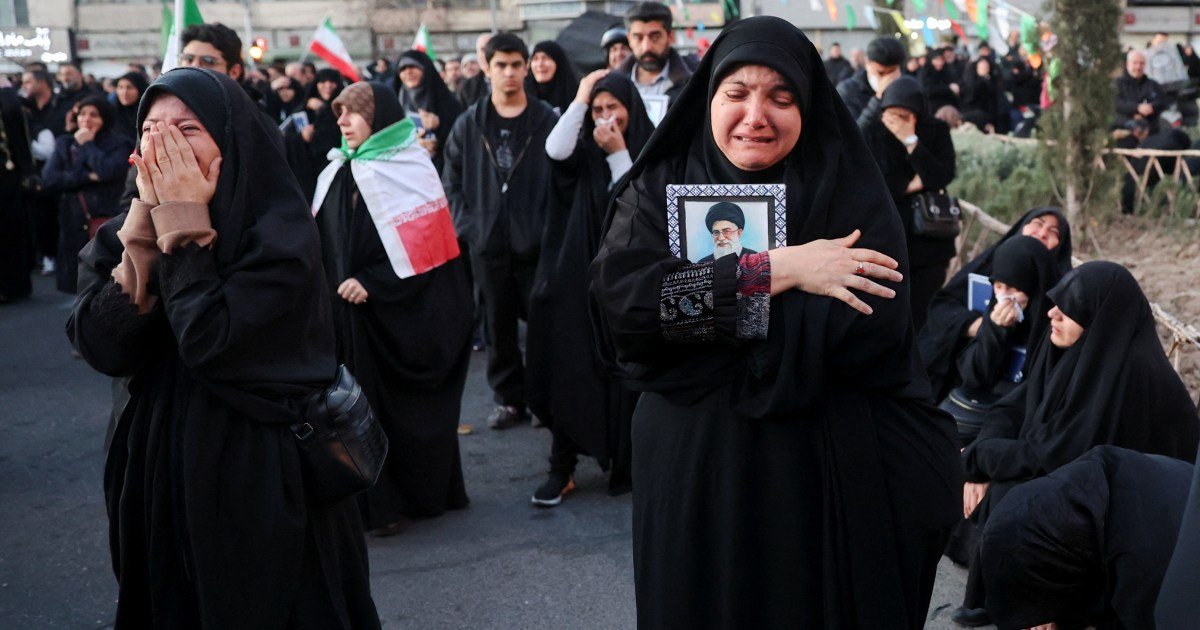
The war is feeding into a theological narrative of martyrdom and sacrifice that is helping maintain the Islamic Republic’s internal cohesion.
The United States-Israel war against Iran is usually described in the language of strategy: Deterrence, escalation, military pressure, missile capacity, nuclear risk. All of these matter, but they do not tell the whole story.
To understand how Iran may fight and survive this war, we need to look beyond military calculations and into the moral world through which the Islamic Republic understands power, loss, and, above all, endurance. This is not merely a state under attack, but one whose ideological core has long been shaped by a Shia political theology of martyrdom, sacrifice and sacred resistance. That matters because wars are not fought only with weapons, but with narratives and values; meaning itself can become a political resource.
Since the assassination of Supreme Leader Ayatollah Ali Khamenei in US-Israeli strikes during Ramadan, hardliners have held state-backed mourning ceremonies night after night, even as bombs continue to fall. Among the Islamic Republic’s loyalists, especially within the paramilitary force, the Basij, are people prepared to die as martyrs for what they regard as rule by a divinely-guided cleric.
This does not mean the Islamic Republic is invulnerable. It means something more complicated and more troubling: External violence may not weaken it in the way its enemies expect. It may instead reactivate the symbolic and moral grammar through which the Islamic Republic has sustained itself for decades while legitimising repression at home and abroad.
The Islamic Republic was never just a bureaucratic state. It presented itself from the beginning as a moral project, one that fused sovereignty with sacred history. The central emotional and symbolic reservoir of that history lies in Shia memory, especially the battle of Karbala of 680, in which an Umayyad army massacred Prophet Mohammad’s grandson Hussein and the small party accompanying him.
In Shia tradition, this historical event has come to represent unjust power, innocent suffering, righteous resistance and redemptive sacrifice. It reminds believers that oppression does not necessarily mean defeat, suffering can signify standing on the side of truth, and death can become a form of witness.
This is why martyrdom is not a secondary theme in the Islamic Republic’s self-understanding, but one of its central organising values. For years, the ruling order has drawn legitimacy from presenting itself as the righteous victim and the guardian of a sacred struggle against Estekbar (imperialism), domination, humiliation and foreign aggression.
A political-theological order built partly on the sanctification of sacrifice can absorb attack into its own moral universe. What appears from outside as devastation can be narrated from within as testimony, endurance and faithfulness, with death itself becoming politically productive.
This is not speculation. Iran’s strategy in the current war is increasingly one of endurance and attrition: Outlasting its enemies, surviving the blows, disrupting energy flows and betting that the political resolve in Washington and allied capitals will fracture before Iran’s own does. Reports suggest that, despite heavy losses, there were no visible signs of internal collapse under bombardment.
The memory of the eight-year Iran-Iraq war also left the Islamic Republic with a durable culture of endurance and sacrifice, alongside experience in surviving prolonged external pressure, even though the human cost to Iranians was immense.
Of course, not all solidarity is theological. Many Iranians who despise the Islamic Republic may still recoil from foreign attack, not out of loyalty to the republic but out of nationalism, fear, grief or horror at collective punishment. Yet this is precisely the point. External violence can blur moral lines inside the country. It can narrow public space, intensify siege mentality and allow the state to present itself once again as the defender of the nation rather than the author of repression.
The Islamic Republic has often benefitted when domestic anger is displaced by external threat. In peacetime, its failures are exposed: Corruption, repression, economic decline, coercive rule. In wartime, especially under foreign, unlawful attack, it can recover an older image: Not the incompetent authoritarian state, but the embattled guardian of resistance.
This does not mean the Islamic Republic’s theology is universally persuasive. Reports suggest that Iran’s next leadership faces a fraying loyalist base and serious long-term questions about legitimacy. Many Iranians have long ceased to believe in the state’s sacred narrative. But political theology does not need universal belief in order to function. It needs enough believers, enough institutions, enough ritual, enough fear and enough war to turn suffering into cohesion.
That is what makes the present war morally and politically dangerous. If the US and Israel imagine that overwhelming force will simply strip the Islamic Republic of meaning, they may be badly misunderstanding the kind of political-theological order they are fighting.
US President Donald Trump’s own rhetoric has not helped. His demand for Iran’s “unconditional surrender”, which pushes war away from limited strategic ends and towards humiliation and absolute defeat, does more than escalate; it gives the Islamic Republic exactly the kind of external enemy it knows how to narrate.
In a secular strategic imagination, violence weakens by destroying capacity. In a political-theological imagination, violence can strengthen by confirming sacred purpose. An ideological state that sees itself through the lens of sacred resistance may lose commanders, infrastructure and territory, yet still gain something symbolically vital: Renewed access to the language of martyrdom. This is one of the tragedies of war against ideological states. The more one attacks them from the outside, the easier it can become for them to recover the myths that sustain them from within.
None of this is to deny the brutality of the Islamic Republic or to romanticise its theology of sacrifice. That theology has often been used cynically, sending people to die while sanctifying loss in the language of faith. But moral criticism requires clarity. If we want to understand how the Islamic Republic survives, we must see that its resilience is not only military or institutional but also symbolic. It lies in its ability to transform injury into moral authority.
That is why the religious dimension matters. Not because this war is simply about religion, but because religion helps turn suffering into political meaning. The Islamic Republic is strong when it can strike back, and equally strong when it can persuade enough people that enduring attack is itself a form of victory.
The war on Iran may therefore produce a striking paradox. It may weaken the state’s material foundations while feeding the sacred story through which it continues to live.
The views expressed in this article are the author’s own and do not necessarily reflect media’s editorial stance.
