
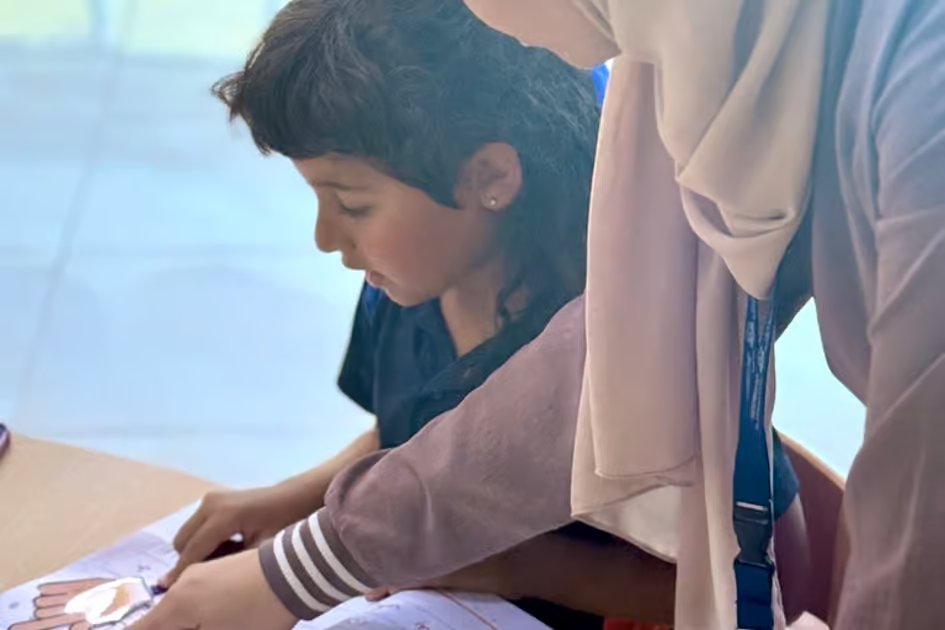
The IQRA programme does not rely on additional school hours or expensive technology
A new independent evaluation in Ras Al Khaimah has found that an early Arabic literacy programme known as IQRA has helped young learners achieve reading gains equivalent to an additional 25% of a school year.
The programme, developed by the Sheikh Saud bin Saqr Al Qasimi Foundation, is designed to strengthen foundational Arabic reading skills in the early years of schooling. Following the findings, it will now be rolled out across private schools in Ras Al Khaimah from September 2026. It will be introduced to children in KG1 through Grade 1.
The results come from a large-scale randomised controlled trial conducted by J-PAL MENA, part of the Abdul Latif Jameel Poverty Action Lab, which is widely regarded for its impact evaluations in education and development.
Conducted during the 2024–2025 academic year across 83 classrooms in 26 schools, the study is among the most extensive examinations of early Arabic literacy in the UAE.
Bridging gap between spoken Arabic and classroom learning
Researchers say the programme addresses a long-standing challenge in Arabic education: the gap between everyday spoken Arabic and Modern Standard Arabic used in schools.
For many children, learning to read Arabic involves navigating new vocabulary, unfamiliar sentence structures, and a more formal written system at the same time. IQRA aims to simplify this process by breaking reading instruction into structured, step-by-step stages.
Unlike many interventions, the programme does not rely on additional school hours or expensive technology. In most classrooms, it was delivered within normal timetables with only a few days of teacher training.
Developed with cognitive psychologist Helen Abadzi, IQRA applies research on how children learn to read, focusing on phonics, decoding, and fluency before comprehension.
Natasha Ridge, Executive Director of the Al Qasimi Foundation, said,
“For too long, weak Arabic reading outcomes have not been adequately addressed and treated as though the language itself is the problem. IQRA shows that this is not the case. When Arabic is taught in a way that reflects how children actually learn to read, progress can be rapid, measurable, and achievable within existing school systems.”
She explains what makes these results so important is that they are not based on anecdote or aspiration. “They come from a rigorous independent evaluation. IQRA demonstrates that evidence-based teaching can strengthen Arabic literacy for both native and non-native speakers, and it offers a scalable model for education systems across the region.”
Stronger fluency and decoding skills
The trial randomly assigned 41 classrooms to IQRA and 42 to standard Arabic instruction. Students in IQRA classrooms showed statistically significant improvements across multiple literacy measures.
Key findings included reading gains equivalent to 25 per cent of a school year, with improvements in letter recognition, word reading, non-word decoding, and oral reading fluency. Word reading showed the strongest improvement, with students moving from the 50th to the 58th percentile in that specific skill area.
Overall literacy performance improved modestly but meaningfully, with the median student moving from the 50th to the 54th percentile.
Nayera Adly Husseiny, Lead of Egypt Impact Lab at J-PAL MENA, said,
“The evaluation shows that IQRA changed classroom practice and translated into measurable improvements in student learning. The programme improved Arabic literacy across key areas, including letter identification, word reading, and reading fluency. How children are taught can make a significant difference.”
Designed for real school conditions
One of IQRA’s key strengths, researchers note, is its ease of implementation. In 21 of the 26 participating schools, it was delivered entirely within normal classroom hours, avoiding added pressure on school timetables.
Lessons are structured using sequenced instruction, large-font workbooks, and guided reading techniques such as echo reading, paired reading, and choral reading. The aim is to help children build automaticity and confidence in reading from the earliest stages.
Notably, the programme has also been tested in classrooms in Morocco, Egypt, and Jordan, with early evidence suggesting it may also support older students who struggle with reading.
Hanadi Mohammed, Education and Community Development Manager at the Al Qasimi Foundation, said, “Arabic is not a difficult language if it is taught in the right way. IQRA gives teachers a clear, structured approach that helps children focus first on the essential skills of reading.”
She added, “The programme supports both native and non-native Arabic speakers by building fluency step by step. It helps students approach Arabic with confidence rather than confusion.”
