
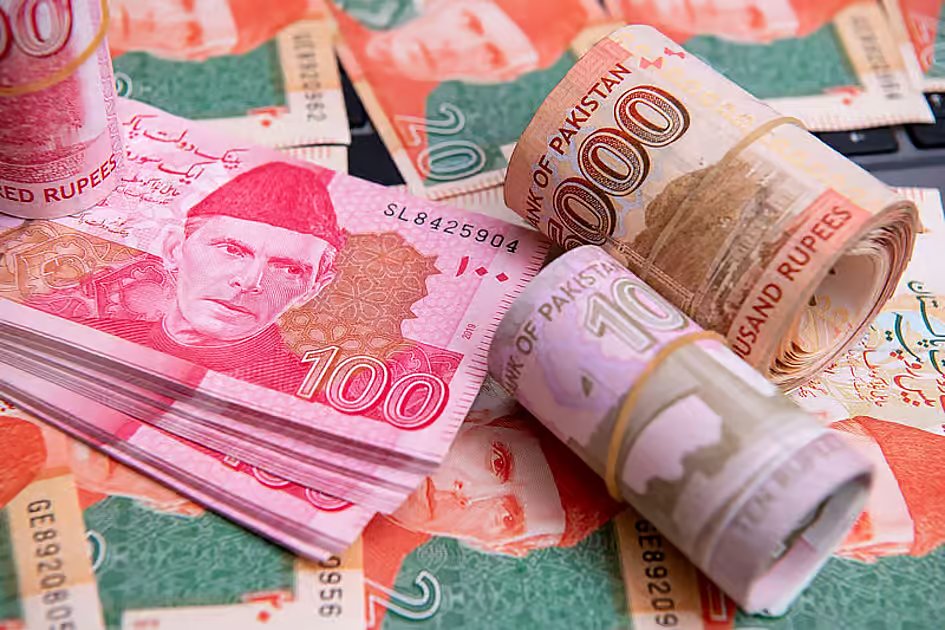
The South Asian currency has been largely steady over the past year after several years of sharp volatility due to political uncertainty and a dollar shortage
The Pakistani rupee strengthened to a nearly 20‑month high on Monday, rising to below 278 against the US dollar and trading at 75.5 against the UAE dirham.
According to xe.com data, the Pakistani rupee has gained over three per cent in the past 10 months, trading at 277.4 against the greenback on Monday, helped by growing foreign exchange reserves and financial support from the International Monetary Fund and Saudi Arabia.
Total liquid reserves have been on the rise over the past couple of years, increasing from $14.75 billion in April 2025 to $22.59 billion this month.
Data from the State Bank of Pakistan showed that the Real Effective Exchange Rate (REER) appreciated to 105.8 in April 2026 compared to 104.3 in March this year.
The current account balance recorded a deficit of $324 million in April 2026, compared to a surplus of $1.134 billion in March 2026, the apex bank said.
Earlier this month, the IMF’s board cleared a $1.32 billion disbursement for Pakistan as part of its third review of its $7 billion extended loan facility.
Over the past year, the Pakistani rupee has largely stabilised after several years of sharp volatility. Against the US dollar, it has traded in a relatively narrow band, mostly in the high 270s to low 280s, a marked improvement from the record weakness seen in 2023 when the currency crossed 300 to the dollar.
Analysts say a key driver of this stabilisation has been Pakistan’s engagement with the International Monetary Fund and the continuation of a reform‑focused policy mix. Fiscal tightening, energy price adjustments and a more market‑based exchange‑rate regime have helped restore a basic level of confidence among investors and multilateral lenders. The perception that Pakistan would avoid a disorderly default, and that external financing needs were being managed under the IMF umbrella, reduced the extreme depreciation pressures that had dominated the currency market earlier.
Monetary policy has also played an important role. The State Bank of Pakistan maintained very high interest rates to tackle inflation and support the rupee, making local‑currency assets relatively more attractive and discouraging excessive dollarisation.
Analysts warn that any delay in IMF disbursements, renewed spikes in global oil prices or deterioration in the security and political environment could push the rupee lower.
