Close Menu
    What's Hot

    Colombia presidential runoff pits leftist senator against pro-Trump rivalLeft-wing senator Iván Cepeda will face Trump admirer Abelardo de la Espriella at the final ballot on 21 June.15 mins agoLatin America

    June 1, 2026

    Killer fungus could be good news for habitats decimated by invasive mossA newly discovered species raises hope that some native British habitats could be restored.24 hrs agoScience & Environment

    June 1, 2026

    Between celebration and confrontation: Paris after PSG victoryNearly 800 people were arrested after clashes with police following the Champions League final.1 hr agoEurope

    May 31, 2026
    Facebook X (Twitter) Instagram
    • Politics
    • Economy
    Facebook X (Twitter) Instagram
    Gulf News Week
    Subscribe
    Monday, June 1
    • Home
    • Politics
      • Europe
      • Middle East
      • Russia
      • Social
      • Ukraine Conflict
      • US Politics
      • World
    • Region
      • Middle East News
    • World
    • Economy
      • Banking
      • Business
      • Markets
    • Real Estate
    • Science & Tech
      • AI & Tech
      • Climate
      • Computing
      • Science
      • Space Science
      • Tech
    • Sports

      Dominant PSG put Liverpool on the brink with 2-0 Champions League quarter-final first-leg win

      April 9, 2026

      Dubai Basketball U-18 Elite Crowned Basket Cup Sarajevo 2026 Champions in Historic Debut

      April 6, 2026

      Saudi boxing crowns 20 champions as Kingdom’s Elite Belt concludes in Riyadh

      April 4, 2026

      “He Signed for a Real Fight”: Pacquiao Contradicts Mayweather Over Rematch Status

      April 3, 2026

      Arsenal Hold Off Chelsea Fightback to Reach Women’s Champions League Semi-Finals

      April 2, 2026
    • Health
    • Travel
    • Contact
    Gulf News Week
    Home»Most Viewed News»Killer fungus could be good news for habitats decimated by invasive mossA newly discovered species raises hope that some native British habitats could be restored.24 hrs agoScience & Environment
    Most Viewed News

    Killer fungus could be good news for habitats decimated by invasive mossA newly discovered species raises hope that some native British habitats could be restored.24 hrs agoScience & Environment

    Gulf News WeekBy Gulf News WeekJune 1, 2026No Comments6 Mins Read
    Share Facebook Twitter Pinterest Copy Link LinkedIn Tumblr Email VKontakte Telegram
    Killer fungus could be good news for habitats decimated by invasive mossA newly discovered species raises hope that some native British habitats could be restored.24 hrs agoScience & Environment
    Share
    Facebook Twitter Pinterest Email Copy Link
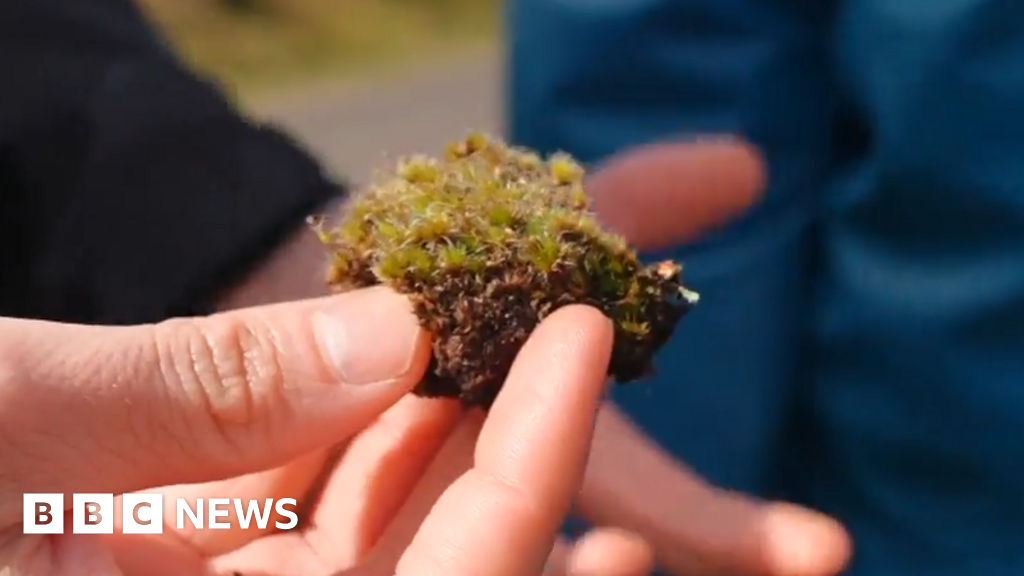
    Gwyndaf Hughes/BBC A close-up picture of hand holding a clump of green moss with brown rootsGwyndaf Hughes/BBC
    The heath-star moss has spread quickly through the UK and Europe

    A new species of “killer fungus” has been discovered in Britain that destroys an aggressively invasive plant, raising hopes that decimated native habitats could be restored.

    It infects the heath-star moss that is damaging UK environments by taking over and turfing out other species.

    Scientists say it could represent a rare fightback by the British environment against invasive species.

    The scientist tracking the spread of the moss die-back fungus across the UK took BBC News to see its “fairy rings of death” in south Wales.

    He spotted dead invasive mosses on a cliffside and took samples, but couldn’t work out the killer.

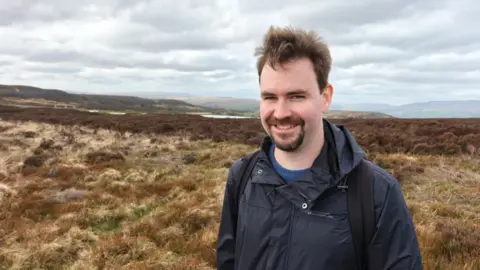
    Gwyndaf Hughes/BBC A man wearing a navy blue coat standing on a hillside with brown heathland behind himGwyndaf Hughes/BBC
    Dr George Greiff, 30, discovered the moss die-back fungus

    But he kept seeing more cases of decaying moss. Working with scientists in the UK and France, he has now managed to piece together the puzzle.

    The culprit was a potent fungus never seen before by scientists, now named moss die-back.

    We often think of fungus as bad but consider this one to be a “goodie”.

    Its victim, the heath-star moss, is all over Britain. Look on hillsides, sand dunes, or a simple garden fence. “It’s aggressive. I’ve even seen it growing in tarmac,” says Greiff.

    “It is a pretty-looking thing,” he concedes, plucking fragments off a clump torn from a carpet of green moss. “But it’s caused a lot of problems,” he says.
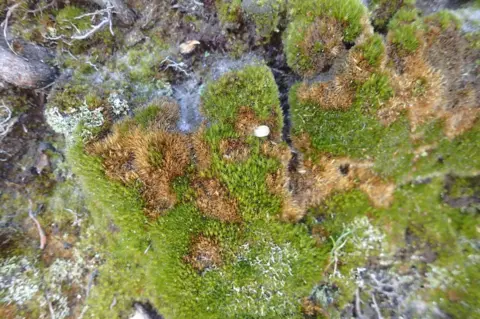
    George Greiff A rock with patches of bright green moss and circles of dead moss, showing where the fungus has killed the plantGeorge Greiff
    The brown patches are dead heath-moss – killed by the moss die-back fungus

    Around 2,000 non-native plants and animals have been brought to Britain from all over the world by people, accidentally or sometimes deliberately.

    Some end up dominating the environment. The most famous is probably the North American grey squirrel, which has nearly wiped out our native red squirrel populations.

    In the plant world, amongst the biggest offenders are the invasive Japanese knotweed which damages people’s homes, or rhododendron that leaves toxins in soils.

    But not a lot is known about the heath-star moss. Scientists think it arrived on British soil in the 1940s from somewhere in the southern hemisphere. By 1990 it was everywhere.

    “This moss has just exploded. In the 1930s, native mosses would have been growing here instead,” Greiff explains.

    There are more than 1,000 types of moss in the UK. They are the backbone of our most precious habitats like rare temperate rainforests (damp coastal woodlands) and peatlands that store carbon. But they are threatened by non-native plants.

    The heath-star moss sends out spores far and wide and reproduces quickly, making it a successful invader.

    “The first time I saw it, I had no idea what it was. I threw it in the bin,” says Greiff, who has been working at Amgueddfa Cymru museum in Cardiff.

    He’s guiding me along a path in the Bannau Brycheiniog national park near Abergavenny, south Wales.

    “In heathlands like this one, native mosses have gone locally extinct or reduced significantly in their populations,” he says.

    His eyes are fixed to the ground. He scans the low banks for “patches of death”.

    His talent for quiet, careful observation of plants no taller than our ankles is on show.

    Just a few metres into our walk, Greiff finds what I’ve come to see. “It’s as big as my hand,” he says, spreading his fingers over a brown ring of dead moss.

    Honestly, it is less dramatic than I expected. But our cameraman Gwyndaf Hughes has brought a macro lens, and when I peer through, I see white blobs suspended on the moss tips. It is the fungus at work.
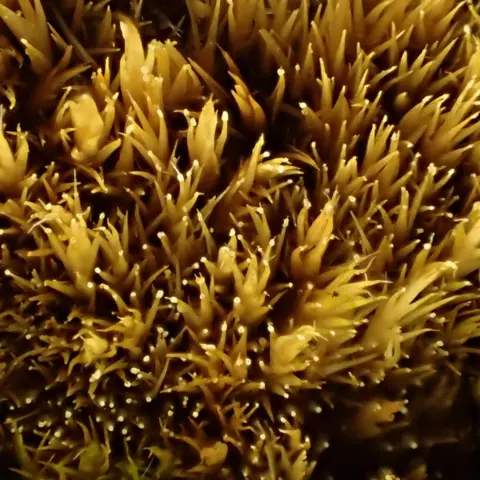
    George Greiff The white tips on the plant tips are the fungusGeorge Greiff
    The white blobs on the plant tips are the fungus

    Greiff points out baby heather plants nearby now able to grow in gaps left by decayed moss.

    Now Greiff knows what the helpful fungus can do, he looks for it anywhere he goes. He jokes that the map of where it has been found is also a map of his holiday destinations.
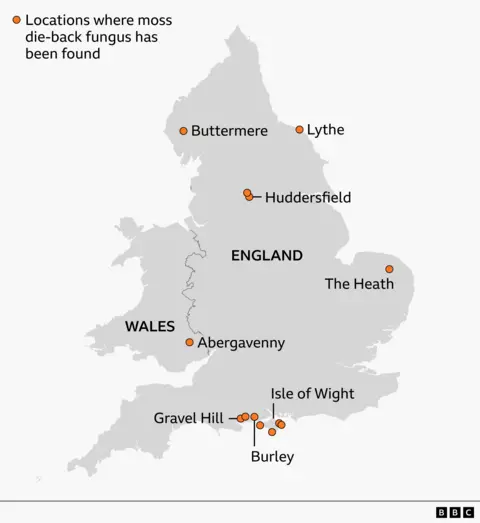
    Map of England and Wales highlighting locations where moss die-back fungus has been found. Orange dots mark sites including Buttermere and Lythe in northern England, Huddersfield in central northern England, The Heath in eastern England, Abergavenny in south Wales, and a cluster of sites in southern England around Burley, Gravel Hill, and the Isle of Wight. A legend indicates that orange circles represent confirmed locations.
    George has found the fungus across England and Wales

    “It’s taken a lot of DNA sequencing to fully identify this fungus,” he says, showing me dead moss under a microscope in a lab at Amgueddfa Cymru museum.

    The fungus clings onto the moss stem, ballooning like candy floss around a stick. It’s even penetrated some of the moss cells.

    He’s now worked out that it is a close relative of the ash die-back fungus that has killed up to 80 million ash trees in Britain.

    A powerful fungus destroying plants sounds like a potential threat to other species and biodiversity.

    But Greiff’s analysis so far suggests it only affects the heath-star moss, and to a limited extent one other type of moss, although more work is needed to confirm the findings.
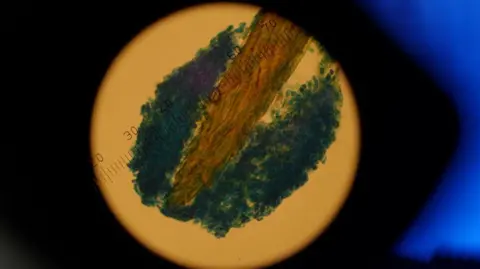
    Gwyndaf Hughes/BBC Fungus under the microscopeGwyndaf Hughes/BBC
    Moss-die back fungus on dead heath-star moss under a microscope

    He believes that the origins of this fungus may be in a native species that has since adapted to kill the heath-star moss. This could be a “rare example of the British environment fighting back”, he says.

    Usually, invasive species are deliberately targeted by humans to try to bring them under control, like the initiative to feed contraceptives to grey squirrels.

    “Some people might try to collect this moss to try and get rid of it, but it’s not very effective. It would be very resource-intensive, very expensive,” says Greiff.

    “To have a natural biological control agent doing it for us is really valuable,” he explains.
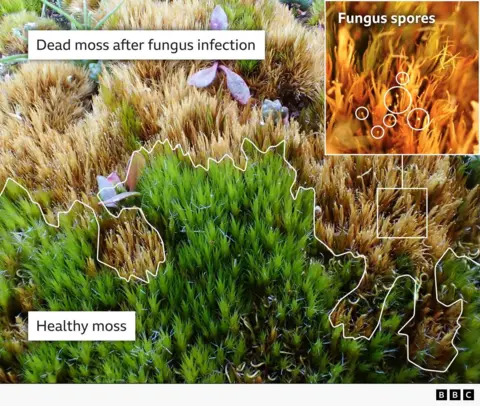
    Close-up of a moss-covered surface showing patches of bright green “healthy” moss alongside brown, dying moss labeled “dead moss after fungus infection.” White outlines highlight affected areas, and an inset image labeled “fungus spores” shows small circular spores among the moss.

    In cabinet drawers holding the oldest collection of mosses in the UK, the museum’s Head of Plant and Earth Science Dr Nathan Smith shows me dried mosses in paper envelopes, some dating back to the 1880s.

    By looking for evidence of the moss die-back fungus on these samples, scientists want to pinpoint exactly how and when it appeared.

    “This fungus gives an opportunity to save these unique moss landscapes that are homes for insects, fungi, molluscs, other plants,” explains Smith.

    “It gives a real chance to preserve and present their uniqueness and beauty,” he says.

    Mosses are just one part of Britain’s complex biodiversity. But as our nature is classed amongst the most depleted in the world, with one in six species at risk of extinction, discovering a control on habitat destruction is a cause for hope.

    “It’s exciting in so many respects. Though I am the only one looking for the fungus. It would be nice if some other people did too,” says Greiff.

    Biodiversity continues to decline, 2025 data shows

    Squirrel contraceptives to tackle tide of greys

    Extinct ‘mountain jewel’ plant returned to wild – in secret location

    Science & Environment
    Nature
    Conservation
    Plants
    Share. Facebook Twitter Pinterest LinkedIn Tumblr Email Telegram Copy Link
    Gulf News Week

    Related Posts

    Most Viewed News

    Colombia presidential runoff pits leftist senator against pro-Trump rivalLeft-wing senator Iván Cepeda will face Trump admirer Abelardo de la Espriella at the final ballot on 21 June.15 mins agoLatin America

    June 1, 2026
    Most Viewed News

    Between celebration and confrontation: Paris after PSG victoryNearly 800 people were arrested after clashes with police following the Champions League final.1 hr agoEurope

    May 31, 2026
    Most Viewed News

    Brazil monitors two patients for possible Ebola infection If confirmed, they would be the first infection cases outside Africa, since the outbreak began in DR Congo.2 hrs agoLatin America

    May 31, 2026
    Most Viewed News

    'Hardest video I've had to make' – KSI quits Sidemen after 13 yearsThe star, whose real name is Olajide Olatunji, has been part of the YouTube group since 2013.3 hrs agoCulture

    May 31, 2026
    Most Viewed News

    'Cancel it', Trump says after artists drop out of US Freedom 250 festivalTrump suggests holding a "Make America Great Again" rally instead after most headliners drop out of White-House-linked event.1 hr agoUS & Canada

    May 31, 2026
    Most Viewed News

    Huge blast kills dozens in rebel-held village in MyanmarInsurgents say it was caused by explosives being used for mining close to the Chinese border. 56 mins agoAsia

    May 31, 2026
    Add A Comment
    Leave A Reply Cancel Reply

    Editors Picks

    Colombia presidential runoff pits leftist senator against pro-Trump rivalLeft-wing senator Iván Cepeda will face Trump admirer Abelardo de la Espriella at the final ballot on 21 June.15 mins agoLatin America

    June 1, 2026

    Killer fungus could be good news for habitats decimated by invasive mossA newly discovered species raises hope that some native British habitats could be restored.24 hrs agoScience & Environment

    June 1, 2026

    Between celebration and confrontation: Paris after PSG victoryNearly 800 people were arrested after clashes with police following the Champions League final.1 hr agoEurope

    May 31, 2026

    Brazil monitors two patients for possible Ebola infection If confirmed, they would be the first infection cases outside Africa, since the outbreak began in DR Congo.2 hrs agoLatin America

    May 31, 2026
    Latest Posts

    Colombia presidential runoff pits leftist senator against pro-Trump rivalLeft-wing senator Iván Cepeda will face Trump admirer Abelardo de la Espriella at the final ballot on 21 June.15 mins agoLatin America

    June 1, 2026

    Between celebration and confrontation: Paris after PSG victoryNearly 800 people were arrested after clashes with police following the Champions League final.1 hr agoEurope

    May 31, 2026

    Brazil monitors two patients for possible Ebola infection If confirmed, they would be the first infection cases outside Africa, since the outbreak began in DR Congo.2 hrs agoLatin America

    May 31, 2026

    Subscribe to News

    Get the latest sports news from NewsSite about world, sports and politics.

    Advertisement
    Demo
    Gulf News Week

    Your source for the serious news. This demo is crafted specifically to exhibit the use of the theme as a news site. Visit our main page for more demos.

    We're social. Connect with us:

    Facebook X (Twitter) Instagram Pinterest YouTube
    Latest Posts

    Colombia presidential runoff pits leftist senator against pro-Trump rivalLeft-wing senator Iván Cepeda will face Trump admirer Abelardo de la Espriella at the final ballot on 21 June.15 mins agoLatin America

    June 1, 2026

    Killer fungus could be good news for habitats decimated by invasive mossA newly discovered species raises hope that some native British habitats could be restored.24 hrs agoScience & Environment

    June 1, 2026

    Between celebration and confrontation: Paris after PSG victoryNearly 800 people were arrested after clashes with police following the Champions League final.1 hr agoEurope

    May 31, 2026

    Subscribe to Updates

    Get the latest creative news from FooBar about art, design and business.

    © 2026 Gulf News Week. Designed by HAM Digital Media.
    • Home
    • Politics
    • Economy
    • Sports

    Type above and press Enter to search. Press Esc to cancel.