
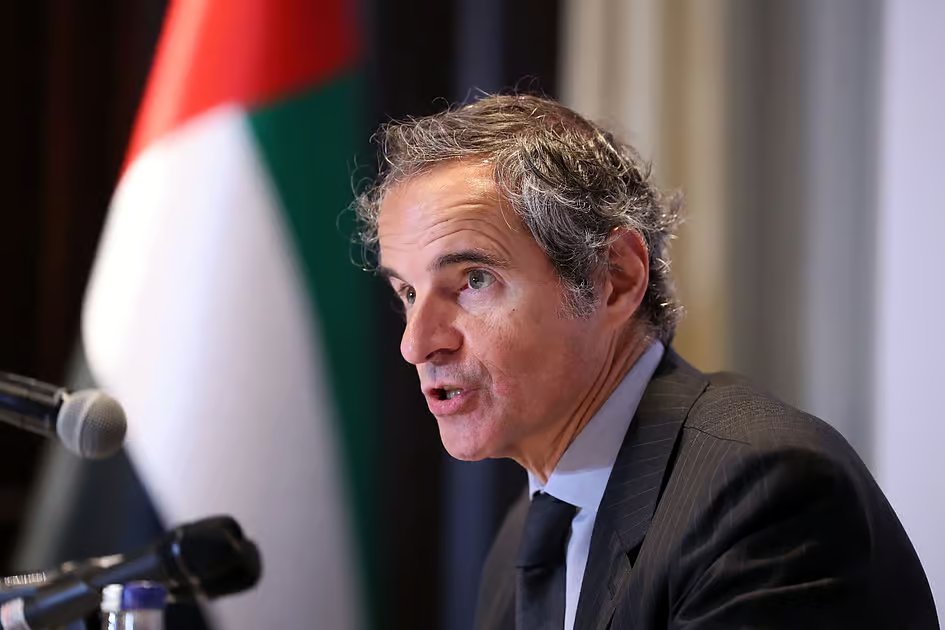
In one of his strongest remarks during the briefing, Grossi suggests that those responsible appeared to understand significance of the infrastructure
The UAE’s Barakah Nuclear Energy Plant passed a “test by fire” following the May 17 attack that disrupted external power infrastructure connected to the facility, according to the head of the UN nuclear watchdog.
He praised plant operators for their response and stressed that there was never any radiological emergency. Speaking after visiting the Barakah plant on Tuesday, Rafael Grossi, Director General of the International Atomic Energy Agency (IAEA), said he travelled to the UAE following the incident to assess the situation firsthand and express the agency’s support.
“The main reason for my visit is the incident that took place on May 17 at the Barakah power plant,” Grossi told reporters. He said the IAEA had been working closely with the UAE since the inception of its nuclear energy programme and had remained in close contact with the country’s authorities and plant operators following the incident.
‘Test by fire’
Grossi said he met senior UAE officials and visited the site to review how the situation had been handled. According to the IAEA chief, established safety protocols and emergency procedures functioned as intended. “It was a test by fire for them,” he said. “And they came out with flying colours.”
Grossi said he had discussed the response directly with the shift team that was on duty when the incident occurred and found that all procedures had been followed correctly. “I had an opportunity to discuss with the shift that was there at that time, all the protocols were applied impeccably, and within a very short period of time, the situation was under control,” he said.
He noted that the incident affected external electrical infrastructure that provides power to systems supporting the plant’s operations rather than the reactor itself. “This attack is an indirect attack on the plant. It is not on the reactor, but on the electrical infrastructures that provide the power that allows it to perform safety and other essential functions,” he explained.
Grossi emphasised that despite the seriousness of the event, the incident never escalated into a nuclear safety emergency, and that “there was never a radiological emergency.”
Grossi also indicated that the incident affected reactor operations, saying the attack on external electrical infrastructure had “took out a nuclear reactor because of the loss of external power that came with that”, although safety systems functioned as designed and operators quickly brought the situation under control.
‘Layers of security’: IAEA chief praises UAE response
According to information shared during the visit, the Barakah nuclear plant continues to operate safely and normally, with all systems and safety protocols remaining fully operational. UAE authorities said the incident demonstrated the effectiveness of the country’s nuclear safety and security framework and the preparedness of personnel responsible for operating the facility.
He explained that multiple layers of safety systems are designed to activate automatically in such situations, allowing operators to maintain safe conditions even when external power supplies are disrupted. “When you have good professionals and good procedures in place, immediately the nuclear power plant is a very safe place,” Grossi said. “You have a number of layers of security that immediately kick in.”
Echoing Grossi’s assessment, Hamad Al Kaabi, the UAE’s Permanent Representative to the IAEA, said all reactor safety systems continued to operate normally following the incident, although some units remain offline as part of the shutdown process.
“All the safety systems of the reactors are in operation,” Al Kaabi said. “There is currently some reactors in outage as part of the shutdown. Some reactors will come online.”
At the same time, Grossi strongly condemned the attack, describing it as unacceptable and warning about the risks associated with targeting infrastructure linked to nuclear facilities. “Any attack on a nuclear power plant is simply unacceptable,” he said, adding that such actions run contrary to international norms and legal frameworks.
While praising the plant’s response, Grossi said the incident demonstrated the gravity of attacks involving critical infrastructure connected to nuclear facilities. “For what we saw, this was a very carefully targeted operation,” he said. In one of his strongest remarks during the briefing, Grossi suggested that those responsible appeared to understand the significance of the infrastructure that was targeted. “Whomever was or is behind this knew exactly what they were doing,” he said. “This is of extreme gravity.”
The IAEA chief said the agency would continue working with UAE authorities, the Emirates Nuclear Energy Company and the Federal Authority for Nuclear Regulation to review lessons learned from the incident and support ongoing repair and assessment efforts.
He added that the event highlighted the value of extensive training, drills and preparedness exercises that are routinely carried out at nuclear facilities. “One could see the value of the extensive training, the drills and all these things that, in a sophisticated piece of industrial infrastructure like a nuclear power plant, you normally do,” Grossi said.
UAE, IAEA to share lessons learnt from incident
UAE officials noted that lessons from the ConvEx-3 international emergency preparedness exercise, hosted in the UAE in 2021 in cooperation with the IAEA, contributed to strengthening national preparedness and resilience during the recent incident.
The UAE and the IAEA have worked closely together since the launch of the country’s peaceful nuclear energy programme. According to officials, the partnership has included more than 100 technical cooperation activities, ranging from training courses and expert missions to capacity-building programmes.
Officials also said the UAE and the IAEA plan to organise a workshop to share lessons learnt from the incident with the wider civil nuclear community. The Barakah Nuclear Energy Plant’s four reactors became fully operational in 2024. The facility generates around 40 terawatt-hours of carbon-free electricity annually, supplying roughly 25 per cent of the UAE’s electricity needs.
Grossi’s visit comes amid heightened international scrutiny of nuclear safety and security following recent attacks on nuclear-related infrastructure in the region, with the IAEA continuing to advocate for the protection of civilian nuclear facilities from military action.
