Close Menu
    What's Hot

    World's largest chipmaker does not rule out price rises as costs increaseIn a rare interview, a senior executive at TSMC discusses the AI boom, the geopolitics of chips and what it means for the price of electronics.2 hrs agoBusiness

    June 10, 2026

    The rebels at the front line of Myanmar's civil warThe BBC’s Quentin Sommerville travels to Myanmar – without the permission of the authorities – to meet a group of rebel fighters.2 hrs agoAsia

    June 10, 2026

    Inside Myanmar, rebels are losing ground as military forces men into armyThe BBC travels with rebels to frontline positions in Myanmar to see how the war is unfolding. 2 hrs agoAsia

    June 9, 2026
    Facebook X (Twitter) Instagram
    • Politics
    • Economy
    Facebook X (Twitter) Instagram
    Gulf News Week
    Subscribe
    Wednesday, June 10
    • Home
    • Politics
      • Europe
      • Middle East
      • Russia
      • Social
      • Ukraine Conflict
      • US Politics
      • World
    • Region
      • Middle East News
    • World
    • Economy
      • Banking
      • Business
      • Markets
    • Real Estate
    • Science & Tech
      • AI & Tech
      • Climate
      • Computing
      • Science
      • Space Science
      • Tech
    • Sports

      Dominant PSG put Liverpool on the brink with 2-0 Champions League quarter-final first-leg win

      April 9, 2026

      Dubai Basketball U-18 Elite Crowned Basket Cup Sarajevo 2026 Champions in Historic Debut

      April 6, 2026

      Saudi boxing crowns 20 champions as Kingdom’s Elite Belt concludes in Riyadh

      April 4, 2026

      “He Signed for a Real Fight”: Pacquiao Contradicts Mayweather Over Rematch Status

      April 3, 2026

      Arsenal Hold Off Chelsea Fightback to Reach Women’s Champions League Semi-Finals

      April 2, 2026
    • Health
    • Travel
    • Contact
    Gulf News Week
    Home»Most Viewed News»Inside Myanmar, rebels are losing ground as military forces men into armyThe BBC travels with rebels to frontline positions in Myanmar to see how the war is unfolding. 2 hrs agoAsia
    Most Viewed News

    Inside Myanmar, rebels are losing ground as military forces men into armyThe BBC travels with rebels to frontline positions in Myanmar to see how the war is unfolding. 2 hrs agoAsia

    Gulf News WeekBy Gulf News WeekJune 9, 2026No Comments9 Mins Read
    Share Facebook Twitter Pinterest Copy Link LinkedIn Tumblr Email VKontakte Telegram
    Inside Myanmar, rebels are losing ground as military forces men into armyThe BBC travels with rebels to frontline positions in Myanmar to see how the war is unfolding.   2 hrs agoAsia
    Share
    Facebook Twitter Pinterest Email Copy Link
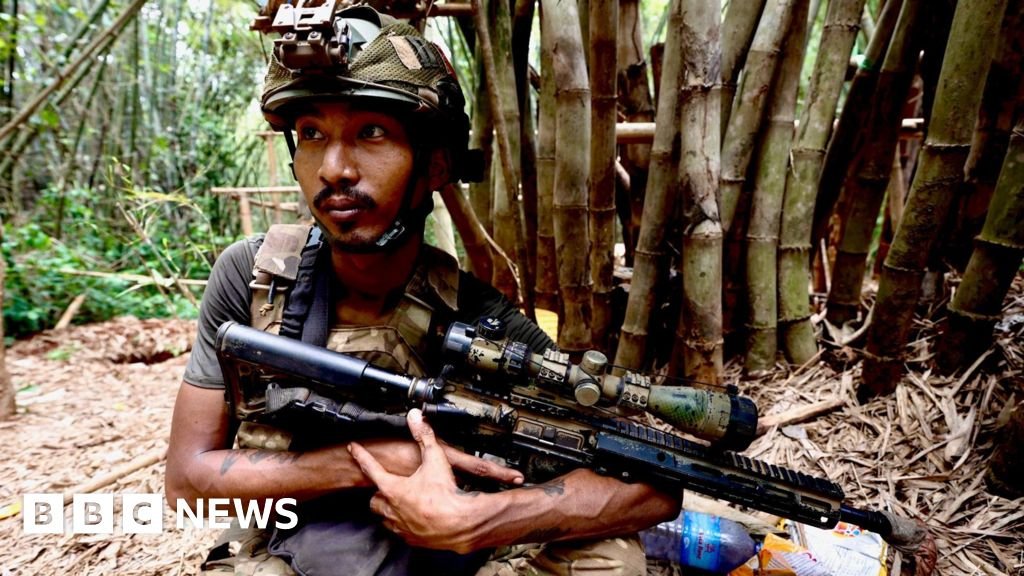
    BBC/Darren Conway A soldier in a camouflage helmet holds a gun in a jungle setting, a tree trunk behind him. He has a watchful expression and his eyes are fixed beyond the camera.BBC/Darren Conway

    The four young men in the rebel camp hidden deep in jungle-covered mountains never wanted a part in Myanmar’s civil war.

    They didn’t choose to be soldiers for the military either.

    One had been a chef on his way home from work when he was grabbed off the street. His lack of ID was enough for the military to detain him and force him to sign up. Another was taken on his way back from a late-night karaoke session; a third had been working for the forestry department when he was arrested. The fourth man says on being arrested, drugs were slipped into his shoe, and he was framed and made to enlist.

    “Before we even understood what was happening, we were sent straight to the front lines,” one of the men – all between the ages of 19 and 25 – tells the BBC.

    “The conscripts had to do everything. While the regular soldiers hardly had to work.”

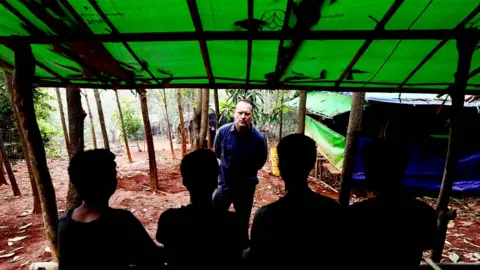
    BBC/Darren Conway Four young men stand with their backs to the camera, in a jungle under a tarpaulin roof. BBC correspondent Quentin Sommerville stands facing towards them. BBC/Darren Conway
    The BBC agreed to hide the men’s identities to avoid their families facing retribution

    They spent four months in basic training and then were sent to the front in Karen state – one night, on their way to get washed, they decided to make a run for it.

    But after escaping they walked into a nearby rebel patrol of People’s Defence Force (PDF) fighters, and were detained.

    They are happier here, they say, being treated “like brothers, not strangers”.

    They’ll stay with the PDF for now, but will be taken to the border with Thailand eventually, “because if we return now”, one says, “the military could still track us”. The BBC agreed to hide their identities to avoid their families facing retribution.

    Watch: The rebels at the frontlines of Myanmar’s civil war

    The reality is that, despite the reluctance of these four unwilling recruits, the military’s forced conscription policy has shifted the junta’s fortunes in the civil war.

    In many parts of the country, the rebels are now on the back foot against the military, who seized power in 2021 from the democratically elected government, jailing its leader Aung San Suu Kyi.

    Civil war has torn the country apart. Thousands have been killed and millions displaced.

    More than two years ago, an alliance of ethnic and rebel groups made sweeping gains throughout the country, notching up a string of victories against the junta. Once on the offensive, in most places across Myanmar the resistance is now on the defensive.

    The military still only fully controls less than half the country, but it has been making gains – including key townships and retaking a critical road from Mandalay to Myitkyina in the north. Thousands of soldiers are advancing in an attempt to re-establish control of several border areas including Kachin, Chin and Karen states.

    The BBC travelled to Myanmar without the permission of the authorities – the only way to report from rebel-held territory. During the 10 days we were there, we spent time with rebel fighters, and travelled to hospitals and front line positions in Bago and Karen states to report on how the war is unfolding.

    Myanmar’s coup leader who set off a brutal civil war becomes president

    In rebel-held Myanmar, civilians face devastating air strikes and a sham election

    Myanmar’s army is taking back territory with relentless air strikes – and China’s help

    And it is men like the four deserters – those required to enlist and serve a minimum of two years after the military began enforcing a conscription law in 2024 – who have made the most difference, says Ko Kaung, a PDF battalion commander.

    “Military forced conscription became the main challenging factor for us on the battlefield as it enabled the military with limitless manpower,” he explains as he takes his men on patrol in the sweltering heat.

    “For us, despite having technology and intellectual advantages, our resources are very constrained. With limited funds, we cannot source required components as much as we want and cannot recruit new soldiers as easily as the military.”

    Ko Kaung and his men took control of Hpapun, a town in Karen state, and a sprawling military base two years ago. It already bears the scars of war. The welcome sign at the entrance has been bombed, as have the town school, a local monastery and most of the now abandoned homes.

    But now he’s braced for the worst – junta drones hover in the sky, and as many as 2,000 soldiers are advancing towards Hpapun.
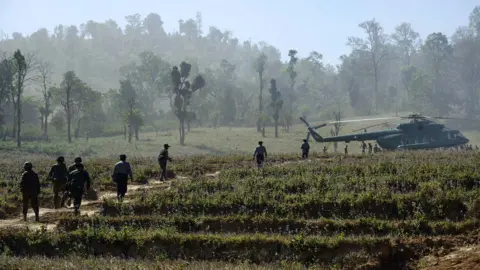
    Getty Images In this photo taken on January 24, 2026, soldiers and police walk towards a military Mi-17 helicopter transporting a military-organised press tour at a drug production site southwest of Mongyai, northern Shan State, that was captured by the Myanmar military.Getty Images
    Myanmar’s military is much better armed than the rebel forces it is fighting

    Back in the mountain camp, PDF commander Da Wa agrees the conscripts are a problem.

    The former political activist – who spent four and a half years in a government prison – says that while many of the junta’s forces aren’t willing recruits, they are improving as fighters because they “are getting better at following orders”.

    He takes me on patrol through winding jungle tracks, and we must seek cover when a junta drone is heard above us. Eventually we make it to a hilltop, where his fighters speak in hushed tones as there is a military sniper on the next hill. There too is a base the rebels captured back in April, but they were only able to hold it for a couple of days until overwhelming artillery and airstrikes forced them back.

    “We’ll take it back,” Da Wa says.
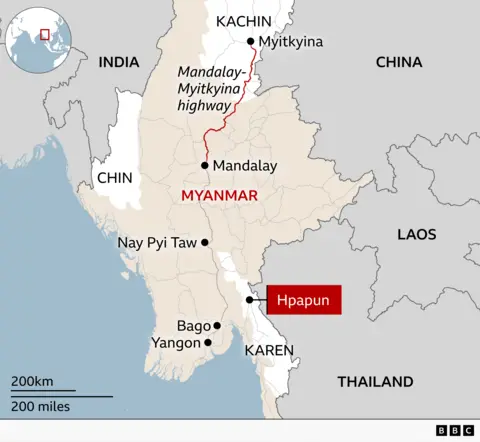
    A map showing Myanmar, its main cities, as well as the three provinces of China, on the Indian border, Kachin, on the Chinese border in the north, and Karen, in the east next to Thailand. It also marks Hpapun, in Karen state.
    The army is trying to re-establish control of several border areas including Kachin, Chin and Karen states

    But like Ko Kaung, he’s facing considerable odds: the military has been attempting to reinforce its positions around him too, some 400 soldiers headed his way.

    It is not just the conscripts, though.

    Da Wa says tactics have changed and that, since the junta signed a security pact with Russia, it has more air power too. “We see pairs of aircraft now, before it would be a single fixed wing.”

    He says the junta now also has the edge “both in terms of technology and in terms of quantity” when it comes to drones – something Ko Kaung agrees with.

    “The [drone] danger is definitely increasing. It would be easier for us if we also had jammers… It depends on how effectively we can counter their drone attacks and how well we can defend ourselves against them.”

    Added to all this, there are the ceasefires that China – which has invested billions in Myanmar and is mining rare earth minerals in Karen and Kachin states – has brokered with several rebel groups, while also throttling the supplies of weapons and ammunition to resistance forces.
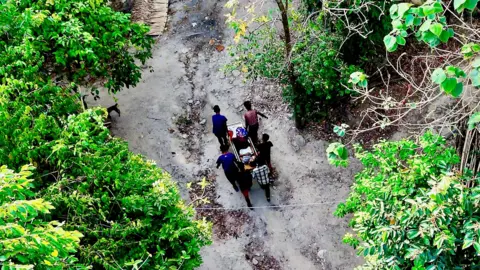
    BBC/Darren Conway Kyar Soe, an injured rebel platoon commander, is carried to the operating tableBBC/Darren Conway
    Kyar Soe, an injured rebel platoon commander, is carried to the operating table

    The lack of weapons is a big problem, Kyar Soe, a platoon commander injured during a battle, says as he shows off a video of a recent fight.

    In it he can be heard shouting to one overly enthusiastic fighter, who is firing at junta positions, “save your bullets, easy, easy!”.

    “Everyone is willing to fight so far,” he tells me from his hospital bed in a clinic hidden deep in the jungle. “But there are still many weaknesses in some places, like we have major shortages when it comes to weapons and ammunition.”

    Hours earlier, we had watched as a doctor’s drill bore deep into his right leg, as surgeons tried to rebuild it with metal brackets and pins.

    Kyar Soe had stepped on a landmine. Myanmar is one of the most heavily mined countries in the world – with 745 people killed or injured by landmines, a quarter of them children, last year alone. Most of his right heel was gone, and this was the second operation he had undergone.

    But still, when I speak to him afterwards, his heavily bandaged leg throbbing, he is determined.

    “I’ll return to the fight,” he says. “One way or another I’ll fight until the very end as turning back home is no longer an option for me any more.”
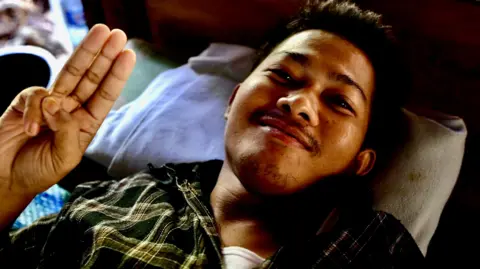
    BBC/Darren Conway Injured rebel commander Kyar Soe after the operation to rebuild his legBBC/Darren Conway
    He may have stepped on a landmine, but Kyar Soe is not giving up

    Dr Saung runs this field hospital, made up of a collection of bamboo and wood huts – complete with an operating theatre which runs on solar power or its backup generator – on a shoestring budget.

    The hospital is short of money and supplies, and lacks an ambulance.

    Yet Dr Saung, who once served in the army, spending 19 years at a military academy, remains determined to inspire the young rebels he sees coming through his doors to keep fighting.

    First, he tells them, “we are fighting this revolution now because the generations before us failed to fulfil that responsibility”.

    “Second,” he says, “if young people choose not to oppose the dictatorship now, then one day, when they grow older like us and can no longer tolerate the oppression, they may also find themselves having to take up arms or join another resistance movement.”
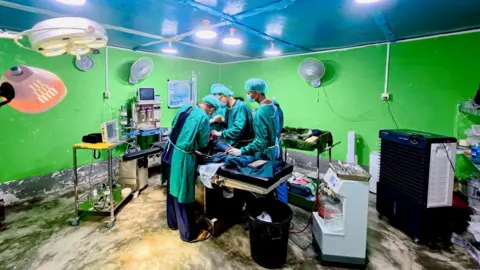
    BBC/Darren Conway The operating theatre, with three doctors wearing green scrubs and facemasksBBC/Darren Conway
    The field hospital, complete with operating theatre, is run on a shoestring

    We break off our interview when we hear cries coming from one of the recovery wards, and Dr Saung must attend.

    In a corner of a ward, on a platform above the dirt floor, the wife of one of the fighters is about to give birth. May Kyut Mon, 29, screams as her contractions increase.

    Her husband, Yine Chit, 24, stands over, his eyes wide and waving a fan towards her in the stifling heat. Buddhist mantras should be chanted while the baby is being delivered, but he can’t remember the words, so he plays them from his phone on speaker instead.

    A team of nurses shout encouragement and then, finally, Dr Saung, with a smile on his face, holds up a baby girl. They will call her Sue Paye which roughly translates as “fulfilled wish”. While his wife recovers, I ask Yine Chit, what he wants for his daughter’s future,

    “A free and democratic Myanmar,” he replies.

    He and his wife want to take Sue Paye to visit their parents, but it isn’t possible as they live in junta territory. “You see, people in my village found out I joined the resistance forces, including my neighbours, who support the military.”

    But, he says, with a smile, “once the revolution is over and peaceful times come, we’ll take the baby and visit both sides of the family”.
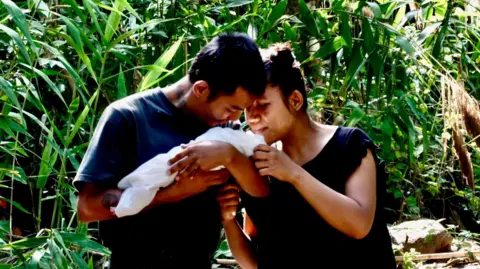
    BBC/Darren Conway A couple hold a newborn baby in the arms, standing in front of the green of the jungleBBC/Darren Conway
    May Kyut Mon (right) and Yine Chit want their baby to grow up in a free country

    Paragliders: The army’s lethal new weapon in Myanmar’s civil war

    Myanmar’s army vowed a ceasefire after the earthquake. I saw them break it repeatedly

    Soldier-spies in Myanmar help pro-democracy rebels make crucial gains

    Myanmar
    Share. Facebook Twitter Pinterest LinkedIn Tumblr Email Telegram Copy Link
    Gulf News Week

    Related Posts

    Most Viewed News

    World's largest chipmaker does not rule out price rises as costs increaseIn a rare interview, a senior executive at TSMC discusses the AI boom, the geopolitics of chips and what it means for the price of electronics.2 hrs agoBusiness

    June 10, 2026
    Most Viewed News

    The rebels at the front line of Myanmar's civil warThe BBC’s Quentin Sommerville travels to Myanmar – without the permission of the authorities – to meet a group of rebel fighters.2 hrs agoAsia

    June 10, 2026
    Most Viewed News

    Bowen: Trump and Netanyahu wanted to reshape the Middle East – now they risk a permacrisisThe US and Israeli leaders have lost control of the consequences after miscalculating the Iran war.1 hr agoMiddle East

    June 9, 2026
    Most Viewed News

    Murder of Lyhanna, 11, enrages France and turns up heat on government Protesters are angry that the suspect had already been reported to police last August in a separate case.6 hrs agoEurope

    June 9, 2026
    Most Viewed News

    Version of AI tool 'too powerful for public' released to publicClaude Fable 5 is a version of Anthropic's Claude Mythos, an AI program which caused a stir among technology, finance, and government leaders.2 hrs agoTechnology

    June 9, 2026
    Most Viewed News

    Nasa names next astronauts for Artemis Moon programmeNasa names its next Artemis crew, though they will not be walking on the Moon or even going anywhere near it.56 mins agoUS & Canada

    June 9, 2026
    Add A Comment
    Leave A Reply Cancel Reply

    Editors Picks

    World's largest chipmaker does not rule out price rises as costs increaseIn a rare interview, a senior executive at TSMC discusses the AI boom, the geopolitics of chips and what it means for the price of electronics.2 hrs agoBusiness

    June 10, 2026

    The rebels at the front line of Myanmar's civil warThe BBC’s Quentin Sommerville travels to Myanmar – without the permission of the authorities – to meet a group of rebel fighters.2 hrs agoAsia

    June 10, 2026

    Inside Myanmar, rebels are losing ground as military forces men into armyThe BBC travels with rebels to frontline positions in Myanmar to see how the war is unfolding. 2 hrs agoAsia

    June 9, 2026

    Bowen: Trump and Netanyahu wanted to reshape the Middle East – now they risk a permacrisisThe US and Israeli leaders have lost control of the consequences after miscalculating the Iran war.1 hr agoMiddle East

    June 9, 2026
    Latest Posts

    World's largest chipmaker does not rule out price rises as costs increaseIn a rare interview, a senior executive at TSMC discusses the AI boom, the geopolitics of chips and what it means for the price of electronics.2 hrs agoBusiness

    June 10, 2026

    The rebels at the front line of Myanmar's civil warThe BBC’s Quentin Sommerville travels to Myanmar – without the permission of the authorities – to meet a group of rebel fighters.2 hrs agoAsia

    June 10, 2026

    Bowen: Trump and Netanyahu wanted to reshape the Middle East – now they risk a permacrisisThe US and Israeli leaders have lost control of the consequences after miscalculating the Iran war.1 hr agoMiddle East

    June 9, 2026

    Subscribe to News

    Get the latest sports news from NewsSite about world, sports and politics.

    Advertisement
    Demo
    Gulf News Week

    Your source for the serious news. This demo is crafted specifically to exhibit the use of the theme as a news site. Visit our main page for more demos.

    We're social. Connect with us:

    Facebook X (Twitter) Instagram Pinterest YouTube
    Latest Posts

    World's largest chipmaker does not rule out price rises as costs increaseIn a rare interview, a senior executive at TSMC discusses the AI boom, the geopolitics of chips and what it means for the price of electronics.2 hrs agoBusiness

    June 10, 2026

    The rebels at the front line of Myanmar's civil warThe BBC’s Quentin Sommerville travels to Myanmar – without the permission of the authorities – to meet a group of rebel fighters.2 hrs agoAsia

    June 10, 2026

    Inside Myanmar, rebels are losing ground as military forces men into armyThe BBC travels with rebels to frontline positions in Myanmar to see how the war is unfolding. 2 hrs agoAsia

    June 9, 2026

    Subscribe to Updates

    Get the latest creative news from FooBar about art, design and business.

    © 2026 Gulf News Week. Designed by HAM Digital Media.
    • Home
    • Politics
    • Economy
    • Sports

    Type above and press Enter to search. Press Esc to cancel.