
 Getty Images
In the 250 years since the US declared its independence from Great Britain, the nation has grown from a sparsely populated collection of settlements scattered along the Atlantic coast into a global power spread over the breadth of a continent and beyond.
Starting from the original 13 colonies that covered 430,000 sq miles (1.1m sq km), its geographic footprint has increased eightfold, to approximately 3.7m sq miles.
America’s population has undergone a similarly dramatic expansion. In 1790, the year of the first US Census, there were approximately four million Americans, including slaves. By 2025, the US population had grown to 343 million – an 8,475% increase.
Even though the US today may be all but unrecognisable to the nation’s founders 250 years ago, the cultural and political influences in the country would likely be familiar.
America’s founders had high hopes for their new nation. Its success, however, was far from guaranteed. Heated debates over slavery, the constitution and the economic and political system created clear fractures among the population.
While the nation nearly doubled in size following the purchase of the Louisiana territory from France in 1803, when the US went to war again with Britain in 1812 it was far from certain that the nation would hold.
“Anybody who was looking at the colonies trying to create this nation is saying, all we need to do is stay over here and wait till they tear themselves apart and go back and pick them up,” said Heather Cox Richarson, an US history professor at Boston College and author of Letters From an American on Substack.
Although America’s future in those early years was uncertain, the forces that contributed to the future trajectory of the nation had already been established.
Colin Woodard, director of the Nationhood Lab at Salve Regina University, divides the US into a number of distinct identities, connected to those early fissures:
The northern region, which Woodard calls “Yankeeland”, is rooted in the early Puritan settlers who fled religious persecution in Europe, with later additions of Germans and Scandinavian settlers helping to solidify a pluralistic outlook.
A middle belt, which he terms “Greater Appalachia”, was first settled by independent-minded Scots and Irish. Their political outlook, formed in part by their experience with English oppression on the British isles, was much more suspicious of government authority.
“For them, freedom means maximising the autonomy and freedom of the individual and any growth in the power of government axiomatically means you know that individuals are less free,” said Woodard. “It is the opposite of the Yankee Greater New England philosophy.”
Meanwhile, the Deep South consisted of a landowning class, some of whom relocated from slave plantations in the Caribbean, who formed an “oligarchic, top-down society”.

 Getty Images
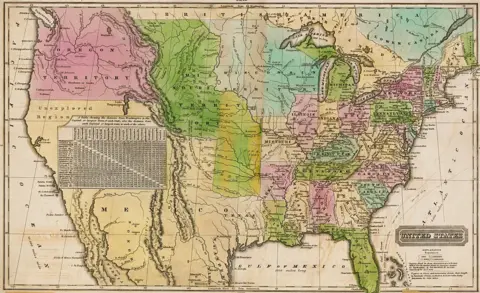
While American identity is defined by the competing cultures of those who came here from abroad, the first full century of America’s existence would include the concerted attempt to erase the culture of the indigenous people who occupied the land for centuries before the first Europeans crossed the Atlantic.
As the nation continued to expand westward, the movement took on a ideological force of its own, as some Americans believed it was the nation’s “manifest destiny” to expand not just to the Pacific but across the Western Hemisphere.
This expansionist push brought these cultures into new confluence and conflict. The interior American west, with its inhospitable landscape, was more akin to the Appalachian wilderness and attracted individuals with similarly rugged individualistic views. Along the Pacific coast, such values clashed with those of the merchants and seafarers who had relocated from the American northeast.
In the modern era, these divisions are obvious on a presidential electoral map – with Republican-controlled “red states” and Democratic “blue states”. The northeastern United States and the West Coast are known as bastions of liberalism, and much more supportive of government involvement in everyday life. While the American south, from Texas to Florida, and the interior west has become the bulwark of Republican conservatism.
 Getty Images
While the US mostly stopped expanding geographically by the end of 19th Century, the population continued to grow dramatically – in no small part due to immigration.
“One of the things that really is at the center of the United States of America is immigration,” said Richardson. “The one thing that does link us all is that concept that we can make a future that we want.”
- After 250 years the American Dream is surviving, but only just
The first wave began in the 1840s and lasted until 1889, bringing approximately 14 million people to the country’s shores, primarily from northern and western Europe nations.
The next wave, of more than 18 million migrants, came from southern and eastern Europe and stretched from 1890 into the 1920s. With each wave came an inevitable backlash, as Americans worried that the new arrivals would take their jobs and threaten their way of life. Quotas and restrictive legislation, such as the Chinese Exclusion Act, soon followed.
The 1924 Immigration Act limited immigration so drastically, that it can be discerned by a distinct bend in the chart of US annual population growth.
The most recent immigration wave began in the 1960s, when those restrictions were lifted. Since then, more than 70 million immigrants have entered the US, many from Asia and Latin America, including approximately 18 million from Mexico alone.
In 2024, 14.8% of the US population was foreign-born – an amount equaling the historical peak in 1890, according to the Migration Policy Institute. Immigration accounted for 84% of the total US population growth.
According to Woodard, the early immigration waves – driven mostly by industrialisation – helped boost the political power of the American north.
And that geographical imbalance helped further fuel ideologically divides.
Southern leaders pushed for territorial expansion – and an expansion of slave states – to ensure they maintained political power at the national level, before they broke off altogether, starting the Civil War.
But modern trends have reversed this geographical divide. Many immigrants – and northern transplants – are now drawn to the south, especially the bustling economies of cities in Texas and Florida. While a recent wave of illegal immigrants at the southern US border has heightened tensions.
Trump’s populist conservatism, then, can be seen as a response to America’s shifting centres of power.
Upon returning to the White House, Trump has delivered on his campaign promise to pursue mass deportations.
Meanwhile, he has expressed a nostalgia for the territorial expansion of the 19th Century, with talk of acquiring Greenland, repatriating the Panama Canal and adding Canada and Venezuela as “51st states”.
His version of American expansionism is thus a kind of mirror image of last 250 years of history. The country spent its first century expanding physically, then stopped trying to get new territory and focused – sometimes haltingly – on opening the nation to immigrants.
Now, Trump has changed course, with aims to expand America’s physical borders again, and limit the number of people the country lets in.
Trump and his supporters say that the character of the American nation is in danger of being fundamentally and permanently changed. “We won’t have a country anymore,” is a common Trump refrain about the dangers of mass immigration.
“That does not come out of nowhere,” said Woodard. “We have the meta struggle in American history: Are we a civic nation devoted to … a society where every individual human can be equally, universally and sustainably free over time? Or is this a state that belongs to a certain group of people that are the real Americans by blood and descent?”
In the vast stretch of world history, 250 years is a blip, a flash, a blink of the eye. But for the US, 250 years has been transformational – even if the divisions at the heart of the nation, and the concerns about its future, have been an enduring feature.

