 Getty Images
When David and Ally first saw Marcus, they knew he was destined to be their son.
“For me it was love at first sight,” said David. Their long adoption journey had come to an end. Months later, the baby from Indonesia was in their arms and the family was ready to start their life together.
But now, years later, they face the possibility of losing Marcus because he is believed to have been trafficked into Singapore.
He is one of at least 20 babies alleged to have been illegally bought in Indonesia for adoption in Singapore in recent years. Nearly two dozen people have been arrested for alleged human trafficking last year and are now on trial in West Java.
Both countries have yet to state what will happen to the children. For David and Ally, these last few months have been agonising.
The high-profile case has highlighted the enduring problem of child trafficking in Indonesia, fuelled by parents who sell their children.
It has also raised questions over how Singapore – known for its tight controls and meticulous checks – failed to detect the alleged trafficking and even approved some of the adoptions.
David and Ally agreed to share their story with the BBC on condition we use pseudonyms, as they fear jeopardising their chance to keep Marcus.
“The anxiety is always there, at the back of our minds,” said David.
“There’s always the thought that Marcus might be taken away.”
‘He smiled at us’
David and Ally had always wanted children but after Ally went through several painful miscarriages, they decided to adopt.
But they faced a long wait for a Singaporean child – with one adoption agency giving them a queue number of 142.
So they did what many Singaporeans in this situation do, and looked overseas. An estimated two-thirds of the children adopted in Singapore every year were born elsewhere, usually in neighbouring countries.
David and Ally chose a local agency that specialised in arranging adoptions of Indonesian babies.
Weeks later, they were peering at a tiny infant held up to the camera, in a video call arranged by the agency.
“What was so special about him that caught our attention? He’s very smart ! He smiled at us,” recalled David.
The couple paid tens of thousands of dollars, a sum they were told would cover agency fees, legal costs, expenses for the child, and a “token sum” for the biological parents.
Within a few months, Marcus was brought over to Singapore. The moment he was placed in their arms, “we felt nervous, scared, but happy,” said David. “We looked at each other and we said…”
“This is it, this is the real deal,” Ally finished his sentence.
Marcus’s adoption in Singapore was approved swiftly, and the final step was to apply for his citizenship. When immigration officials called them in for a meeting, they were expecting good news.
Instead, their lives were upended. They were told the citizenship application was suspended and that Marcus had possibly been trafficked into Singapore.
“That’s when I burst,” said David, who felt the Singaporean government should have done more in their checks.
“I said to them: ‘Didn’t you do your due diligence? You did all the checks, right? You put us through a tough but necessary process, that is why we abided to it’. They could not answer us.”

 BBC Indonesian
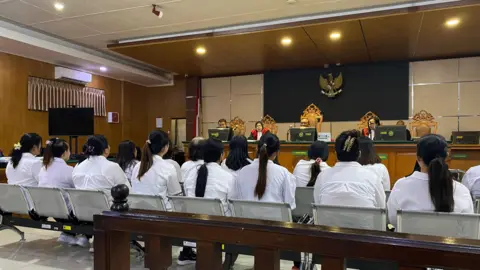
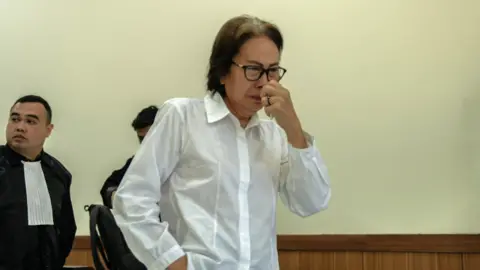
A total of 19 people are now on trial in West Java. They are accused of illegally purchasing the children and transferring them overseas for “exploitation” while forging documents to make them look like legal adoptions.
Under Indonesian law, human trafficking can be defined as paying for a person and transferring that person for the purpose of exploitation.
Indonesia also has strict rules and processes for transnational adoptions, which the defendants are alleged to have bypassed.
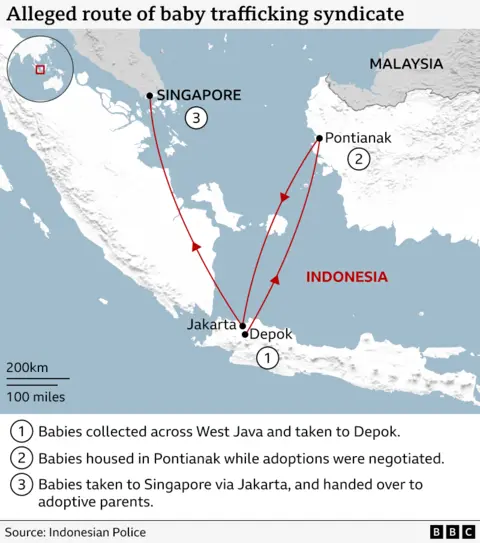
In court, it was revealed that at least 12 out of the 20 babies had already entered Singapore. Singapore authorities declined to confirm these figures with the BBC.
Prosecutors allege that an Indonesian woman named Lie Siu Luan, who is among those on trial, is the ringleader.
She has admitted supplying babies for adoption to at least four Singaporean contacts who promised to pay at least 18,000 Singapore dollars ($14,000; £10,300) for each baby.
Lie is accused of recruiting people to act as brokers, source babies, take care of the infants, and forge documents.
The brokers were said to have trawled social media looking for parents interested in giving up their babies for adoption. In one case, a broker allegedly posed as a woman looking to adopt a baby to convince a man to give up his newborn son.
Once procured, the infants were taken to a house in Pontianak where they were taken care of by hired nannies. Lie also allegedly hired someone specifically to forge birth certificates and adoption documents.
Some members of the trafficking ring allegedly pretended to be the babies’ biological parents on paper. Not only were their names listed in the fake documents, they would also get on video calls with prospective adopters.
Prosecutors are asking for jail sentences ranging from five to ten years for the defendants.
 BBC Indonesian
David and Ally have yet to receive official confirmation from authorities that Marcus is one of the allegedly trafficked babies. But the BBC has found clear signs, which have been shared with the couple.
Going through court documents, we found Marcus’s full Indonesian name listed as one of the allegedly trafficked babies.
One woman on trial, who is accused of falsely declaring she is the biological mother of some of the babies, is listed as Marcus’s mother in his Indonesian adoption papers.
Separately, the Indonesian branch of Interpol has identified the Singaporean adoption agency that handled the babies. It is the same agency that offered Marcus to David and Ally.
The agency is still registered as a live business in Singapore. The BBC tried contacting the agency’s owner but has yet to receive a response.
Singapore’s Ministry of Home Affairs (MHA) declined to respond to the BBC’s questions on whether it was investigating the agency and Lie Siu Luan’s alleged Singapore collaborators, noting that Indonesian court proceedings were still ongoing.
It pointed the BBC to to previous statements where the MHA, along with the Ministry of Social and Family Development (MSF), said they were working with Indonesian counterparts to assist investigations.
Since news broke of the latest case, lawmakers have repeatedly raised it in parliament.
One pointed out that the children’s adoptions had been approved based on government officers’ recommendations, and that the adoptive parents “are innocent parties that have done every step in accordance with the law”.
But the MSF argued that adoption agencies are responsible for ensuring their babies come from “appropriate sources” and must do rigorous checks, and that adoptive parents must also do their due diligence.
David and Ally say the possibility that Marcus could have been trafficked never once crossed their minds.
They said they tried their best to do their own background checks but were limited in their lack of knowledge. It was, after all, the first time they had ever adopted a child.
The couple argue that the onus is on the Singapore government, given that its officials had done thorough checks on them during the approval process for Marcus’s adoption.
“The [officials] are the experts on this, to see whether this is legitimate. They deal with so many adoptions, day in day out. Not us,” said Ally.
The MSF declined to answer the BBC’s questions on whether it did any checks on the babies who entered Singapore and how it usually conducts checks on the adoptions of foreign children.
It pointed to previous statements saying it was providing support to the affected parents and there were “some delays” in processing citizenship applications for their children.
The ministry has also promised to conduct a review of adoption processes.
Black market for babies
In Indonesia, this case is one of at least seven suspected baby trafficking syndicates investigated by authorities in the last few years. One of these syndicates that operated out of Yogyakarta allegedly handled at least 66 babies.
Official figures show the number of trafficked young children nearly tripled between 2021 and 2024, from 27 to 70 children. These only account for cases they have tracked, with the actual number likely to be much higher.
While some parents were allegedly coerced by traffickers into selling their babies, others were willing to do so because they could not afford to raise their children or needed money.
During the West Java trial, a witness named Dani Hidayat said he was bankrupt and jobless when his wife was about to give birth to their fifth child, and their “financial and economic situation was not ready”.
Hidayat joined a Facebook group for adoptions, and was approached by a woman claiming she could not have children. They agreed she could adopt his baby once the child was born.
The woman gave Hidayat five million rupiah ($290; £214) and promised him two million more. Hidayat said he needed the money for his wife’s recovery.
The woman is alleged to be a broker for the trafficking ring – and it was Hidayat who ended up exposing them.
When he failed to receive his second payment, he went to the police alleging his son was abducted. Police caught the woman and, upon inspecting her phone, found she had procured dozens more babies for adoption in Singapore and Indonesia.
Hidayat’s son was eventually located and is currently in the care of social services. The child was not one of the 20 babies bound for Singapore.
Officials and activists say more must be done to address the root causes that drive parents to sell their children.
These include poverty, inadequate support for mothers, a lack of access to state help, and the cultural stigma of having children outside of marriage.
There is also a more informal attitude towards adoption in rural parts of Indonesia, where it is culturally acceptable for young children to be given away to relatives or neighbours without formal adoption processes.
Some of those involved in trafficking thus tend to portray their actions as altruism.
The defendants in the West Java case have argued they were “helping families” and were unaware that what they did was illegal.
In court, Lie Siu Luan said she “didn’t know it was wrong” to send the babies overseas for adoption and said her Singapore partner had led her to believe that it was above board.
“It’s not just a matter of finding out who’s selling the babies and then punishing them,” said Eko Kriswanto, a child rights activist based in West Java.
The main problem is that “children end up being treated as commodities. So what must be explored is the cause.”
While Indonesia has numerous laws that protect children and outlaw trafficking, the lack of consistent enforcement is still an issue, Kriswanto added.
Ai Rahmayanti, the head of the independent rights body Indonesian Commission for Child Protection, noted that “the state has not built the capacity to provide safe spaces or services” to surrender unwanted children. Facilities like these, known as “baby boxes”, are rare in Indonesia.
A black market has sprung up in the vacuum, where traffickers “openly use social media to offer solutions to people’s problems: free childbirth, go home with money, while the baby comes with them,” said Rahmayanti.
The BBC has asked Indonesia’s Ministry of Women Empowerment and Child Protection for a response to Rahmayanti and Kriswanto’s comments, and what it is doing to tackle child trafficking. It has yet to respond.
Babies’ fate hang in the balance
As David and Ally anxiously await the verdict of the trial, one key question remains unanswered – what will happen to Marcus and the other babies.
Indonesian rights activists and officials argue that as a matter of principle the allegedly trafficked children should be returned to their biological parents.
One Indonesian police official even told the BBC that it was a matter “of Indonesia’s national pride”.
But by the time the trial ends and a decision is made on the children’s fate, they would have spent years in the care of their adopted parents in Singapore.
Jeremy Heng, a senior clinical psychologist with the Singapore Children’s Society, said the stress of multiple disruptions early in a child’s life could “negatively affect brain development, emotional regulation, learning and attachment security”.
There would also be increased risks of trauma-related symptoms and mental health difficulties, he added.
Singapore authorities declined to comment when asked if the babies would stay or return to Indonesia.
Indonesia’s foreign ministry spokesperson Yvonne Mewengkang told the BBC that they would prioritise “child protection based on the principle of the best interests of the child”.
After waiting so long for a child, David and Ally are not about to let go of Marcus that easily.
“We will go to whatever lengths we can legally abide to, to keep our child,” David said.
If Marcus has to return to Indonesia, David said he would find a way to adopt the boy legally.
“I will not give up on him,” vowed David. “Any parent would fight till the end.”
Additional reporting by Yulia Saputra and Aseanty Pahlevi for BBC Indonesian.