
 Reuters
The US launched a new attack on Iran on Sunday evening, continuing days of strikes between the two countries. Iranian state media reported that the strikes killed one person in southwestern Iran, while four were injured.
Within hours of the fresh US strikes, Iran’s Islamic Revolutionary Guard Corps (IRGC) said it had struck US military bases in Kuwait, Jordan and Bahrain.
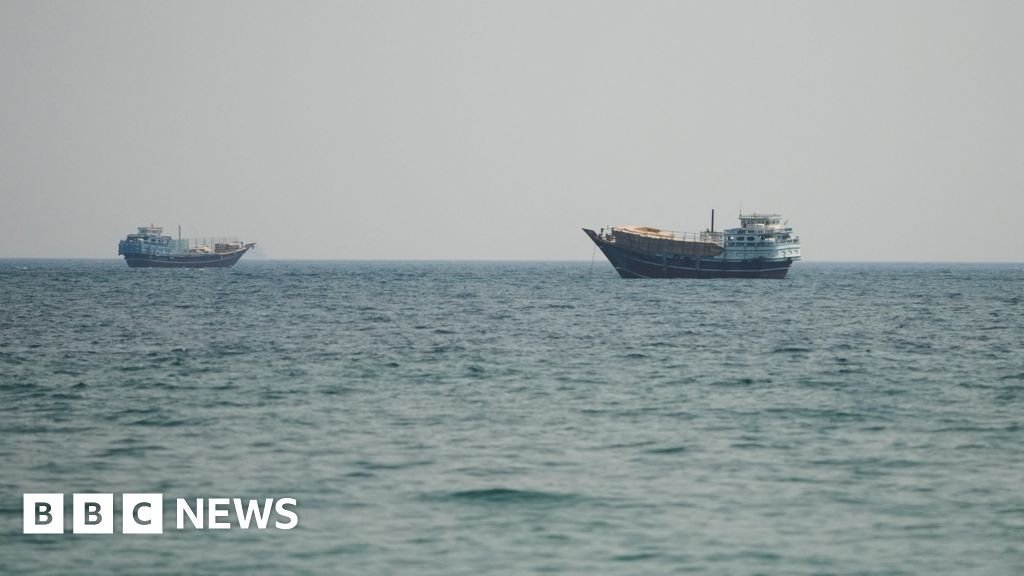
The escalating attacks, which cast doubt over the future of the interim US-Iran agreement signed in June, come amid conflicting claims over whether the Strait of Hormuz is open.
Iran says it has closed the key waterway until further notice, while the US insists it is open.
Dozens of Iranian military targets, including air-defence systems, coastal radar sites, and missile and drone capabilities were struck, it said later.
US forces were “prepared to ensure that freedom of navigation remains available to commercial shipping despite Iran’s continued unwarranted aggression, harassment, threats, and arbitrary declarations,” Centcom said.
Minutes before the initial Centcom announcement, Iranian state TV reported explosions in Sirik, Qeshm, Bandar Abbas and Jask.
“Following the attack of the American enemy on Monday morning… one person was martyred and four others were injured,” IRNA reported, citing the deputy governor for security and law enforcement in Khuzestan province, Valiollah Hayati.
Oil prices jumped on Monday in Asia. Brent crude was up by 4.3% at $79.26 (£59.22) a barrel, while US-traded oil also rose by 4.3% to $74.50.
Energy prices on global wholesale markets have swung wildly in recent months as traders reacted to developments in the conflict.
Shortly after the US and Israel attacked Iran on 28 February Tehran effectively closed the Strait of Hormuz, through which around 20% of the world’s oil and liquefied natural gas (LNG) usually passes.
Despite the latest gains, prices are well below the more than $120 a barrel mark Brent reached at the end of April.
The new wave of US strikes on Sunday evening, came after US forces hit 140 Iranian military targets, Centcom said on Saturday evening.
Iran’s Islamic Revolutionary Guard Corps (IRGC) responded to those strikes with wide-ranging attacks on US bases and allies across the region, marking an escalation in the scale of hostilities.
Among those targeted by Iran were Qatar, a mediator in ceasefire talks which had not been attacked since April, and the UAE, which had not been attacked since May. The BBC has approached US Central Command (Centcom) for comment on an attack in Jordan.
The renewed fire has put in jeopardy an interim ceasefire agreement signed last month, which aimed to reopen the strait and eventually bring a permanent end to the conflict.
Earlier this week, US President Donald Trump declared the Iranian attacks meant the ceasefire was over, while Iran’s Foreign Minister Abbas Araghchi accused the US of violating the deal.
However, Trump said talks would still continue and mediators were trying to revive the process.
On Sunday, US Central Command insisted the Strait was open, warning the US military was in position to make sure it stayed free-flowing.
Additional reporting by Goncheh Habibiazad.
