
 Getty Images
US President Donald Trump has vigorously defended his economic policies in Michigan – a state hit hard by his tariffs, particularly in the automobile sector.
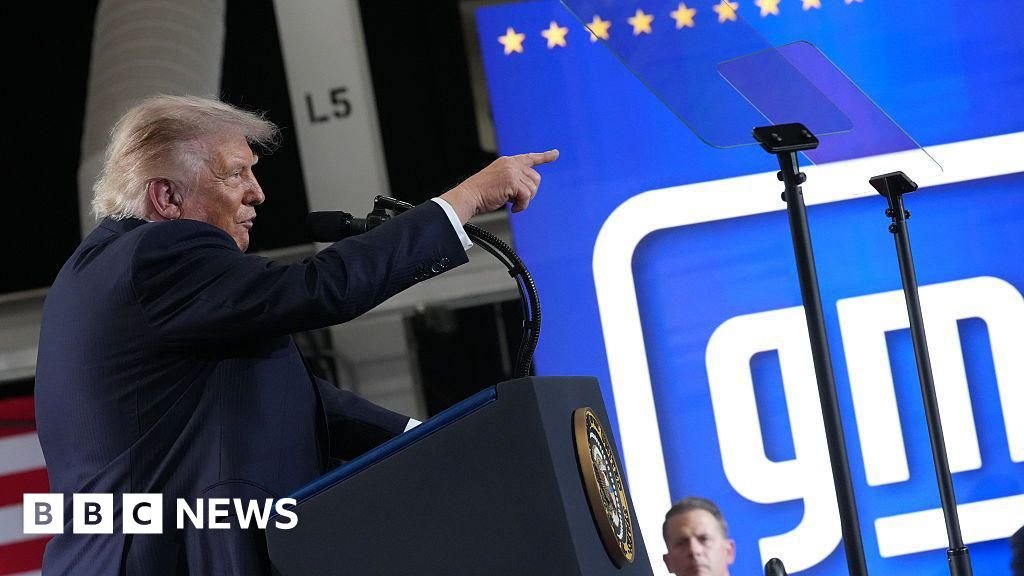
Speaking at a General Motors plant in the town of Milford, Trump claimed his “historic” tariffs are reinvigorating the auto industry and forcing companies to relocate their overseas operations to the US.
Job growth in Michigan, however, has slowed to a crawl and the state has one of the highest unemployment rates in the country.
Trump’s comments come as he ramps up rally-type appearances ahead of the upcoming midterms in November.
There is a 25% levy on non-US content on Canadian-assembled passenger vehicles, as well as parts that don’t fall under the current North American free trade pact, or USMCA. There are also steel tariffs, which indirectly affect the industry.
These will only rise if the US follows through with a planned increase to 50% on some Canadians goods, including autos, in August.
Canada has responded with 25% tariffs on US vehicles and content not compliant with the USMCA.
“The rule is straightforward: Build your trucks or cars outside the United States and you’ll pay a fee for the right to sell them here and profit,” Trump said on Monday.
“Build your plant in Michigan or anywhere else in America and produce the vehicles right here at home, and you’ll face no tariff at all,” he added.
As evidence that Trump’s economic policies are working, the White House earlier on Monday pointed to GM’s $6m (£4.5m) investment in US manufacturing, as well as smaller investments by Ford, Stellantis and Detroit Diesel.
What tariffs has Trump introduced and why?
‘Everything on the table’ including retaliation as Canada plans response to US tariffs
Last year, vehicle production fell in all three North American countries, though Canada saw the largest decline of 5.4%, according to an analysis by TD Bank, and automakers have begun to make changes to their production lines.
The impact of those tariffs, along with inflation and rising gas prices stemming from the Iran war, have prompted alarm in many communities in Michigan and across the country.
Statistics from the Bureau of Labor Statistics, or BLS, show that in the 12 months leading up to June this year, Michigan gained just 500 jobs, compared to 177,900 in Texas.
State officials also put Michigan’s unemployment rate at 5.1% in May, a slight uptick from April. Only a handful of states – which also include Illinois, Nevada, California, Connecticut, Oregon and Washington – stood at 5% or higher.
Trump, however, repeatedly lauded his economic policies and the impact they are having on the state’s auto workers.
“Now, at long last, Michigan finally has a president who stands up for Michigan autoworkers,” Trump told the assembled GM workers, blaming any lingering woes on “globalist” US politicians he believes “sold out” American workers.
The president’s visit to Michigan coincided with the opening of the new Gordie Howe International Bridge, a span between Detroit and Windsor, the auto manufacturing capitals of each country.
The first commercial truck – carrying auto parts headed into Michigan – crossed the bridge just hours before Trump’s event.
