Close Menu
    What's Hot

    Pakistan restricts international media reportingAnyone working for foreign media, including Pakistanis, will now need permission to report from anywhere outside three major cities.6 hrs agoAsia

    August 5, 2026

    UN rights chief alarmed by rise in Iran executions since MarchVolker Türk says 56 people have been executed on national security-related charges, including 27 in cases linked to January's protests.1 hr agoMiddle East

    August 5, 2026

    What can scientists learn from a stray SpaceX rocket hitting the Moon?While the collision was an accident, it is a unique scientific gift for planetary geologists that could provide important data for future space missions.3 hrs agoUS & Canada

    August 5, 2026
    Facebook X (Twitter) Instagram
    • Politics
    • Economy
    Facebook X (Twitter) Instagram
    Gulf News Week
    Subscribe
    Wednesday, August 5
    • Home
    • Politics
      • Europe
      • Middle East
      • Russia
      • Social
      • Ukraine Conflict
      • US Politics
      • World
    • Region
      • Middle East News
    • World
    • Economy
      • Banking
      • Business
      • Markets
    • Real Estate
    • Science & Tech
      • AI & Tech
      • Climate
      • Computing
      • Science
      • Space Science
      • Tech
    • Sports

      Dominant PSG put Liverpool on the brink with 2-0 Champions League quarter-final first-leg win

      April 9, 2026

      Dubai Basketball U-18 Elite Crowned Basket Cup Sarajevo 2026 Champions in Historic Debut

      April 6, 2026

      Saudi boxing crowns 20 champions as Kingdom’s Elite Belt concludes in Riyadh

      April 4, 2026

      “He Signed for a Real Fight”: Pacquiao Contradicts Mayweather Over Rematch Status

      April 3, 2026

      Arsenal Hold Off Chelsea Fightback to Reach Women’s Champions League Semi-Finals

      April 2, 2026
    • Health
    • Travel
    • Contact
    Gulf News Week
    Home»Most Viewed News»What can scientists learn from a stray SpaceX rocket hitting the Moon?While the collision was an accident, it is a unique scientific gift for planetary geologists that could provide important data for future space missions.3 hrs agoUS & Canada
    Most Viewed News

    What can scientists learn from a stray SpaceX rocket hitting the Moon?While the collision was an accident, it is a unique scientific gift for planetary geologists that could provide important data for future space missions.3 hrs agoUS & Canada

    Gulf News WeekBy Gulf News WeekAugust 5, 2026No Comments5 Mins Read
    Share Facebook Twitter Pinterest Copy Link LinkedIn Tumblr Email VKontakte Telegram
    What can scientists learn from a stray SpaceX rocket hitting the Moon?While the collision was an accident, it is a unique scientific gift for planetary geologists that could provide important data for future space missions.3 hrs agoUS & Canada
    Share
    Facebook Twitter Pinterest Email Copy Link
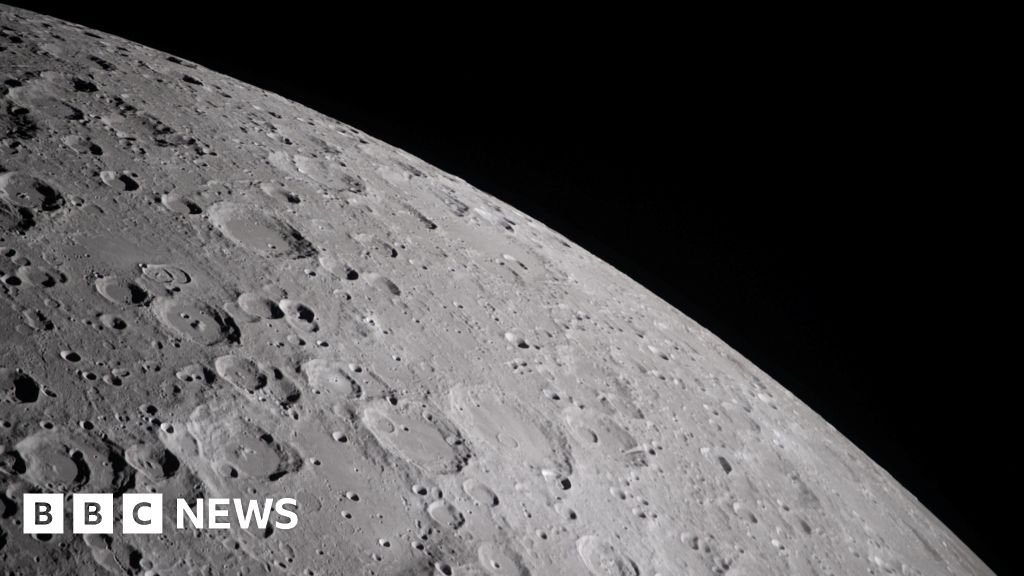
    Reuters A cratered section of the moon is seen close-upReuters
    The last time it was confirmed that part of a rocket had collided with the Moon by accident was in 2022

    A stray SpaceX rocket is believed to have crashed into the Moon, forming a crater near a famous lunar landmark and giving scientists a unique research opportunity that could help future missions.

    The empty upper stage of a Falcon 9 rocket was due to strike the Moon near the Einstein crater at a speed of about 5,400mph (8,700km/h) on Wednesday.

    The short, dramatic flash it created would have been hard to catch by amateur astronomers even with high-end telescopes, but larger observatories in the Americas are analysing the information.

    It could be days or even weeks before the full picture of what happened and what we can learn from it is known – but for planetary geologists, this accidental collision is a scientific gift.

    Space X’s Falcon 9 rocket is a reusable model and has been sent into space on several missions. Its design allows part of the rocket to return to Earth, but other sections are shed in space.

    The rocket blasted off from Florida in January last year, carrying two lunar landers into space.

    Its job was to fire the upper stage hard enough to send both of the landers out of Earth’s orbit and onto a path towards the Moon – mission accomplished.

    The spent stage – which is about the size of a five-storey building and weighs at least 4,000kg – was left drifting in a long, looping orbit that swung out towards the Moon and back again.

    Over the next 18 months, the gentle gravitational tug of the Earth, Moon and Sun, along with even light from the Sun, gave a faint push.

    Astronomers tracking the rocket part eventually worked out that those small nudges had put it on a course towards the Moon and was picking up speed every day.

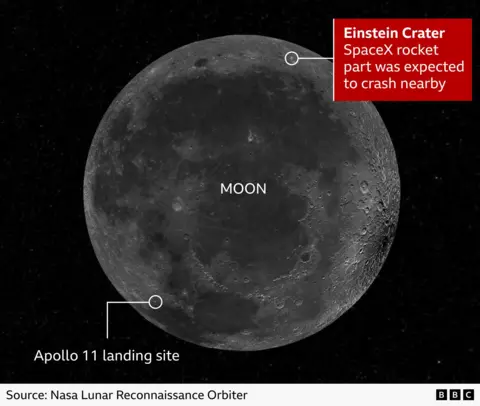
    A picture of the moon, showing the Apollo 11 landing site on the south-west section, and the Einstein Crater, where the SpaceX rocket part was due to crash nearby, on the northern section shown.

    The impact at around 07:35 BST (06:35 GMT) on Wednesday happened in broad daylight for many parts of the world, but the tiny flash it produced would have been far too faint to see, even through a telescope.

    Amateur astronomers observing in darkness would also have had little realistic chance of seeing the flash, given that it would have lasted a fraction of a second and occured on a part of the Moon bathed in daylight. And so it may also have been hard for them to see a plume of dust stretching as far as 100km (62 miles) that lasted for several minutes.

    Even spacecraft orbiting the Moon were not in the right place at the right time to watch the impact happen live. South Korea’s Danuri orbiter had the best chance, having passed near the crash site shortly beforehand. Its team has told Korean media that any footage will only be released once researchers have completed their analysis.

    Over the next few days, Nasa’s Lunar Reconnaissance Orbiter will be in position to photograph the site, allowing images before and after the crash to be compared.
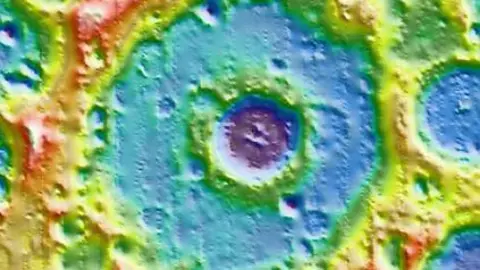
    NASA The Einstein crater, seen in a colourful image, with a smaller crater withinNASA
    The Einstein crater is over 180km (112 miles) wide, and is large enough to contain a smaller crater inside

    The science and probably the first images might come from powerful telescopes in the Americas where the sky was still dark. Even then, turning the detection of a 14m object hitting a daylight part of the lunar surface i385,000km away won’t be easy but not impossible.

    Image processing to clean up the picture can take hours, days or even weeks, as scientists check and process the data.

    But the sight of the new crater from the orbiting spacecraft will be eagerly anticipated. Because researchers already know the rocket’s exact size, speed and point of impact, this collision turns from being a random accident into a rare, controlled experiment.

    It is a dream moment for planetary scientists because it lets them test their models of how impacts dig out craters, throw debris across the surface, and send tremors through the Moon’s interior.

    That has real practical value.

    Understanding how much rock and dust an impact throws up will help engineers design safer landers and future Moon bases, working out how far flying debris can travel and how hard the ground might shake nearby.
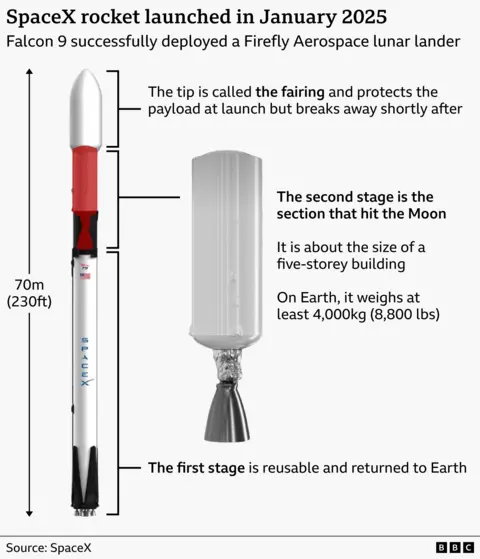
    Annotated graphic of a SpaceX Falcon 9 rocket used to launch a Firefly Aerospace lunar lander in January 2025. The rocket is shown as 70 metres (230 feet) tall and divided into three sections: the fairing at the top, which protects the payload during launch before breaking away; the second stage, highlighted and described as the portion expected to crash on the Moon; and the reusable first stage, which returns to Earth after launch. A separate illustration of the second stage notes that it is about the size of a five-storey building and weighs at least 4,000kg (8,800 lbs) on Earth.

    Material thrown up from beneath the surface offers fresh clues about the Moon’s geology, adding to what scientists already know about how the Earth-Moon system formed some 4.5 billion years ago.

    This is not the first time a human-made object has struck the Moon. Since 1959, dozens of spacecraft have crashed into it, some by accident and many deliberately for science.

    The Soviet probe Luna 2 was the first, followed over the decades by Nasa’s Ranger probes in the 1960s, several Apollo-era rocket stages, and more recently the LCROSS mission in 2009, which was deliberately crashed to search for water ice.

    The last confirmed accidental impact, in 2022, was thought to be the leftover booster from a Chinese lunar mission launched back in 2014 – a reminder that this sort of space debris has been quietly piling up above our heads for well over half a century.

    The space junk clean-up!

    What will happen when a SpaceX rocket collides with the Moon?

    Abandoned rocket ‘hits the Moon’ – scientists

    Space exploration
    Nasa
    The Moon
    SpaceX
    Share. Facebook Twitter Pinterest LinkedIn Tumblr Email Telegram Copy Link
    Gulf News Week

    Related Posts

    Most Viewed News

    Pakistan restricts international media reportingAnyone working for foreign media, including Pakistanis, will now need permission to report from anywhere outside three major cities.6 hrs agoAsia

    August 5, 2026
    Most Viewed News

    UN rights chief alarmed by rise in Iran executions since MarchVolker Türk says 56 people have been executed on national security-related charges, including 27 in cases linked to January's protests.1 hr agoMiddle East

    August 5, 2026
    Most Viewed News

    Drone carrying explosives found at German airport, police sayThe drone was found in the cargo area near a Ukrainian aircraft before another suspected object collided with a cargo aircraft in mid-air.15 mins agoEurope

    August 5, 2026
    Most Viewed News

    Record heatwave in South Korea as temperatures soar to 42.5CThere have been at least 19 deaths related to the heatwave which has brought the country's hottest day since records began.33 mins agoAsia

    August 5, 2026
    Most Viewed News

    Key questions as Infantino faces Fifa executivesFifa president Gianni Infantino will face senior leaders of football's world governing body on Wednesday. This is what is expected to happen.53 mins agoFootball

    August 5, 2026
    Most Viewed News

    Riders' clothing checked at Tour de France Femmes over bra padding concernsOfficials at the Tour de France Femmes Avec Zwift will check the clothing worn by riders to prevent attempts to make "aerodynamic gains". 2 hrs agoCycling

    August 5, 2026
    Add A Comment
    Leave A Reply Cancel Reply

    Editors Picks

    Pakistan restricts international media reportingAnyone working for foreign media, including Pakistanis, will now need permission to report from anywhere outside three major cities.6 hrs agoAsia

    August 5, 2026

    UN rights chief alarmed by rise in Iran executions since MarchVolker Türk says 56 people have been executed on national security-related charges, including 27 in cases linked to January's protests.1 hr agoMiddle East

    August 5, 2026

    What can scientists learn from a stray SpaceX rocket hitting the Moon?While the collision was an accident, it is a unique scientific gift for planetary geologists that could provide important data for future space missions.3 hrs agoUS & Canada

    August 5, 2026

    Drone carrying explosives found at German airport, police sayThe drone was found in the cargo area near a Ukrainian aircraft before another suspected object collided with a cargo aircraft in mid-air.15 mins agoEurope

    August 5, 2026
    Latest Posts

    Pakistan restricts international media reportingAnyone working for foreign media, including Pakistanis, will now need permission to report from anywhere outside three major cities.6 hrs agoAsia

    August 5, 2026

    UN rights chief alarmed by rise in Iran executions since MarchVolker Türk says 56 people have been executed on national security-related charges, including 27 in cases linked to January's protests.1 hr agoMiddle East

    August 5, 2026

    Drone carrying explosives found at German airport, police sayThe drone was found in the cargo area near a Ukrainian aircraft before another suspected object collided with a cargo aircraft in mid-air.15 mins agoEurope

    August 5, 2026

    Subscribe to News

    Get the latest sports news from NewsSite about world, sports and politics.

    Advertisement
    Demo
    Gulf News Week

    Your source for the serious news. This demo is crafted specifically to exhibit the use of the theme as a news site. Visit our main page for more demos.

    We're social. Connect with us:

    Facebook X (Twitter) Instagram Pinterest YouTube
    Latest Posts

    Pakistan restricts international media reportingAnyone working for foreign media, including Pakistanis, will now need permission to report from anywhere outside three major cities.6 hrs agoAsia

    August 5, 2026

    UN rights chief alarmed by rise in Iran executions since MarchVolker Türk says 56 people have been executed on national security-related charges, including 27 in cases linked to January's protests.1 hr agoMiddle East

    August 5, 2026

    What can scientists learn from a stray SpaceX rocket hitting the Moon?While the collision was an accident, it is a unique scientific gift for planetary geologists that could provide important data for future space missions.3 hrs agoUS & Canada

    August 5, 2026

    Subscribe to Updates

    Get the latest creative news from FooBar about art, design and business.

    © 2026 Gulf News Week. Designed by HAM Digital Media.
    • Home
    • Politics
    • Economy
    • Sports

    Type above and press Enter to search. Press Esc to cancel.