

 Getty Images
Many will have experienced it – that feeling at 3pm when all you want to do is go to bed and sleep like a log.
Or, finding yourself wide awake at 3am, brain whirring and no prospect of sleep.
Jet lag – the world’s most annoying holiday souvenir – is the price we pay for flying off around the globe on travels or holidays.
So how does it work, and what can you do about it?
Jet lag is what you feel when local time changes abruptly, but your body clock is playing catch up, says Dr Nina Rzechorzek, who leads research at the University of Cambridge on human brain temperature, sleep, and circadian rhythms.
“After rapid travel across several time zones, your internal biological time initially stays aligned with home while you are trying to sleep, eat, and function on destination time.
“That mismatch can cause disturbed sleep, daytime sleepiness, poor concentration, irritability, reduced performance, and digestive problems,” she says.
And jet lag is closely linked to what are called our circadian rhythms – the body’s internal body clock.
“Almost all the cells in our body maintain their own 24-hour clock, which are synchronised by a master clock in the brain,” explains Dr Anna Edmondson, of the Laboratory of Molecular Biology at the University of Cambridge.
“The master clock is set to environmental timing cues, one of the most important cues being daily cycles in sunlight and darkness. However, if the timing of the sunlight/darkness cycles suddenly change (you fly far east or west), then it takes several days for the master clock to adjust to the new time, leading to jet lag.
“So effectively, it’s like your body is still stuck in the timezone of where you’ve just flown from.”

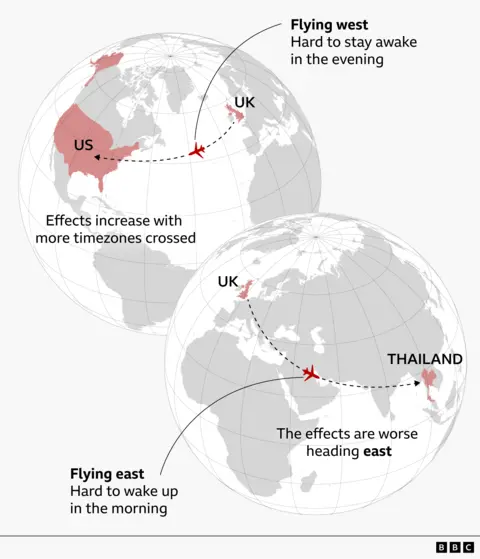
The direction of travel also makes a difference, says Rzechorzek.
“Travelling east is often harder, because most people find it easier to shift their clock later than earlier. That quirk is partly because the average human internal cycle is slightly longer than 24 hours, giving us a modest natural bias towards delaying rather than advancing our timing.”
Get sun, go for a walk, good sleep hygiene
So what can we do about it?
Well the bad news is there’s no cure, but it is possible to mitigate it.
“There are many ways to set the clock that we can control, including light, food, and exercise,” says Dr Tatiana Wilson, another circadian researcher at Newnham College, Cambridge University.
Here are some of her top tips:
- Light in the morning sets your clock earlier, light in the evening makes you stay awake later – use this to expose yourself to natural light at the correct time
- Exercise like walking during the day will also reinforce your new time zone. Indoor light is much dimmer than natural light, even on a cloudy day, so try to go outside at the correct time of day to set your clock
- Eat during the day and avoid food at night several hours before bed. Eating late at night can push back the release of the hormone melatonin, which helps to make us feel sleepy
- Some people swear by sleep aids like melatonin, but Edmondson says it is a prescription drug in the UK and to only use it if prescribed by a healthcare professional
- Wilson says even if you can buy melatonin over the counter when you reach your destination, you may not know quite what you’re getting. “The dose in the supplements can vary significantly from what is stated on the packaging,” she says
- Try to go to bed at your desired time and practise good sleep hygiene – keep light levels low before bed, make sure your room is dark and cool, and practise your usual bedtime routine

