
 Getty Images
Spain has threatened to impose counter-measures on Italy if it fails to lift border controls introduced following the mass crossing of migrants into the Spanish exclave of Ceuta.
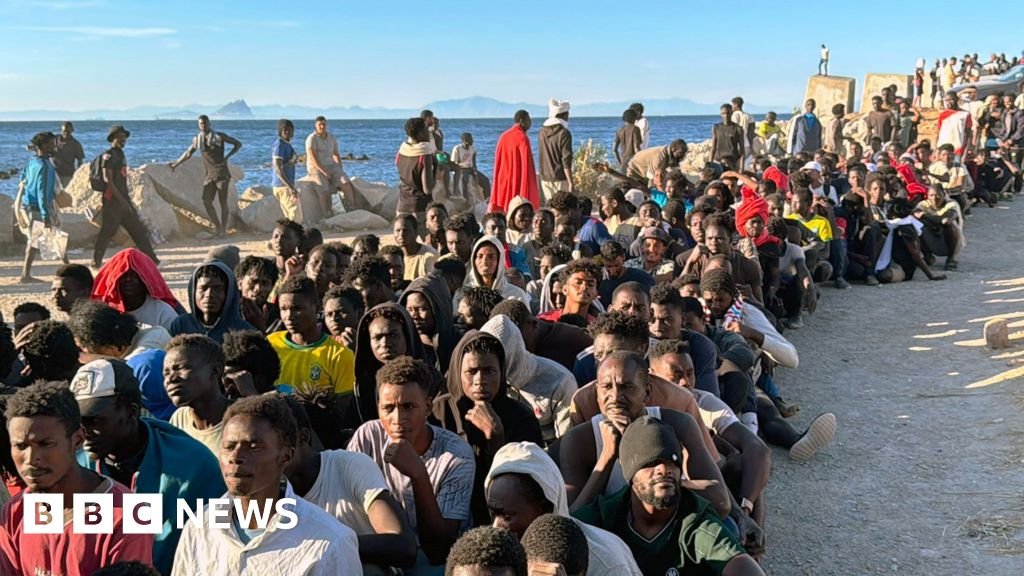
Roughly 78,000 migrants from neighbouring Morocco arrived in Ceuta by sea in a matter of hours on Thursday and Friday last week.
In the wake of the crossings, which saw around 100 people die, Italy partially suspended its Schengen arrangement with Spain, which included the closure of maritime and air entry points as well as the reinforcement of land border controls.
On Friday, Spain called the move “unjustified” and “discriminatory against the Spanish population” and demanded it be reversed by Sunday 9 August.
The statement did not specify what these reprisals would be.
Italy promptly responded to Spain’s warning, saying it would not accept “ultimatums or impositions” from Madrid and that it plans to keep border checks in place until at least 15 August – when it says Spain “expects a new wave of migration” to hit Ceuta.
Spain has not announced an anticipated second wave of crossings. Reports have been fuelled by social media activity by Moroccan users planning another attempt, El Pais reports.
The Spanish prime minister’s office told the newspaper they were monitoring the situation but did not expect a repeat of scenes from last week.
Italy, which does not share a land border with Spain, said its decision to partially suspend the EU’s border-free Schengen arrangements was to prevent any of the migrants who had entered Ceuta from travelling on to Italy.
Madrid dismissed this position, saying it was based on “spurious arguments” that lacked any basis in fact because the migrants who entered Ceuta had no way of entering the Schengen area. It added the vast majority of migrants have already returned to Morocco.
Last week’s crossings marked a new low in relations between Spain’s socialist leader Pedro Sanchez and Italy’s conservative leader Giorgia Meloni – who has long called for stricter migration rules in the EU.

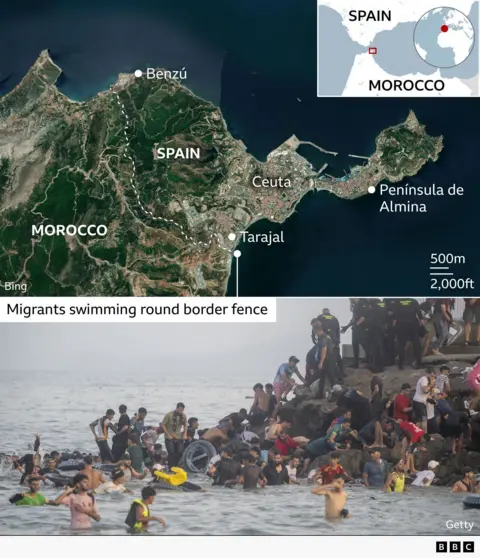
It remains unclear exactly why tens of thousands of migrants attempted to cross into Ceuta, but the EU’s Migration Commissioner Magnus Brunner has suggested criminal networks spreading disinformation were to blame – an assertion the Spanish government has agreed with.
The crossings came after Spain’s Supreme Court ruled that migrants stopped at sea while trying to reach Ceuta or Melilla cannot be summarily returned to Morocco.
The two exclaves have long been a bone of diplomatic contention between Spain and Morocco, which does not recognise Spanish sovereignty over them.
The number of people swimming to Ceuta at once has raised questions about why Morocco’s border guards did not attempt to stop them
The Ceuta crossings have also caused a diplomatic rift among EU nations that share open borders as part of the Schengen area.
Italy’s decision to suspend its agreement was backed by Finland and Denmark, while the Czech Republic called for Spain’s membership to be temporarily suspended.
Morocco, for its part, has laid blame for the crisis on Spain’s Supreme Court, with an unnamed government source briefing local outlets that “the deterrent element of the system collapsed and the dam gave way, not under the weight of the criminals, but of a judge’s decision”.
Meanwhile, Moroccan media is reporting fresh online calls to co-ordinate another mass border-crossing attempt, similar to what was seen before the influx last week.
Nearly 1,400 minors, some of them “very young boys and girls”, still remain in Ceuta following last week’s crossings, Spanish Youth Minister Sira Rego said on Friday.
She added: “There was a situation in which the system was overwhelmed, but it is now being brought under control. It is true that there are many boys and girls, and the procedure takes time.
“We wanted to make clear that we have prioritized the most vulnerable cases.”
