
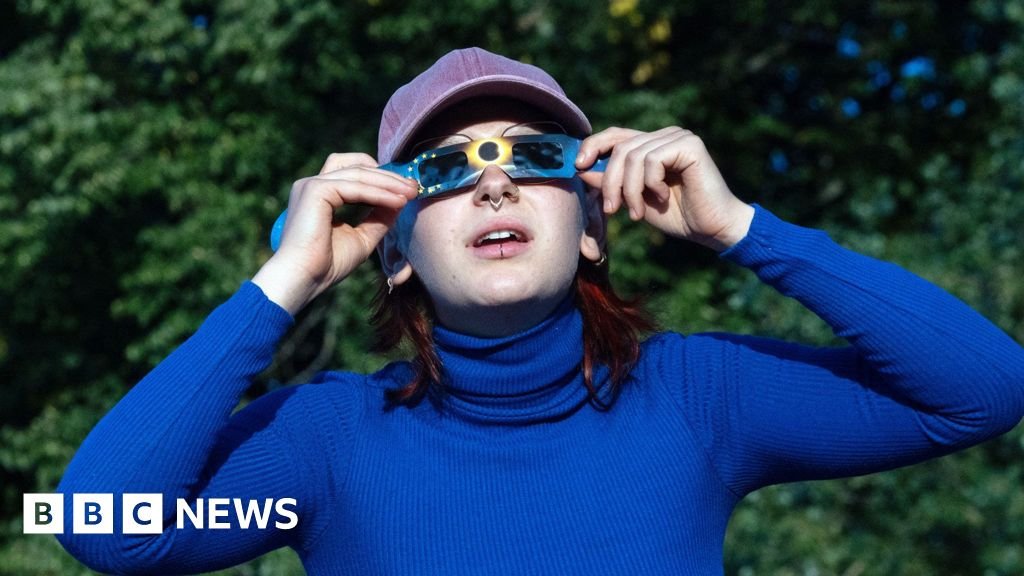
Eye experts are warning people to be on the alert for any signs their vision has been damaged by looking at the sun during Wednesday’s eclipse.
The symptoms can include blurred vision, a central blind or dark spot and increased sensitivity to light.
After the previous total eclipse of the sun that was visible in the UK in 1999, around 70 people were left with damaged sight.
Many of them had spent less than a minute looking at the spectacle, without realising they were harming their eyes.
The sun is incredibly bright, even when partially obscured by the moon.
Normally if we stare at it, we wince and quickly look away.
But when it is darker, during an eclipse, that instinct may not kick in, even while our eyes are being damaged.
The bright light and ultraviolet radiation given off by the sun can lead to a condition known as “solar retinopathy”.
And because the retina has no pain receptors, it’s hard for people to notice the damage as it happens, so symptoms may only appear several hours later.
Leading up to the eclipse itself, experts were warning only genuine specially-designed solar eclipse glasses should be used, and that ordinary sunglasses or other devices were not enough to prevent potential damage.
What to look out for?
Alexander Ionides, a consultant eye surgeon at Moorfields Eye Hospital in London says if you have damaged your eyes, the symptoms will start to come on within a few hours.
“It’s a central spot in the visual field, whatever you’re looking at, if you’re looking at someone’s face, or the writing of the page or the clock on the wall, you may have a distortion.
“It’ll be a grey or a yellow or a dark spot right in the very centre of your vision.
“It doesn’t hurt, there’s no pain like what a burn might be considered to be like, and it can just very gradually come on.”
Other symptoms to be aware of include:
- Eye pain
- Redness
- Grittiness or irritation
- Sudden changes in sight
- Increased sensitivity to light
Ionides says if you think you have damaged your eyes, you should seek urgent medical attention.
“There are different ways to get the eyes checked out in the UK, you can always go to a local optician, they’re very well equipped now,” he added.
“They can do retinal scans to look for any solar retinopathy, which is the damage to the retina from looking at the eclipse.
“And also they can refer you on to the local eye unit. There are local eye casualties as well. And most hospitals will have an eye doctor on call.”
Because of the delay in symptoms developing it is not yet possible to say if anyone has experienced any damage to their eyes.
A partial eclipse like the one the UK experienced on Wednesday meant the sun was still pretty bright, so far fewer people may have tried to stare at it directly.
Ionides says compared to 1999, so far fewer people have contacted his hospital.
“Back in 1999, the switchboard and the casualty were inundated with many, many people coming along worried, or having had some damage.
“But so far, it’s only the morning after, but at the moment there have been a lot fewer people contacting the hospital or coming along to casualty, which might mean that the message is getting out there, that it is damaging to look directly at the sun with the naked eye.”
