
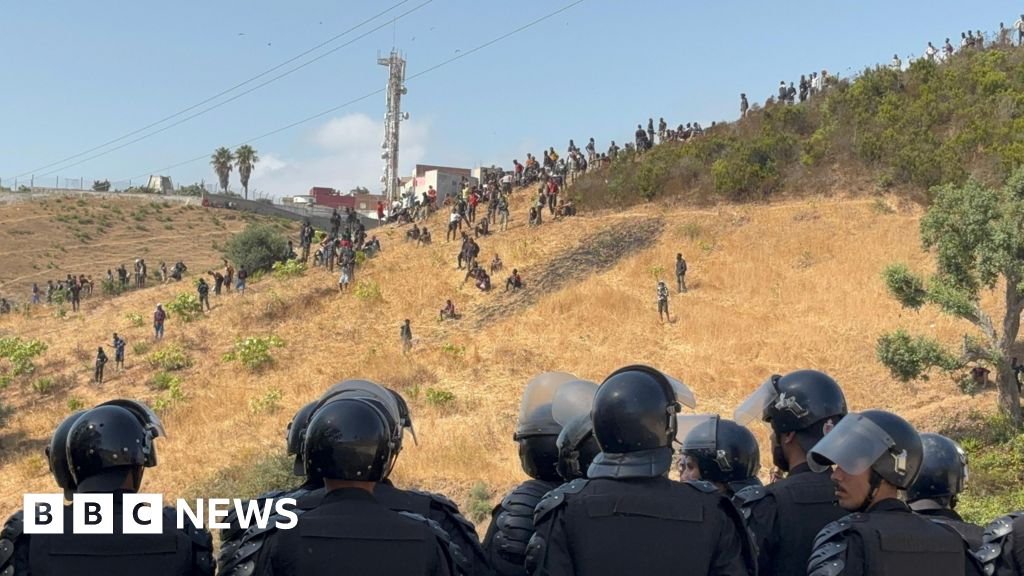
Moroccan authorities intercepted dozens of migrants seeking to cross into the Spanish North African exclave of Ceuta on Saturday, reports say.
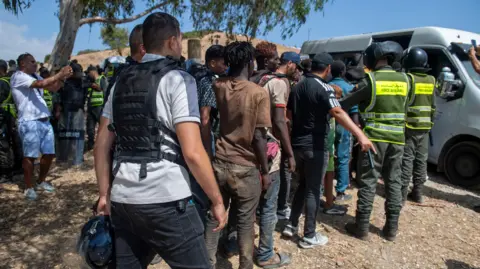
More than 100 people were blocked trying to make their way to the border on the outskirts of the town of Fnideq, according to Moroccan security sources cited by Spanish media and the Reuters news agency.
It comes a fortnight after roughly 78,000 migrants arrived in the exclave by sea in a matter of hours – 100 of whom died, according to the city’s mayor, who also said the vast majority of arrivals had returned to Morocco.
Security had been stepped up in the area after the influx and amid suggestions on social media of a second mass crossing attempt this weekend.
Moroccan police – including some in riot gear – reportedly used tear gas to disperse groups of migrants gathered on nearby hills.
Earlier this week, Rabat said it was monitoring “the circulation of social media posts and messages of unknown origin” calling for a mass crossing Saturday, warning it would prosecute organisers and participants.
 EPA/Shutterstock
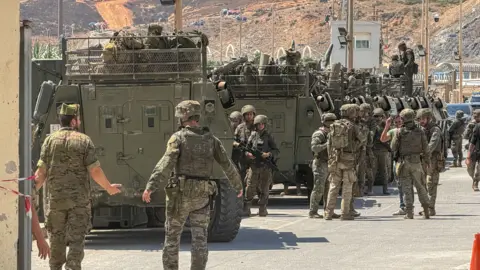
Security at the breakwater entrance was “10 times stronger than the previous day”, Spanish newspaper El País reported.
In addition to a metal fence and a floating barrier installed earlier this week, Morocco had dispatched army officers, navy speedboats and drones to the border on Saturday.
Madrid meanwhile deployed more than 1,500 security officers to patrol the area.

 EPA/Shutterstock
The crisis had calmed since breaking out in late July, but it has sparked tensions between EU nations who share open borders as well as criticism of the Spanish government.
Italy suspended its Schengen arrangement with Spain, backed by Finland and Denmark, while the Czech Republic called for Spain’s membership to be temporarily suspended – despite Spanish Prime Minister Pedro Sánchez noting Ceuta was not part of the Schengen area.
On Saturday, Italy’s Foreign Minister Antonio Tajani said his country had been afraid of a “risk of a new wave of arrivals in Ceuta”.
“We’re not waging any kind of “battle” against Spain; we’re simply carefully controlling arrivals,” he said.
“Instead of worrying about us, Spain should worry about Morocco: that’s where the problems are coming from, certainly not from our controls.”
