Close Menu
    What's Hot

    Cat returns home after 10-year 'adventure'Charlie's owners were shocked when they received a call from the vet saying she had been found safe.7 hrs agoWales

    August 17, 2026

    India built the world's biggest digital payments miracle. Now comes the billIndia's UPI may finally face merchant fees, raising questions over who pays and whether users will resist.3 hrs agoAsia

    August 17, 2026

    'I want my brother back' – Tupac’s brother tells BBC murder trial won’t bring justiceThe BBC's Shaimaa Khalil sat down with Mopreme Shakur ahead of the trial for his brother and late rapper's 1996 murder.2 hrs agoUS & Canada

    August 17, 2026
    Facebook X (Twitter) Instagram
    • Politics
    • Economy
    Facebook X (Twitter) Instagram
    Gulf News Week
    Subscribe
    Monday, August 17
    • Home
    • Politics
      • Europe
      • Middle East
      • Russia
      • Social
      • Ukraine Conflict
      • US Politics
      • World
    • Region
      • Middle East News
    • World
    • Economy
      • Banking
      • Business
      • Markets
    • Real Estate
    • Science & Tech
      • AI & Tech
      • Climate
      • Computing
      • Science
      • Space Science
      • Tech
    • Sports

      Dominant PSG put Liverpool on the brink with 2-0 Champions League quarter-final first-leg win

      April 9, 2026

      Dubai Basketball U-18 Elite Crowned Basket Cup Sarajevo 2026 Champions in Historic Debut

      April 6, 2026

      Saudi boxing crowns 20 champions as Kingdom’s Elite Belt concludes in Riyadh

      April 4, 2026

      “He Signed for a Real Fight”: Pacquiao Contradicts Mayweather Over Rematch Status

      April 3, 2026

      Arsenal Hold Off Chelsea Fightback to Reach Women’s Champions League Semi-Finals

      April 2, 2026
    • Health
    • Travel
    • Contact
    Gulf News Week
    Home»Most Viewed News»India built the world's biggest digital payments miracle. Now comes the billIndia's UPI may finally face merchant fees, raising questions over who pays and whether users will resist.3 hrs agoAsia
    Most Viewed News

    India built the world's biggest digital payments miracle. Now comes the billIndia's UPI may finally face merchant fees, raising questions over who pays and whether users will resist.3 hrs agoAsia

    Gulf News WeekBy Gulf News WeekAugust 17, 2026No Comments7 Mins Read
    Share Facebook Twitter Pinterest Copy Link LinkedIn Tumblr Email VKontakte Telegram
    India built the world's biggest digital payments miracle. Now comes the billIndia's UPI may finally face merchant fees, raising questions over who pays and whether users will resist.3 hrs agoAsia
    Share
    Facebook Twitter Pinterest Email Copy Link
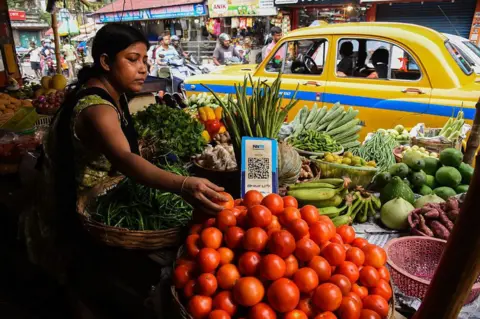
    NurPhoto via Getty Images A  vegetable vendor waits for customers, displaying a barcode for Paytm, an Indian cellphone-based digital payment platform, at a market in Kolkata.NurPhoto via Getty Images
    A vegetable vendor waits for customers at a market in Kolkata, with a QR code displayed for digital payments

    For most Indians, paying by Unified Payments Interface (UPI) has become almost absurdly routine.

    Scan a QR code, tap a few buttons and the money moves instantly. There is no card machine, no cash, and – most importantly – for the user, no visible fee.

    That may be about to change.

    India has paved the way for banks and payment companies to charge merchants a fee on UPI transactions, potentially ending a decade-long experiment in free digital payments.

    The government says consumers and person-to-person UPI payments will remain free. If merchant fees are introduced, they will apply only to some transactions above a set threshold, at a nominal rate, meaning most UPI payments will remain free.

    The question is whether putting a price on UPI could weaken the network that made it such a success.

    The stakes are enormous. Launched in 2016, UPI has grown into one of the world’s biggest real-time payment networks.

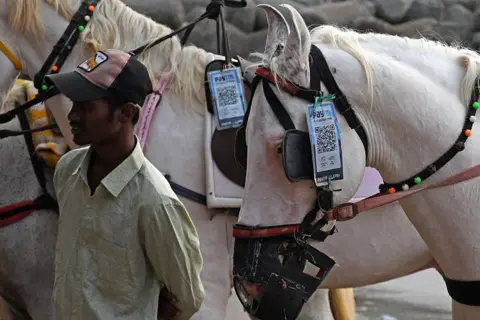
    LightRocket via Getty Images A man stands near a horse, attached with paytm scanner code near its eyes used for payment after joy ride on the beach. LightRocket via Getty Images
    A man stands beside a horse fitted with a payments QR code near its eye, allowing riders to pay digitally after a beach ride

    According to official data, in July alone, there were 23.6 billion UPI transactions worth 29.87 trillion rupees ($313.5bn; £232.2bn). Fintech apps such as PhonePe and Google Pay account for most UPI payments.

    In the financial year just ended, the figure was about 241.6 billion transactions – almost 12,000 times the volume in UPI’s first full year. More than 550 million people now use it, and the system is now available in some form for payments in 11 countries outside India.

    UPI is not merely big. Its design is unusual. Rather than building a closed system around a single dominant app, India created common digital plumbing on which competing companies could operate.

    Google Pay and PhonePe can fight fiercely for customers while still allowing their users to transact across the same network. The system is run by the National Payments Corporation of India, a non-profit entity, with banks and technology companies providing the consumer-facing services.

    But one of the less glamorous ingredients in the UPI story may now be the most important: merchants.

    A vegetable seller, taxi driver or small shopkeeper does not need to buy a card terminal to accept UPI. A printed QR code will do. And because merchants have not had to pay MDR, there has been little financial reason to turn customers away.
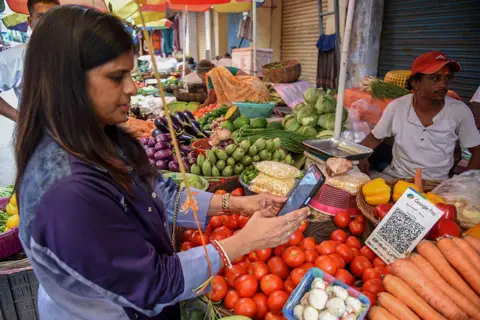
    NurPhoto via Getty Images A woman uses her phone to scan a QR code of the digital payment app Paytm after purchasing some vegetables at a market in Kolkata, India, on August 4, 2025. NurPhoto via Getty Images
    A woman scans a QR code after buying vegetables at a market in Kolkata

    New research by economists Abhinav Motheram and Sharon Buteau suggests that this merchant network was not merely an effect of UPI’s success. It helped drive it.

    “Our study suggests that merchant acceptance is not just a result of UPI growth, but one of its key drivers,” Motheram says. Districts with stronger merchant networks tended to see higher UPI adoption.

    “If charges are limited to large merchants or higher-value transactions, the effect on broad-based adoption may be modest. But if they reach small and informal merchants, especially in districts where acceptance networks are still developing, they could slow the merchant expansion that has helped UPI scale,” he says.

    The immediate proposal is designed to minimise that risk.

    One option reportedly under discussion would target transactions above 2,000 rupees at larger merchants, leaving small businesses and low-value payments untouched. Transactions above that threshold account for only about 4% of merchant-payment volumes but roughly 67% of their value, according to brokerage firm Jefferies.

    That could generate a sizeable new revenue stream – up to a billion dollars, by one estimate – for banks and payment companies while leaving the everyday smaller payment to the neighbourhood grocer effectively unchanged.

    It also addresses a problem that is becoming harder to ignore. UPI may feel free, but it is not costless.
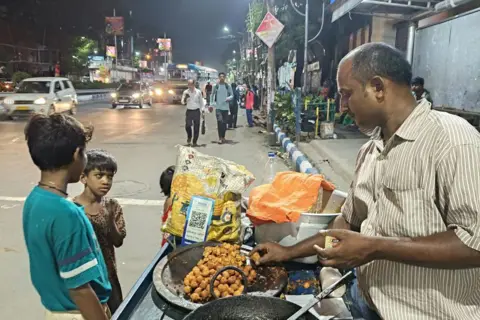
    NurPhoto via Getty Image Digital payment firm Paytm's QR codes are displayed at a street food vendor in Kolkata, India, on September 13, 2025. NurPhoto via Getty Image
    Even street food vendors accept digitial payments in India

    Servers have to run, transactions settled, fraud detected and the system protected against cyberattacks. For years, the government has helped compensate banks and payment firms for providing a service that has effectively been treated as public infrastructure.

    As Sanjay Malhotra, governor of the Reserve Bank of India (RBI), the country’s central bank, recently put it: “Someone will have to pay the cost.”

    But the economics become trickier the further down the merchant chain a fee travels.

    Motheram’s research does not estimate precisely how sensitive merchants are to MDR. But it offers a warning against assuming that a small fee will have a small effect.

    “Even a small fee could matter if it changes the incentives of small merchants operating on thin margins,” he says. The effect, he argues, depends heavily on the design of the charge. A fee imposed on a large retailer is very different from one imposed on a tiny shop or informal trader.

    That distinction matters because UPI’s extraordinary growth was not simply a story about Indians getting smartphones. It was also a story about millions of businesses acquiring the ability – and the incentive – to accept digital payments.

    “If charges are limited to large merchants or high-value transactions, the risk to mass adoption is likely lower,” Motheram says.

    “The bigger concern would be if charges eventually reach small and informal merchants in less-developed districts, where merchant networks are still thin and adoption is still maturing.”
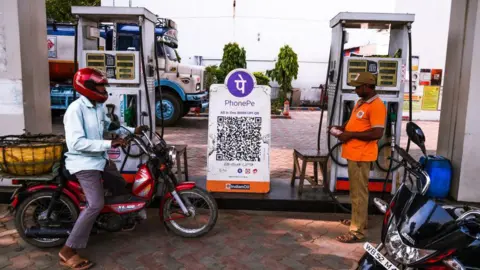
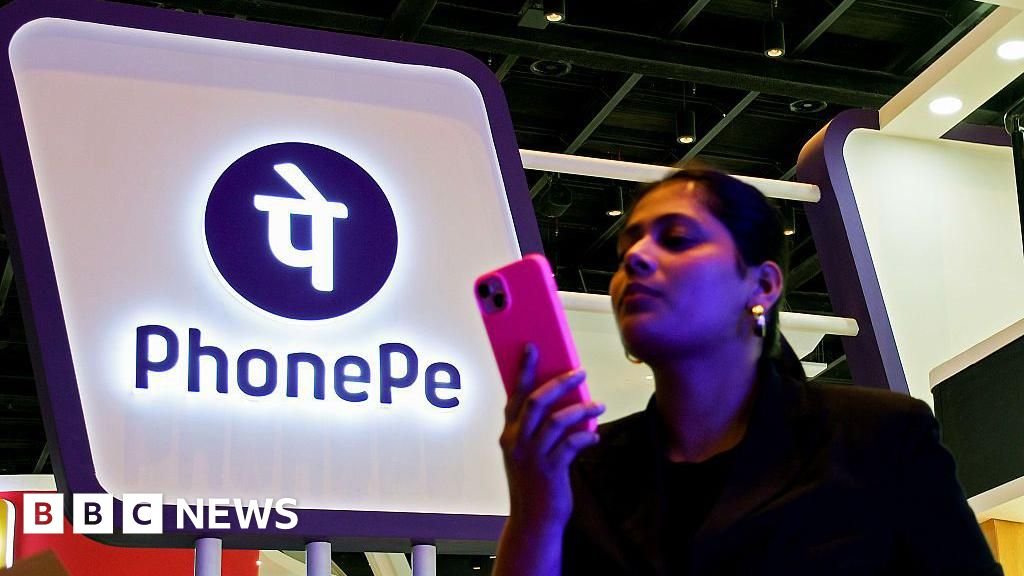
    NurPhoto via Getty Images A rider sitting on his moped waits next to a large PhonePe placard at a petrol pump in India.  NurPhoto via Getty Images
    More than 550 million Indians use UPI for digital payments

    India therefore faces a delicate balancing act. It wants to make UPI financially sustainable without disturbing the conditions that helped make it ubiquitous.

    It is not an impossible task. Brazil’s Pix, another hugely successful instant-payment system, is free for individuals but permits low-cost charges for businesses. Yet it is the world’s fastest-growing real-time payment system, used by more than 140 million people and 14 million companies, with more than four billion transactions a month averaging about $88 each.

    “The key question is not simply whether UPI should remain free for every merchant transaction,” Motheram says, “but whether the pricing structure protects the marginal merchants who are still being brought into the digital payments ecosystem.”

    That may be the real test of India’s next UPI experiment.

    The first phase was about creating the network. The second was about getting hundreds of millions of people and millions of merchants onto it. The third is now beginning: figuring out how to pay for the system without making it less useful.

    Economist Renuka Sane believes the right pricing structure could finally restore “commercial sanity” to India’s digital payment rails, allowing the market to price risk, fund critical infrastructure and build a more resilient payments ecosystem.

    The bigger risk may not be that Indians suddenly abandon UPI because a large retailer is charged a fraction of a percentage point: experts say its network effects are now too powerful for that.

    But there is a potential perception problem: a 2024 survey by polling agency LocalCircles found that 75% of UPI users said they would stop using it if transaction fees were introduced, while only 22% said they would be willing to pay.

    The risk is subtler. If charging merchants makes some of them less enthusiastic about accepting UPI – or eventually discourages the smallest ones from joining – the network could begin to lose some of the frictionless quality that made it so successful.

    India
    Asia
    Contactless payment
    Share. Facebook Twitter Pinterest LinkedIn Tumblr Email Telegram Copy Link
    Gulf News Week

    Related Posts

    Most Viewed News

    Cat returns home after 10-year 'adventure'Charlie's owners were shocked when they received a call from the vet saying she had been found safe.7 hrs agoWales

    August 17, 2026
    Most Viewed News

    'I want my brother back' – Tupac’s brother tells BBC murder trial won’t bring justiceThe BBC's Shaimaa Khalil sat down with Mopreme Shakur ahead of the trial for his brother and late rapper's 1996 murder.2 hrs agoUS & Canada

    August 17, 2026
    Most Viewed News

    'Ghana was the crime scene' – the country leading the demand for slavery reparationsGhana has become Africa's leading voice in telling the world that Western nations owe reparations1 hr agoAfrica

    August 17, 2026
    Most Viewed News

    What's driving men to get penis fillers, despite the risks?Men who have had the procedure can expect 10-20% more girth for the next six to nine months – but it can go wrong.24 hrs agoHealth

    August 17, 2026
    Most Viewed News

    Trump says US to scale back military drills with South Korea after it stayed out of Iran warHis decision to reduce the partnership came after South Korea recently declined to aid his war effort in Iran.28 mins agoWorld

    August 16, 2026
    Most Viewed News

    US commander says mental health a 'priority' on USS LincolnAdm Brad Cooper acknowledged that navy service at sea for long periods is "uniquely challenging and tough", following a visit to the warship.17 mins agoUS & Canada

    August 16, 2026
    Add A Comment
    Leave A Reply Cancel Reply

    Editors Picks

    Cat returns home after 10-year 'adventure'Charlie's owners were shocked when they received a call from the vet saying she had been found safe.7 hrs agoWales

    August 17, 2026

    India built the world's biggest digital payments miracle. Now comes the billIndia's UPI may finally face merchant fees, raising questions over who pays and whether users will resist.3 hrs agoAsia

    August 17, 2026

    'I want my brother back' – Tupac’s brother tells BBC murder trial won’t bring justiceThe BBC's Shaimaa Khalil sat down with Mopreme Shakur ahead of the trial for his brother and late rapper's 1996 murder.2 hrs agoUS & Canada

    August 17, 2026

    'Ghana was the crime scene' – the country leading the demand for slavery reparationsGhana has become Africa's leading voice in telling the world that Western nations owe reparations1 hr agoAfrica

    August 17, 2026
    Latest Posts

    Cat returns home after 10-year 'adventure'Charlie's owners were shocked when they received a call from the vet saying she had been found safe.7 hrs agoWales

    August 17, 2026

    'I want my brother back' – Tupac’s brother tells BBC murder trial won’t bring justiceThe BBC's Shaimaa Khalil sat down with Mopreme Shakur ahead of the trial for his brother and late rapper's 1996 murder.2 hrs agoUS & Canada

    August 17, 2026

    'Ghana was the crime scene' – the country leading the demand for slavery reparationsGhana has become Africa's leading voice in telling the world that Western nations owe reparations1 hr agoAfrica

    August 17, 2026

    Subscribe to News

    Get the latest sports news from NewsSite about world, sports and politics.

    Advertisement
    Demo
    Gulf News Week

    Your source for the serious news. This demo is crafted specifically to exhibit the use of the theme as a news site. Visit our main page for more demos.

    We're social. Connect with us:

    Facebook X (Twitter) Instagram Pinterest YouTube
    Latest Posts

    Cat returns home after 10-year 'adventure'Charlie's owners were shocked when they received a call from the vet saying she had been found safe.7 hrs agoWales

    August 17, 2026

    India built the world's biggest digital payments miracle. Now comes the billIndia's UPI may finally face merchant fees, raising questions over who pays and whether users will resist.3 hrs agoAsia

    August 17, 2026

    'I want my brother back' – Tupac’s brother tells BBC murder trial won’t bring justiceThe BBC's Shaimaa Khalil sat down with Mopreme Shakur ahead of the trial for his brother and late rapper's 1996 murder.2 hrs agoUS & Canada

    August 17, 2026

    Subscribe to Updates

    Get the latest creative news from FooBar about art, design and business.

    © 2026 Gulf News Week. Designed by HAM Digital Media.
    • Home
    • Politics
    • Economy
    • Sports

    Type above and press Enter to search. Press Esc to cancel.