
 Reuters
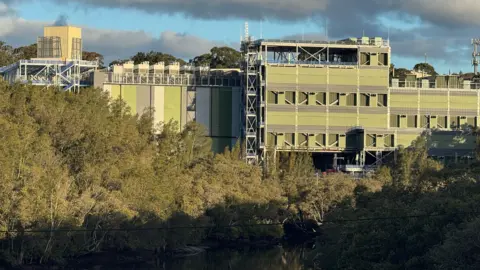
The sheer size and noise of data centres are what people tend to notice first. Some say they sound like a jet plane about to take off, others complain of a high-pitched whine.
When Lucy* puts her child to bed, she hears a constant humming. “I’ll hear it and think, ‘What is that? What is going on?’,” she says.
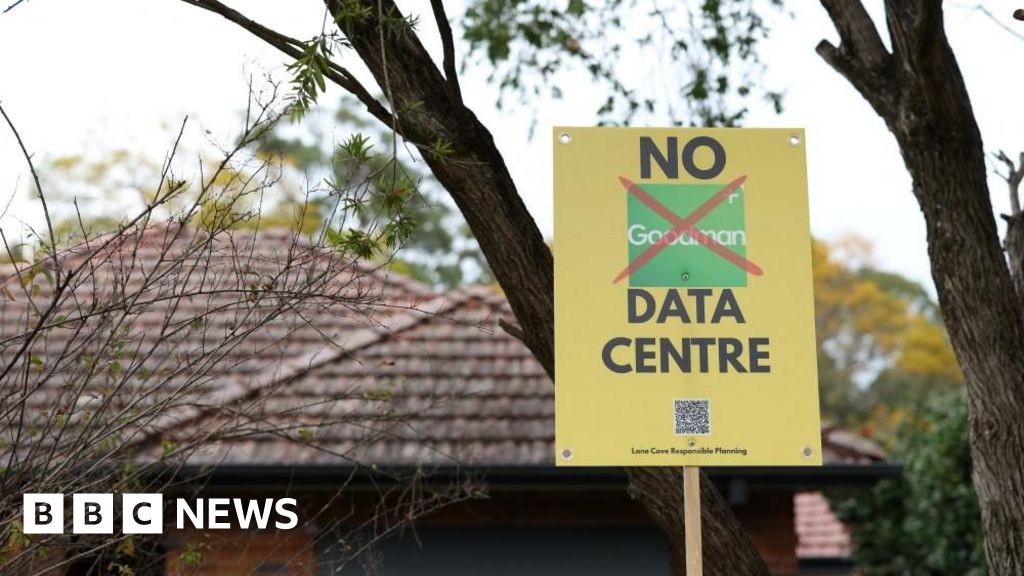
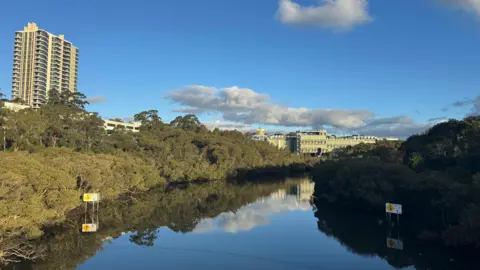
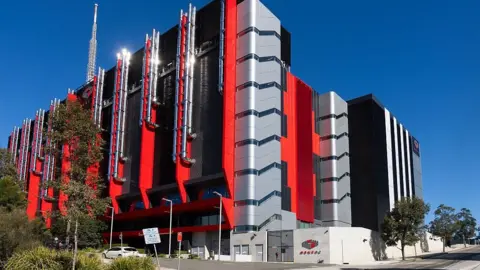
And then she’ll remember that the noise is a data centre just 350m (0.2 miles) from her front door in the desirable suburb of Lane Cove, in Sydney’s lower north-shore. Another four are in the pipeline at the local industrial park.
Earlier this year, OpenAI’s CEO Sam Altman said Australia could become a data centre capital of the world, if it wanted to.
Australia is already headed in the direction of big tech’s wishes. There are 162 data centres across the country, with plans for 90 more, and an estimated more than A$155bn (£80bn) of investment money lined up.
If approved, one of the world’s biggest data centres will be built in western Sydney. At one gigawatt, it is expected to be Australia’s largest single energy user.
And in Marsden Park, also in western Sydney, the biggest data centre in the Southern Hemisphere is already under construction only 100m away from a local community.
But as more Australians find themselves living next door to data centres – triggering concerns about water supplies, energy use and the environment – many are asking whether joining the artificial intelligence (AI) race is worth it.
‘What happens if we don’t?’

 Supplied
Data centres have been essential to the digital economy since the arrival of the internet.
They were originally built to process and store data for things like emails, online banking and cloud services. But everything changed after 2022 when ChatGPT launched and AI exploded in popularity. This prompted a sudden race to build more data centres to power the technology.
The location of these large, windowless buildings filled with beeping servers and cables also became important to latency – the time it takes for data to travel from its source to its destination.
Delays for things like air traffic control, robotic surgery or even Netflix would not be tolerated today, Belinda Dennett, CEO of Data Centres Australia, says.
Australia has roughly 13.6 million users of AI every month, making them the sixth most active users of the tech globally.
And experts say having data centres in Australia will lower the barrier to building more of its own AI companies.
“If we think about it in reverse, what happens if we don’t build infrastructure here”, Dennett says. “We get none of the value chain, we are just importing tools from someone else and we become just a user.”
Australia is also an attractive market for foreign investment, as “we’ve got availability of land, we’ve got political stability, and we’ve got the Five Eyes security alliance,” Dennett says.
“We’ve also got a skilled workforce, a pretty stable energy grid, and an abundance of renewable energy potential.”
 Adrien Rossignol
Leading business experts and economists say that without Australia’s data centre boom over the last couple of years, the country would likely have headed into a recession.
Jon Whittle, a former director of the digital research centre at the country’s national science agency CSIRO, who is now a leading voice in AI and business, agrees with this. He says the government doesn’t really have a choice but to continue down the investment path.
“There’s some very serious considerations around this, but my main message would be we need to lean into it,” he says.
 Supplied to BBC
Fears over power and water supplies
But leading energy and environmental experts argue Australia has little capacity to meet the massive energy and water demands of new data centres.
The Australian Energy Market Operator says data centre energy demands could triple by 2030 nationwide.
Without significant new renewable generation and storage, data centres could push power prices 26% higher in New South Wales (NSW) by 2035, according to the Climate Council, an independent non-profit that provides expert advice.
Because data centres need uninterrupted power at a scale and speed that wind and solar cannot match, there are fears the current boom will trigger a new generation of coal and gas power plants.
No data centre operator analysed in a recent report by Greenpeace Australia Pacific adequately proved their claim of driving the country’s renewable energy growth.
In the US, many data centres are not waiting to build more renewable energy and have found it cheaper to build new gas-fired power stations instead.
Just a 90-minute drive from Sydney’s central business district, the Australian-owned data group Cloud Carrier plans to build three gas-fired power stations to generate energy for an existing data centre and two more in the future.
Moreover, if energy demands place too much pressure on the grid or there is a power outage, data centres, like in Lane Cove, will rely on backup diesel generators.
But NSW Treasurer Daniel Mookhey says Australia’s investment boom in data centres is being accompanied by a boom in renewable energy.
“We don’t see the two [as] unrelated,” he tells the BBC. “We see data centres allowing us to replace a lot of our old coal-fired power with clean, green renewable energy with the private sector picking up a large amount of the tab because otherwise households would.”
The new private investment will help with renewable energy and create “new industries that are likely to employ future generations”, Mookhey says.
 Getty
GettyBut data centres also consume large amounts of water – some up to 40 million litres a day, which is equivalent to 80,000 households – to prevent their servers from overheating. In a drought-prone country that is a potentially huge problem.
Sydney already needs to increase its drinking water supply over the next five to 10 years in order to provide for its growing population, according to Water Services Association of Australia (WSAA).
But if that water is used for data centres, households are likely to pay the price for sourcing water from elsewhere, such as through desalination, which costs more than traditional water sources.
Sydney Water, Australia’s largest water utility, says data centres could use up to 25% of Sydney’s drinking water by 2035.
In July, Prime Minister Anthony Albanese announced a new legal obligation for “large-scale” data centres to underwrite power supplies, limit water use, and pay for any extra water infrastructure needed.
But the prime minister also told media that the legislation, which will be introduced in 2027, would only apply to new proposals, not projects that were already built or under construction.
In response, environmental and community groups want a pause on all data centre development.
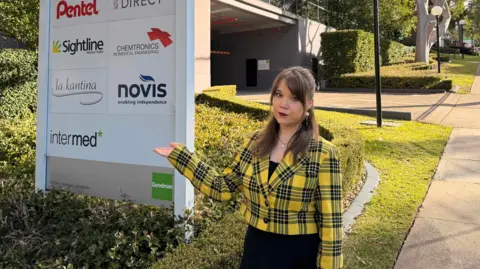
“We’ve got the government rolling out the red carpet saying we want to be the data centre capital of the world,” Sydney’s Lane Cove deputy mayor, Rochelle Flood, says.
“But can we actually do that sustainably or is it going to set us back in terms of net zero and our water storage targets?”
 Supplied by Rochelle Flood
‘What is it for?’
On a rainy Monday night during a town hall event led by Greenpeace Australia Pacific at the Lane Cove library, locals say they were never consulted on their area becoming a data centre hub.
One of the proposed centres from the cluster is 16m from the nearest home and 160m from a local primary school.
In addition, Flood says if the four data centres get approved in the industrial park, 50% of the current businesses will have to move – taking their jobs with them.
Felipe Tanaka, 40, is a manager of a business in the industrial park who has been told he must relocate for a data centre.
“We never knew that something like this would happen,” Tanaka tells the BBC. “Thousands of jobs are going to be gone from this area in the next few years.”
While a large data centre can employ more than a thousand workers during construction, research says that number drops to more like 100 jobs once the centre is operational.
“Most of our 300 to 400 workers here are locals,” Tanaka says. “Having to move will probably see half of my employees gone.”
NSW Treasurer Mookhey says the jobs that data centres will bring come not from those who work in them but from those who use them.
“When Microsoft and Amazon do business here in NSW, it’s pleasing to see they are committed to providing some of their more skilled operations and locating them here,” he says.
But what other skilled jobs might be created is not clear, and effectively what the data centres will be used for. As some critics have pointed out, many AI users are making cat GIFs, which uses the equivalent amount of energy as running a microwave for an hour.
“They’re telling us this is essential… that we need to have these centres in our neighbourhood but they’re not saying what it’s for,” Flood says.
“When our drinking water, energy and land is being used for generative AI slop, that is not giving any value back.”
*Names have been changed to protect identities
