Close Menu
    What's Hot

    LIVEUK condemns 'thuggish' behaviour after second small boats protest of weekendHundreds of protesters blocked roads in Portsmouth last night, after 140 migrants arrived via a dinghy. It comes after a similar protest in Dover on Saturday.

    September 7, 2026

    New videos of man at centre of 9/11 lawsuit reveal links to extremists and Saudi stateThe footage and other evidence the FBI failed to share undermine Omar al-Bayoumi's 25 years of denials.45 mins agoBirmingham & Black Country

    September 7, 2026

    The next James Bond: The (00)7 questions fans want answeredSpeculation has been building recently that an announcement about Daniel Craig's successor could be close.1 day agoCulture

    September 7, 2026
    Facebook X (Twitter) Instagram
    • Politics
    • Economy
    Facebook X (Twitter) Instagram
    Gulf News Week
    Subscribe
    Monday, September 7
    • Home
    • Politics
      • Europe
      • Middle East
      • Russia
      • Social
      • Ukraine Conflict
      • US Politics
      • World
    • Region
      • Middle East News
    • World
    • Economy
      • Banking
      • Business
      • Markets
    • Real Estate
    • Science & Tech
      • AI & Tech
      • Climate
      • Computing
      • Science
      • Space Science
      • Tech
    • Sports

      Dominant PSG put Liverpool on the brink with 2-0 Champions League quarter-final first-leg win

      April 9, 2026

      Dubai Basketball U-18 Elite Crowned Basket Cup Sarajevo 2026 Champions in Historic Debut

      April 6, 2026

      Saudi boxing crowns 20 champions as Kingdom’s Elite Belt concludes in Riyadh

      April 4, 2026

      “He Signed for a Real Fight”: Pacquiao Contradicts Mayweather Over Rematch Status

      April 3, 2026

      Arsenal Hold Off Chelsea Fightback to Reach Women’s Champions League Semi-Finals

      April 2, 2026
    • Health
    • Travel
    • Contact
    Gulf News Week
    Home»Most Viewed News»The volunteers risking their lives to defuse Indonesia's wildfire 'carbon bombs'Peat fires in Borneo are releasing ancient stores of carbon – and sending a toxic smog across South East Asia.53 mins agoAsia
    Most Viewed News

    The volunteers risking their lives to defuse Indonesia's wildfire 'carbon bombs'Peat fires in Borneo are releasing ancient stores of carbon – and sending a toxic smog across South East Asia.53 mins agoAsia

    Gulf News WeekBy Gulf News WeekSeptember 7, 2026No Comments8 Mins Read
    Share Facebook Twitter Pinterest Copy Link LinkedIn Tumblr Email VKontakte Telegram
    The volunteers risking their lives to defuse Indonesia's wildfire 'carbon bombs'Peat fires in Borneo are releasing ancient stores of carbon - and sending a toxic smog across South East Asia.53 mins agoAsia
    Share
    Facebook Twitter Pinterest Email Copy Link
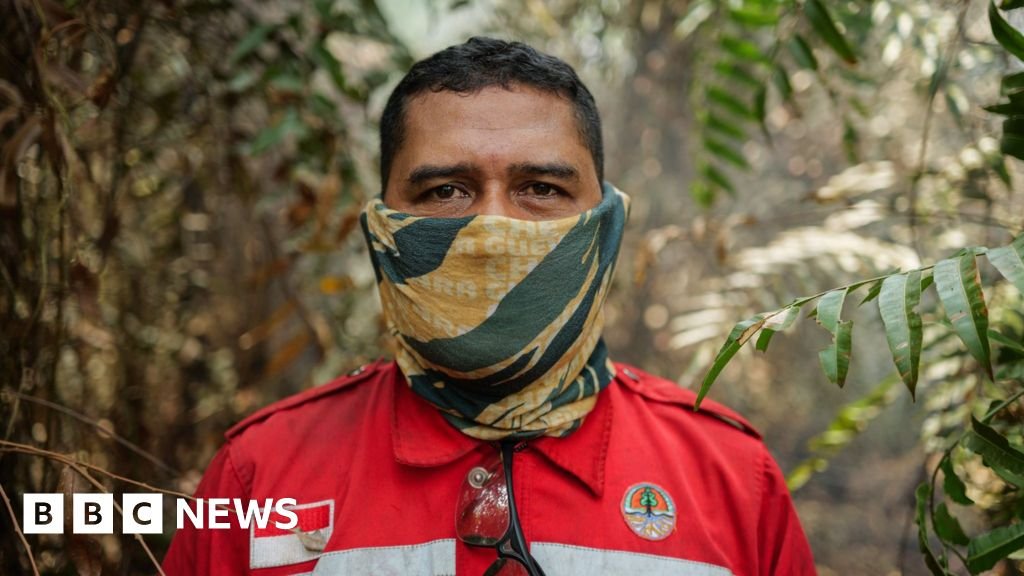
    Ahmad Dhani for BBC A man in red firefighting uniform patched with Indonesia's flag, and with a yellow and green neck gaiter pulled over his face, stands in a forest and looks into the cameraAhmad Dhani for BBC
    Fahrin Ramadhianto has been fighting Borneo’s wildfires for a month – and noticing the impacts on his body.

    The sky grows heavy in Borneo, though not with rain. The air, amber-hued and treacle-thick, is smudged under a blanket of smog that has spilled across international borders – to Singapore, Manila, Kuala Lumpur.

    Down on the ground, smoke steams from the soil.

    It’s like tear gas, says Dwi Sujatmoko.

    “It hits your nose straight away, your eyes burn – that’s more or less what it’s like,” he says. “People say these fires are extraordinary because of the flames and the smoke. And they’re right.”

    Using hand tools, carts and portable fire pumps, he and thousands of other volunteer firefighters – many of them indigenous Dayak or Banjar people – are up against an inferno that has carbonised some 200,000 hectares of forest and farmland across Indonesian Borneo since early July.

    Underground and out of sight, giant subterranean peat fires continue to smoulder, choking the air with poisonous fumes.

    “Once a fire becomes uncontrolled, it harms many people. Not just humans, but also animals and plants,” Sujatmoko says. “If underground fire spreads and can no longer be controlled, the losses are enormous.”

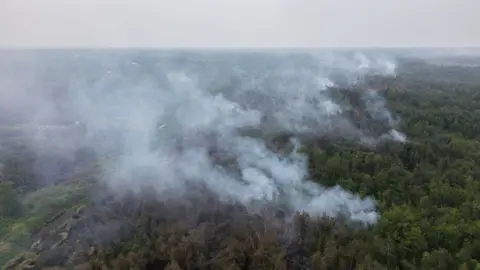
    Ahmad Dhani for BBC An aerial shot of bushland with large plumes of smoke rising into the airAhmad Dhani for BBC
    Fires have torched some 200,000 hectares across Indonesian Borneo since early July

    Indonesia is in the throes of a wildfire catastrophe.

    Amid a so-called “Super El Niño” that has supercharged local drought conditions, thousands of active fire hotspots are spreading and multiplying across the country, fuelling a transnational haze crisis that is the region’s worst in more than a decade.

    But what makes Borneo’s fires particularly worrying is the fact that they are burning through one of the world’s largest tropical peatland ecosystems.

    This 4.5-million-hectare swathe of forest and swamp, under normal conditions, serves as a valuable reservoir for ancient carbon.

    When these peatlands catch fire, they risk releasing millions of tonnes of carbon dioxide, carbon monoxide and methane into the atmosphere – a “pulse” of greenhouse gas emissions that has earned them the sobriquet of “carbon bomb”.

    “Peatlands are incredibly effective carbon stores because their waterlogged conditions slow decomposition, allowing carbon to accumulate underground for thousands of years,” explains Dr Nisa Novita, a peatland researcher at Indonesian conservation NGO Yayasan Konservasi Alam Nusantara (YKAN).

    “But this also means they can become a ‘carbon bomb’ when they are drained or burned, because that carbon can be rapidly released into the atmosphere.

    “Tropical peatlands in Indonesia are among the world’s most effective natural carbon stores. The deeper the peat, the greater the carbon stock – and in Kalimantan, we have found peat deposits that can exceed 20 metres in depth.”

    A peatland that deep has been known to harbour more than 6,000 tonnes of carbon – roughly equivalent to the annual COâ‚‚ emissions of 4,800 cars – per hectare. And when it burns, says Dr Nisa, that fossilised carbon can be released into the atmosphere “very rapidly”.
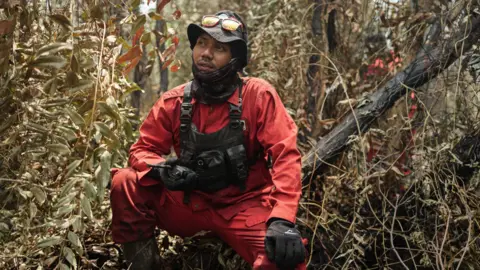
    Ahmad Dhani for BBC A man wearing red firefighting uniform, tactical vest, gloves, neck gaiter and hat crouches in a forest, holding a handheld radio deviceAhmad Dhani for BBC
    “We’re doing everything we can to help deal with this haze disaster because it’s our duty,” says firefighter Dwi Sujatmoko

    The toxic cloud

    Thousands of people across South East Asia are now feeling the effects of those emissions in their eyes, chests and throats.

    Across Indonesia as well as Brunei, Malaysia, Singapore and the Philippines, air pollution indices have soared to “unhealthy” extremes – almost 75 times the World Health Organization’s recommended level, in some cases – and hospital admissions have surged.

    Between July and August, Indonesia’s Health Ministry recorded over 50,000 cases of respiratory infections linked to land and forest fires. More than 12,000 of them were children under the age of five.

    “Everybody who’s living within that pollution cloud is breathing in the products of those smouldering peat fires,” says Susan Page, a professor at the University of Leicester’s school of geology and the environment, who’s been researching peatlands in Asia for three decades.

    “They’re breathing in carbon monoxide, which is toxic, and they’re breathing in the very finely divided particulate matter… [which] can pass through the alveoli in the lungs into the bloodstream and cause further problems elsewhere in the body, including issues with the heart.

    “Living in this kind of pollution cloud is extremely unhealthy.”
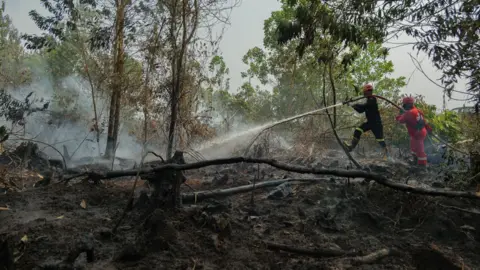
    Ahmad Dhani for BBC Two firefighters hold a hose, one behind the other, and spray water onto a blackened patch of land. Smoke rises in the background.Ahmad Dhani for BBC
    Fighting peat fires requires saturating the ground so thoroughly that it becomes “like porridge”

    Nowhere are these health impacts being felt more acutely than at the coalface of the disaster: the fire front.

    Here, volunteer firefighters have been risking their lives and lungs to extinguish burning peatlands which are notoriously difficult to put out. Two volunteers in Central Kalimantan have died in recent days, reportedly after their health deteriorated from putting out fires.

    Cloaked in toxic haze that can burn years off a person’s lifespan, volunteers have been digging ponds, canals and borewells through bone-dry peat in a desperate attempt to keep their hoses tapped.

    Some have been driving pipes into the earth, making ad hoc irrigation systems to combat subterranean fires. Others have been sleeping within a stone’s throw of the frontline so they can battle the blazes through the night.

    “The worst thing here has been the smoke,” says Fahrin Ramadhianto, a volunteer firefighter in South Kalimantan’s Banjarbaru, one of the worst-hit areas.

    “The smell is like decaying wood being burned – that’s the characteristic smell of peat. And that peat contains decomposed wood and organic material from many different sources.”

    An unnatural imbalance

    Indonesia’s peatland fires are not a new phenomenon.

    Experts say the crisis is rooted in decades of land-use change, dating back to the Suharto era, when vast areas of rainforest and peatland in Kalimantan were opened for logging, plantations and large-scale development projects.

    Yet authorities have historically avoided blaming industrial actors for causing large-scale fires.

    Instead, the same indigenous communities who are now engaged in firefighting operations across the island have often been accused of triggering the blazes, due to traditional farming methods that use controlled burns to clear away vegetation.

    Tono, a representative of the Dayak Kanayatn people of West Kalimantan, told the BBC that Dayak communities are frequently used as scapegoats, despite carrying out land clearing with extensive planning, caution and adherence to multi-generational customs.

    Tono says these communities’ traditional practices, known as uma bukit or “hill farming”, are rooted in the idea of maintaining balance with nature.
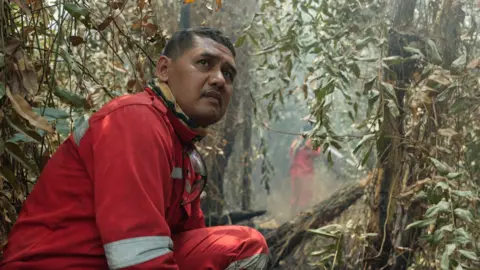
    Ahmad Dhani for BBC A man in red firefighting uniform crouches in bushlandAhmad Dhani for BBC
    “The worst thing here has been the smoke,” says Fahrin Ramadhianto

    But the natural balance is fast unravelling in Kalimantan, the most deforested area in Indonesia.

    The region lost almost 160,000 hectares of forest area in 2025, more than one-third of the nationwide figure – much of it to make way for plantations and monocrop agriculture.

    It is these same industrial-scale development projects that have been largely responsible for draining the area’s peat swamps, which renders them significantly more fire-prone, Prof Page says.

    “Peatlands aren’t really the ideal place to set up a plantation – but of course, once the more suitable mineral soils had been exhausted it became possible, by using large machinery, to drain the peatlands and create conditions which would be dry enough,” she says.

    “So not only have you got the deforestation, but peatland drainage of course has also greatly increased the fire risk.”

    Page also points out that, whether on fire or not, a drained peatland emits carbon dioxide into the atmosphere “all of the time”.

    “I think that’s forgotten,” she says. “I think it’s important to recognise that when we see the fires, they’re like a dramatic example of what is actually going on the whole time in a drained peatland… The fires are just the worst expression of [that].”

    Now, as these latest fires continue to spiral out of control, Sujatmoko and others face a concatenation of difficulties in the coming days, weeks and months – not least of which is a shortage of water.
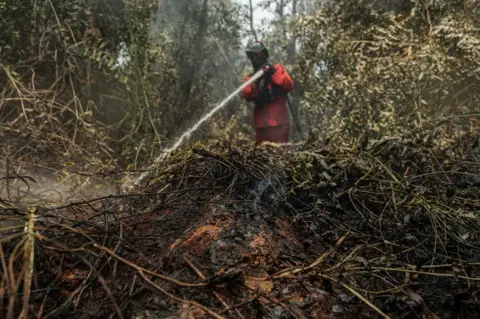
    Ahmad Dhani for BBC A man in the background wearing red firefighting uniform and a hat sprays water onto the underbrush in the foreground, where burnt vegetation smouldersAhmad Dhani for BBC
    Drainage and drought in Indonesia’s peatlands has exacerbated their vulnerability to fire

    Fighting peat fires requires saturating the ground so thoroughly that it becomes “like porridge”, Sujatmoko explains.

    Even then there is a high chance the fire will reappear, like a smoking revenant, fed by hidden fuel buried in the invisible depths of the peat swamp.

    In the face of these persistent reignitions, ongoing drought conditions and toxic smog, fatigue is another concern.

    “We’re definitely tired,” says Sujatmoko.

    “We get exhausted, we miss our families, our children, our wives. But for now, all of us are putting those things aside. We’re doing everything we can to help deal with this haze disaster because it’s our duty.”

    “We also hope rain comes soon,” he adds. “We’ve spent months away from home… May all the efforts of those on the front lines be a blessing for everyone.”

    Additional reporting by Faisal Irfani from BBC Indonesian.

    Indonesia
    Asia
    Wildfires
    Climate
    Greenhouse gas emissions
    Share. Facebook Twitter Pinterest LinkedIn Tumblr Email Telegram Copy Link
    Gulf News Week

    Related Posts

    Most Viewed News

    LIVEUK condemns 'thuggish' behaviour after second small boats protest of weekendHundreds of protesters blocked roads in Portsmouth last night, after 140 migrants arrived via a dinghy. It comes after a similar protest in Dover on Saturday.

    September 7, 2026
    Most Viewed News

    New videos of man at centre of 9/11 lawsuit reveal links to extremists and Saudi stateThe footage and other evidence the FBI failed to share undermine Omar al-Bayoumi's 25 years of denials.45 mins agoBirmingham & Black Country

    September 7, 2026
    Most Viewed News

    The next James Bond: The (00)7 questions fans want answeredSpeculation has been building recently that an announcement about Daniel Craig's successor could be close.1 day agoCulture

    September 7, 2026
    Most Viewed News

    Europe wrestles with impact of historic regional gains for Germany's AfDThe BBC's Europe editor Katya Adler sees the far-right win in Saxony-Anhalt state ringing alarm bells for the EU and traditional parties.8 mins agoEurope

    September 7, 2026
    Most Viewed News

    Protesters block roads in Portsmouth as 140 migrants rescuedThe government condemns "thuggish behaviour" in the second major anti-migrant protest of the weekend. 1 hr agoUK

    September 7, 2026
    Most Viewed News

    Andrew Scott feels the Pressure as 'unsung hero' in WW2 thrillerThe actor says it was wonderful playing James Stagg, the "chilly" meteorologist key to D-Day's success.38 mins agoCulture

    September 7, 2026
    Add A Comment
    Leave A Reply Cancel Reply

    Editors Picks

    LIVEUK condemns 'thuggish' behaviour after second small boats protest of weekendHundreds of protesters blocked roads in Portsmouth last night, after 140 migrants arrived via a dinghy. It comes after a similar protest in Dover on Saturday.

    September 7, 2026

    New videos of man at centre of 9/11 lawsuit reveal links to extremists and Saudi stateThe footage and other evidence the FBI failed to share undermine Omar al-Bayoumi's 25 years of denials.45 mins agoBirmingham & Black Country

    September 7, 2026

    The next James Bond: The (00)7 questions fans want answeredSpeculation has been building recently that an announcement about Daniel Craig's successor could be close.1 day agoCulture

    September 7, 2026

    Europe wrestles with impact of historic regional gains for Germany's AfDThe BBC's Europe editor Katya Adler sees the far-right win in Saxony-Anhalt state ringing alarm bells for the EU and traditional parties.8 mins agoEurope

    September 7, 2026
    Latest Posts

    LIVEUK condemns 'thuggish' behaviour after second small boats protest of weekendHundreds of protesters blocked roads in Portsmouth last night, after 140 migrants arrived via a dinghy. It comes after a similar protest in Dover on Saturday.

    September 7, 2026

    New videos of man at centre of 9/11 lawsuit reveal links to extremists and Saudi stateThe footage and other evidence the FBI failed to share undermine Omar al-Bayoumi's 25 years of denials.45 mins agoBirmingham & Black Country

    September 7, 2026

    The next James Bond: The (00)7 questions fans want answeredSpeculation has been building recently that an announcement about Daniel Craig's successor could be close.1 day agoCulture

    September 7, 2026

    Subscribe to News

    Get the latest sports news from NewsSite about world, sports and politics.

    Advertisement
    Demo
    Gulf News Week

    Your source for the serious news. This demo is crafted specifically to exhibit the use of the theme as a news site. Visit our main page for more demos.

    We're social. Connect with us:

    Facebook X (Twitter) Instagram Pinterest YouTube
    Latest Posts

    LIVEUK condemns 'thuggish' behaviour after second small boats protest of weekendHundreds of protesters blocked roads in Portsmouth last night, after 140 migrants arrived via a dinghy. It comes after a similar protest in Dover on Saturday.

    September 7, 2026

    New videos of man at centre of 9/11 lawsuit reveal links to extremists and Saudi stateThe footage and other evidence the FBI failed to share undermine Omar al-Bayoumi's 25 years of denials.45 mins agoBirmingham & Black Country

    September 7, 2026

    The next James Bond: The (00)7 questions fans want answeredSpeculation has been building recently that an announcement about Daniel Craig's successor could be close.1 day agoCulture

    September 7, 2026

    Subscribe to Updates

    Get the latest creative news from FooBar about art, design and business.

    © 2026 Gulf News Week. Designed by HAM Digital Media.
    • Home
    • Politics
    • Economy
    • Sports

    Type above and press Enter to search. Press Esc to cancel.