
 BBC
BBCWhen Meta first launched its AI-powered smart glasses in 2023, in collaboration with the sunglasses brand Ray-Ban, it unleashed a storm of controversy.
There have been multiple reports of the devices being used to harass women and girls in particular, filming them without their consent, then sharing the footage.
The image problem doesn’t seem to have been cured by Meta’s enlistment this summer of Kylie Jenner, Kim Kardashian’s sister, as their prime model. The devices have been dubbed “pervert” or “creepy” glasses. In the UK, JD Wetherspoon pubs, a handful of major theatres, Comic-Con, some schools, and Faslane, home of the UK’s nuclear submarines, have all chosen to ban them.
On Thursday, Meta is unveiling a new version which does not contain a camera at all, called Ray-Ban Meta Audio. They will have the audio functions of the original glasses – including the ability to make phone calls or play music, with the sound funnelled directly into your ear – but with fewer implications for privacy.

 Getty Images
The tech giant denies that the new glasses have been rushed out in response to public anger. They say the product has been in development for two years. The audio-only version is cheaper than its camera-enabled cousins, and Meta says it has a lighter frame and better battery life.
When I put it to Meta Glasses’ head of product Ankit Brahmbhatt that I thought they might overtake the original camera-enabled glasses in sales, there was a pregnant pause.
“We have, I think, something for everyone,” he said, choosing his words very carefully.
Does the release of a camera-free option represent a shift in how tech companies see the future of smart glasses? And is Meta’s original vision getting further away?
Or should we see camera-free glasses as a niche side-product that serves a small market – a bit like how some mobile manufacturers are now releasing internet-disabled “brick” phones for people who are tired of social media?
Music, maps, and washing cars
There’s no doubt that smart glasses have become controversial.
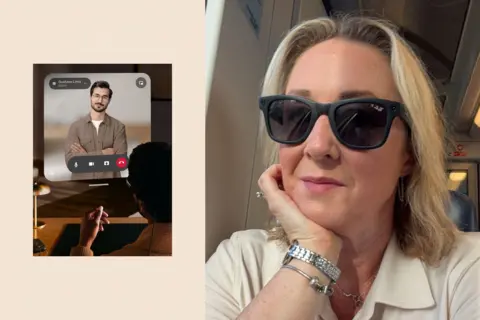
I was lent a pair of Meta Ray-Bans – with cameras – to try out. I was initially nervous about wearing them in public, in case someone got physical: I have heard of people knocking them off wearers’ heads and smashing them in the street.
The reality was that I wore them on public transport and on foot in several cities including London, Glasgow and Portsmouth, and nobody batted an eyelid. It made me wonder whether awareness of them is really as high as both Meta and anti-glasses campaigners believe.
That said, some people quietly told me they would not be confident enough to approach someone wearing them even if they did spot them, for fear of the interaction being filmed and uploaded.
The glasses are designed to work as an extension of your phone. They use Bluetooth to sync with a handset via Meta’s AI app. They are voice-activated, with open speakers in the arms funnelling sound into your ears. The result is a bit like wearing headphones without the addition of noise-cancelling features, so you can still hear the world around you.
My potentially cancellable opinion is that I found many of the glasses’ features useful. Interestingly, none of them included the camera.
Listening to music and podcasts on the move without having earbuds stuffed into my ears felt safer. I felt more confident about avoiding the gamut of e-bike-riding phone thieves in central London without my phone physically in my hand.
 Meta and BBC
And as someone with a pitiful sense of direction, I rely a lot on map apps. It was handy to have the directions spoken in my ears. The pay-off for this, however, was having to accept allowing the Meta AI app to know exactly where I was at all times. Meta is notorious for its hunger for personal data.
When I posted about using the Meta Ray-Bans on social media, I got a bit of a hard time. Less so when I showed them to people in my everyday life.
My hairdresser loved the idea of using them to record her clients’ hair transformations. A builder I chatted to at the gym reckoned they would be useful on sites for recording what he was doing, either in the event of an accident or even to teach others new skills. My friend who runs said he would like to wear them on a jog.
Plenty of content creators are big fans. My son borrowed them to wash my car, and was proud of his film showing me how he delicately chipped away at a stubborn bit of bird poo without damaging the paintwork (I was pleased, and happy to take his word for it).
More broadly, smart glasses have been welcomed by the blind community. One user described them to the BBC as a “game-changer” because they can give audio descriptions of current locations and read out visible text like restaurant menu options. Earlier this year Meta donated 15,000 pairs to a charity for the blind in Ireland.
Calls for regulation
But still, anger over privacy has grown.
The glasses have a blinking white LED that switches on when the camera is active, but a whole industry has sprung up around finding technical workarounds to disable that light, some of which involve taking the glasses apart.
Meta says less than 0.1% of the frames it has sold worldwide have been physically tampered with. Exact sales figures are unknown, but Ray-Ban’s parent company EssilorLuxottica has reported that it sold seven million last year.
Liz Hunter, a tech founder and parent who has set up a petition calling for urgent new regulation of smart glasses, is furious.
“They should never, ever have left the lab at Meta,” she told me. “It’s a real travesty of public trust, and of women’s equality, and it’s rolled back our privacy rights right before our very eyes.”
Hunter thinks smart glasses should remain available for blind people, but not for the general population.
“We don’t need them, we don’t want them,” she says.

A Polish developer has released an app called ZuckOff which uses Bluetooth to identify nearby smart glasses. It’s been downloaded thousands of times, reports Wired magazine.
Ben Wood, from tech research firm CCS Insight, remembers first reading the phrase “pervert glasses” in the usually strait-laced Financial Times – a sign, he says, that it had prompted a “significant public backlash”.
The furore has not deterred other companies from eyeing the market, however.
Samsung is reported to be working on a collaboration with the upmarket glasses brand Warby Parker. Google is also said to be working on a set. Snap, the firm behind Snapchat, has just launched Specs, which are retailing in the US for $2,195 (and £1,995 in the UK). Users can see data inside the glass, and snap their fingers to take a photo.
Snap founder Evan Spiegel says he thinks smart glasses will eventually replace phones, and he’s not alone.
Step back or ‘half step to the side’?
When Meta launched smart glasses in 2021, they were geared in part around what the user could see. The firm promised they would allow users to “easily record the world as you see it”, and to “capture life’s moments as they happen from a unique first-person perspective”.
So Meta’s latest announcement – glasses without a camera – is notable.
Janusz Swierczynski, a researcher at Oxford University’s Saïd Business School, who is worried about smart glasses, says the release of a camera-free version is a “positive sign” that Meta seems to have listened to privacy concerns. “They’re thinking about it and that they’re responding,” he says, though he thinks it’s “not a perfect” response because the camera-enabled glasses are still on the market.
Others are less sure it represents a real shift.
“It’s certainly not the end of cameras in glasses,” says Wood, from CCS Insight. He thinks that smart glasses are largely about capturing information; the glasses collect as much data as they can from your surroundings and then use AI to tell you about it.
And glasses armed with a camera – trained on whatever you can see – are an “extremely good” source of that information.
“That is an invaluable data stream to an AI platform, which can then interpret that data and provide you with the best possible information related to it,” Wood says. “So having the vision parts of it with the cameras is a key pillar for getting the best experience.”
He imagines Meta has been working on the camera-free glasses for several years, and the current backlash over privacy provides “fantastic timing” for their release.
Indeed, Meta doesn’t yet show any signs of slowing down its development of camera-enabled glasses. The company is bringing its third generation of the glasses to the UK next month. These can visually display data inside the specs’ lenses. (As a live broadcast journalist who has talked openly about brain fog, I can see the appeal of glasses that can discreetly display a script).
Kate Winick, a tech analyst at the research firm Forrester, says it’s not a step back from camera-enabled glasses but more of a “half step to the side, where they give users time to get comfortable with the technology… so that users themselves start to say, ‘Oh, this would be so much more useful if it had a camera’.”
And she says, paradoxically, the existence of camera-free glasses might help “take the heat” off people who wear camera-enabled glasses in public. “It’s now clear that out in the market some glasses have cameras and some don’t,” she says. “You can’t automatically get mad at everybody wearing Meta’s glasses, because you may not know whether or not they have a camera.”
Towards a social norm
And other companies are trying to address privacy concerns in different ways – without getting rid of the camera.
The Taiwanese firm HTC recently launched Vive Eagle glasses, which cost less than a quarter of Snap’s.
Thomas Dexmier, a vice president at HTC Vive, says that if anyone near an Eagle specs wearer says “stop filming” or “stop recording”, and it is picked up by one of the four microphones, the camera will deactivate.
And he adds that all recordings captured by the glasses are encrypted, and the firm itself cannot see them – though this also means HTC cannot flag harmful content.
“We acknowledge that there are some challenges, potentially becoming a real problem, especially for women,” he said.
He said HTC Vive was working to make it as difficult as possible for the tech to be misused but said it was “too early to comment” on whether the firm would consider a version without cameras.
Ultimately, Wood thinks that camera-enabled glasses are “not going away”.
He says the current moment reminds him of the 2000s, when some people said that mobile phone companies couldn’t install cameras in their devices because of similar concerns over privacy. “There’s an inevitability there,” he says.
“We will have to find a societal norm, a framework for the use of these products.”
Top image credit: Getty.

BBC InDepth is the home on the website and app for the best analysis, with fresh perspectives that challenge assumptions and deep reporting on the biggest issues of the day. Emma Barnett and John Simpson bring their pick of the most thought-provoking deep reads and analysis, every Saturday. Sign up for the newsletter here
