Close Menu
    What's Hot

    Trump unveils 'Super Intelligence Force' to oversee AI policyThe president named his national intelligence chief as the taskforce's head as worries over AI grow.32 mins agoBusiness

    October 5, 2026

    How India became dangerously addicted to Chinese importsIndia’s toy shops provide an unlikely barometer by which to measure its economic relationship with China.21 mins agoAsia

    October 5, 2026

    UK Celebrity Traitors connections that might surprise youLots of the stars have worked together, some are good friends – and that can impact the show's dynamics.23 hrs agoCulture

    October 5, 2026
    Facebook X (Twitter) Instagram
    • Politics
    • Economy
    Facebook X (Twitter) Instagram
    Gulf News Week
    Subscribe
    Monday, October 5
    • Home
    • Politics
      • Europe
      • Middle East
      • Russia
      • Social
      • Ukraine Conflict
      • US Politics
      • World
    • Region
      • Middle East News
    • World
    • Economy
      • Banking
      • Business
      • Markets
    • Real Estate
    • Science & Tech
      • AI & Tech
      • Climate
      • Computing
      • Science
      • Space Science
      • Tech
    • Sports

      Dominant PSG put Liverpool on the brink with 2-0 Champions League quarter-final first-leg win

      April 9, 2026

      Dubai Basketball U-18 Elite Crowned Basket Cup Sarajevo 2026 Champions in Historic Debut

      April 6, 2026

      Saudi boxing crowns 20 champions as Kingdom’s Elite Belt concludes in Riyadh

      April 4, 2026

      “He Signed for a Real Fight”: Pacquiao Contradicts Mayweather Over Rematch Status

      April 3, 2026

      Arsenal Hold Off Chelsea Fightback to Reach Women’s Champions League Semi-Finals

      April 2, 2026
    • Health
    • Travel
    • Contact
    Gulf News Week
    Home»Most Viewed News»How India became dangerously addicted to Chinese importsIndia’s toy shops provide an unlikely barometer by which to measure its economic relationship with China.21 mins agoAsia
    Most Viewed News

    How India became dangerously addicted to Chinese importsIndia’s toy shops provide an unlikely barometer by which to measure its economic relationship with China.21 mins agoAsia

    Gulf News WeekBy Gulf News WeekOctober 5, 2026No Comments5 Mins Read
    Share Facebook Twitter Pinterest Copy Link LinkedIn Tumblr Email VKontakte Telegram
    How India became dangerously addicted to Chinese importsIndia’s toy shops provide an unlikely barometer by which to measure its economic relationship with China.21 mins agoAsia
    Share
    Facebook Twitter Pinterest Email Copy Link
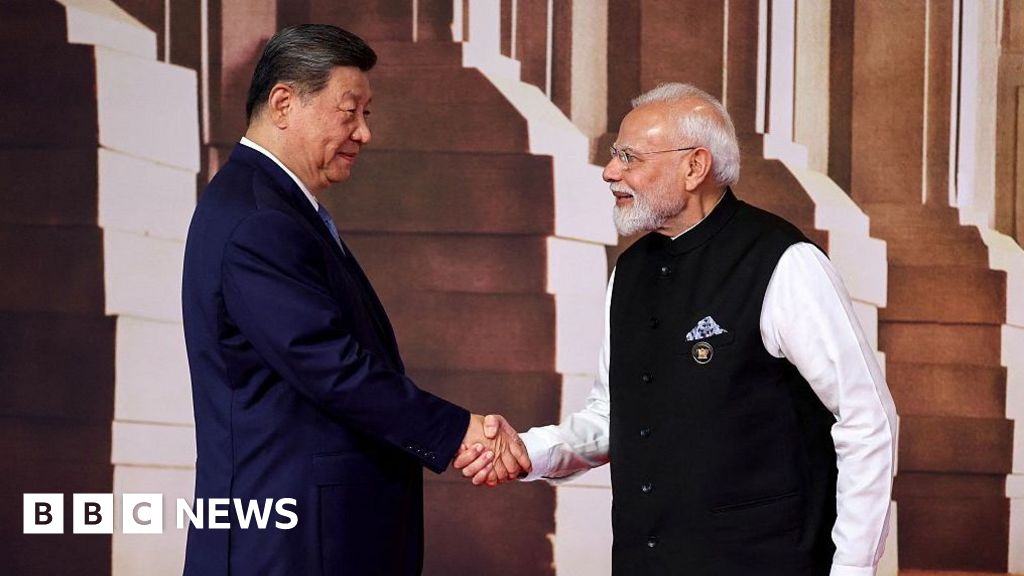
    AFP via Getty Images India's Prime Minister Narendra Modi (R) shakes hands with China's President Xi Jinping before the start of the 18th BRICS Summit in Delhi on 18 September 2026. AFP via Getty Images
    Xi and Modi have vowed to address growing trade imbalances

    Take a walk into an Indian toy shop and as well as picking up a new favourite plaything for a child, you might just get an insight into how the nation is battling for a batter economic relationship with its all-powerful neighbour China.

    Six years ago, in an attempt to push local manufacturing and keep substandard toys out of its market, India raised tariffs on imported toys from 20% to 60% and eventually to 70%.

    Retailers were up in arms and said that domestic firms could never match the foreign-made stuff. But the combination of higher customs duties and quality control standards worked.

    Indian imports of toys fell by a third from nearly $300mn in 2020 to $100mn this year, while exports rose from around $129mn to $200mn in the same period. Moreover, the country was able to drastically reduce its dependence on China, which held a 70% share of the local toy market.

    Even as diplomatic ties between the two countries completely broke down following the Galwan Valley clashes in 2020 and Delhi announced a slew of anti-dumping duties and a ban on Chinese apps such as Tik Tok, its trade deficit with Beijing has only ballooned – from $44bn in 2020 to an eye-popping $112bn this year.

    “India’s economic dependence on China continued to deepen while political, security, and investment ties were at their lowest point,” Kevin Zongzhe Li, a Washington-based Fellow at the Asia Society Policy Institute’s Centre for China Analysis, told the BBC.

    More worryingly, exports to China remained below pre-pandemic level even as imports doubled in this period.

    “China now supplies over 30% of India’s industrial imports, and India depends on it for more than 100 critical products. And the imbalance is worsening,” says Ajay Srivastava of the Delhi-based Global Trade and Research Initiative (GTRI).

    If the rapid pace of imports continues, bilateral deficit could jump to $134bn, giving Beijing even more leverage over Indian industry, according to Srivastava.

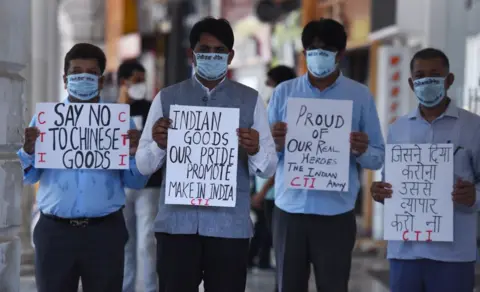
    Bloomberg via Getty Images Indian traders in Delhi wearing masks hold placards during a silent protest against China and Chinese products in 2020, after 20 Indian soldiers were killed in the skirmish with Chinese troops in the Galwan Valley. 

Bloomberg via Getty Images
    Anti-China sentiment hit a fever pitch post border skirmishes in 2020, but relations have now thawed

    On the sidelines of the Brics summit in Delhi in September, amid a deepening thaw between the Asian giants, Prime Minister Narendra Modi and Chinese President Xi Jinping vowed to address these “structural trade imbalances and supply chain issues”.

    But given how deeply entrenched Chinese imports have become to India’s industrial economy, this will be a formidable task for Delhi, experts told the BBC.

    That’s primarily because India depends on China to not merely consume end-products, but increasingly to produce industrial goods.

    To be true, India has reduced its reliance on imports of finished goods such as smartphones and solar equipment, and now produces more than a quarter of the world’s iPhones.

    “Yet, production remains largely assembly-based and depends heavily on imported components, particularly from China,” says Srivastava.

    It’s the same story with industrial machinery, battery inputs, chemicals, solar cells, and manufacturing equipment.

    Electrical machinery and electronics alone account for 36% of imports, followed by machinery and mechanical appliances at 21.7%, while organic chemicals and plastics also have a significant share, according to the Observer Research Foundation (ORF) think tank.

    “Their interruption would not merely affect consumption; it would disrupt production itself,” according to Soumya Bhowmik, a Fellow at ORF’s Centre for New Economic Diplomacy, who argues that this reflects India’s difficulty in substituting Chinese inputs with local production.

    Besides a growing reliance on inputs and raw material, Chinese imports to India are also being propelled by other macroeconomic trends.

    China has huge excess capacity in sectors from steel to solar panels and electric vehicles, while its slowing economy cannot absorb the output.

    Manufacturers are therefore increasingly turning to overseas markets, selling goods cheaply. China’s trade surplus is expected to top $1tn for a second straight year.

    A lot of these goods are coming to Indian shores because it is rapidly expanding manufacturing across segments of the economy, but also as “Western markets impose tariffs and other restrictions”, says Srivastava.
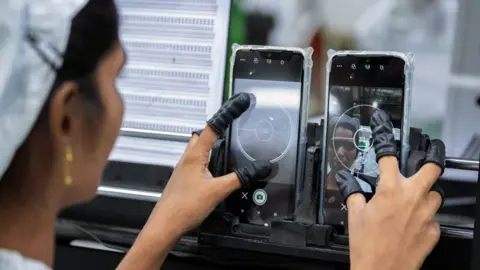
    Bloomberg via Getty Images An employee tests the camera quality of mobile phones at a unit of Foxconn Technology Co in Andhra Pradesh state in southern India. 
Bloomberg via Getty Images
    India has reduced smartphone imports but depends heavily on China for components

    On the other hand, lack of access to the Chinese market remains a major challenge for Indian companies.

    “Indian products face a variety of tariff and non-tariff hurdles in China that make it difficult to scale exports,” says Li.

    “If normalisation [of ties] continues without a serious push for reciprocal market access, India risks a situation where the political relationship improves but the economic dependency stays the same.”

    The long term solution to both reducing avoidable imports and improving exports performance will be to strengthen manufacturing, says Srivastava.

    But that requires sector-specific industrial policy and stronger fundamentals – affordable power and credit, efficient logistics and stable regulations – areas where India still falls short.

    India has also recently softened foreign direct investment rules, which could open the door to Chinese companies wanting to expand Indian investments. But these too will need careful vetting, he adds.

    “Investment that merely expands distribution networks or assembles products using Chinese parts could increase imports and deepen dependence. Approvals should therefore prioritise technology transfer, local value addition, domestic component production and exports from India.”

    More immediately, India could focus on targeting higher exports to China in specific sectors to reduce its trade asymmetry, says Li. Sectors like pharmaceuticals could be a natural fit with China’s population aging and healthcare costs rising.

    “But narrowing a $112 billion deficit won’t come from finding niche export sectors alone,” he adds.

    “The key question is whether Beijing is ready and willing to make concessions on market access as part of the broader normalisation. Alternatively, India will need to find its own leverage to force that conversation.”

    Follow BBC News India on Instagram, YouTube, X and Facebook.

    India
    China
    Global trade
    Economics
    Trade
    Xi Jinping
    Narendra Modi
    Toys

    Share. Facebook Twitter Pinterest LinkedIn Tumblr Email Telegram Copy Link
    Gulf News Week

    Related Posts

    Most Viewed News

    Trump unveils 'Super Intelligence Force' to oversee AI policyThe president named his national intelligence chief as the taskforce's head as worries over AI grow.32 mins agoBusiness

    October 5, 2026
    Most Viewed News

    UK Celebrity Traitors connections that might surprise youLots of the stars have worked together, some are good friends – and that can impact the show's dynamics.23 hrs agoCulture

    October 5, 2026
    Most Viewed News

    Forced to call him 'Dad': Sexual abuse of disabled residents that shocked South KoreaThe BBC spoke to one of three residents at a care home who were sexually assaulted by a staff member.2 hrs agoAsia

    October 5, 2026
    Most Viewed News

    Polls close in Brazil as Lula and Flávio Bolsonaro remain neck and neckIf no candidate gets more than 50% of the vote, the election will go to a run-off on 25 October.2 hrs agoLatin America

    October 4, 2026
    Most Viewed News

    Kyiv bridge hit in further Russian drone attack as German chancellor makes surprise visitFootage shows a drone hitting the Pivnichyi (Northern) Bridge as vehicles move across it, creating a large fireball.10 hrs agoEurope

    October 4, 2026
    Most Viewed News

    British Museum announces changes to ease Bayeux Tapestry queuesMeasures include extended opening hours, as well as an audio guide and additional seating for visitors.7 hrs agoCulture

    October 4, 2026
    Add A Comment
    Leave A Reply Cancel Reply

    Editors Picks

    Trump unveils 'Super Intelligence Force' to oversee AI policyThe president named his national intelligence chief as the taskforce's head as worries over AI grow.32 mins agoBusiness

    October 5, 2026

    How India became dangerously addicted to Chinese importsIndia’s toy shops provide an unlikely barometer by which to measure its economic relationship with China.21 mins agoAsia

    October 5, 2026

    UK Celebrity Traitors connections that might surprise youLots of the stars have worked together, some are good friends – and that can impact the show's dynamics.23 hrs agoCulture

    October 5, 2026

    Forced to call him 'Dad': Sexual abuse of disabled residents that shocked South KoreaThe BBC spoke to one of three residents at a care home who were sexually assaulted by a staff member.2 hrs agoAsia

    October 5, 2026
    Latest Posts

    Trump unveils 'Super Intelligence Force' to oversee AI policyThe president named his national intelligence chief as the taskforce's head as worries over AI grow.32 mins agoBusiness

    October 5, 2026

    UK Celebrity Traitors connections that might surprise youLots of the stars have worked together, some are good friends – and that can impact the show's dynamics.23 hrs agoCulture

    October 5, 2026

    Forced to call him 'Dad': Sexual abuse of disabled residents that shocked South KoreaThe BBC spoke to one of three residents at a care home who were sexually assaulted by a staff member.2 hrs agoAsia

    October 5, 2026

    Subscribe to News

    Get the latest sports news from NewsSite about world, sports and politics.

    Advertisement
    Demo
    Gulf News Week

    Your source for the serious news. This demo is crafted specifically to exhibit the use of the theme as a news site. Visit our main page for more demos.

    We're social. Connect with us:

    Facebook X (Twitter) Instagram Pinterest YouTube
    Latest Posts

    Trump unveils 'Super Intelligence Force' to oversee AI policyThe president named his national intelligence chief as the taskforce's head as worries over AI grow.32 mins agoBusiness

    October 5, 2026

    How India became dangerously addicted to Chinese importsIndia’s toy shops provide an unlikely barometer by which to measure its economic relationship with China.21 mins agoAsia

    October 5, 2026

    UK Celebrity Traitors connections that might surprise youLots of the stars have worked together, some are good friends – and that can impact the show's dynamics.23 hrs agoCulture

    October 5, 2026

    Subscribe to Updates

    Get the latest creative news from FooBar about art, design and business.

    © 2026 Gulf News Week. Designed by HAM Digital Media.
    • Home
    • Politics
    • Economy
    • Sports

    Type above and press Enter to search. Press Esc to cancel.