Close Menu
    What's Hot

    Toilet paper and secret recorders: What we know about the arrest of the Saudi OpenAI engineerAbdulrahman Alfozan had worked for the AI giant for more than a year before he was arrested by the FBI. 18 hrs agoTechnology

    October 15, 2026

    India and China aren't friends – but Nepal wants to unite them against climate threatsCan Nepal bring the two regional giants together to confront a shared climate threat in the Himalayas?10 hrs agoAsia

    October 15, 2026

    LIVEAt least 28 killed in Pakistan school roof collapse as rescuers search for survivorsIn a statement, the office of Pakistan's President Asif Ali Zardari says "this heart-wrenching tragedy has plunged the entire nation into shock".

    October 15, 2026
    Facebook X (Twitter) Instagram
    • Politics
    • Economy
    Facebook X (Twitter) Instagram
    Gulf News Week
    Subscribe
    Thursday, October 15
    • Home
    • Politics
      • Europe
      • Middle East
      • Russia
      • Social
      • Ukraine Conflict
      • US Politics
      • World
    • Region
      • Middle East News
    • World
    • Economy
      • Banking
      • Business
      • Markets
    • Real Estate
    • Science & Tech
      • AI & Tech
      • Climate
      • Computing
      • Science
      • Space Science
      • Tech
    • Sports

      Dominant PSG put Liverpool on the brink with 2-0 Champions League quarter-final first-leg win

      April 9, 2026

      Dubai Basketball U-18 Elite Crowned Basket Cup Sarajevo 2026 Champions in Historic Debut

      April 6, 2026

      Saudi boxing crowns 20 champions as Kingdom’s Elite Belt concludes in Riyadh

      April 4, 2026

      “He Signed for a Real Fight”: Pacquiao Contradicts Mayweather Over Rematch Status

      April 3, 2026

      Arsenal Hold Off Chelsea Fightback to Reach Women’s Champions League Semi-Finals

      April 2, 2026
    • Health
    • Travel
    • Contact
    Gulf News Week
    Home»Most Viewed News»India and China aren't friends – but Nepal wants to unite them against climate threatsCan Nepal bring the two regional giants together to confront a shared climate threat in the Himalayas?10 hrs agoAsia
    Most Viewed News

    India and China aren't friends – but Nepal wants to unite them against climate threatsCan Nepal bring the two regional giants together to confront a shared climate threat in the Himalayas?10 hrs agoAsia

    Gulf News WeekBy Gulf News WeekOctober 15, 2026No Comments7 Mins Read
    Share Facebook Twitter Pinterest Copy Link LinkedIn Tumblr Email VKontakte Telegram
    India and China aren't friends - but Nepal wants to unite them against climate threatsCan Nepal bring the two regional giants together to confront a shared climate threat in the Himalayas?10 hrs agoAsia
    Share
    Facebook Twitter Pinterest Email Copy Link
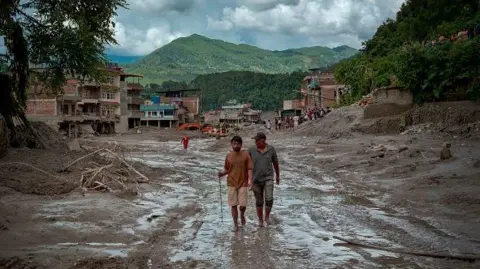
    Getty Images Residents walk along a muddy road following flash floods on August 27, 2026 in Trishuli, Nepal.Getty Images
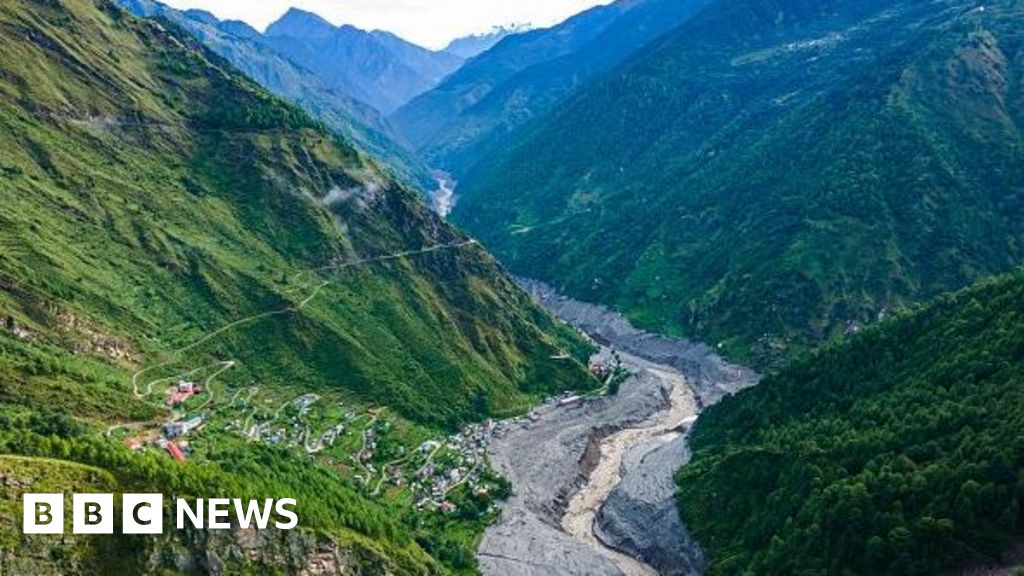
    The recent floods in Nepal have highlighted the need for cross-border co-operation in the Himalayan region

    Nepal’s Prime Minister Balendra Shah used much of his speech at the recent UN General Assembly to warn of the growing threat of climate-related disasters in the Himalayas, recalling the devastating debris floods that struck his country in August.

    But it was his ambitious proposal to bring together regional rivals India and China, alongside Nepal, to tackle these shared threats that drew particular attention.

    Shah called for the creation of a Himalayan Climate Resilience Mechanism to strengthen cross-border disaster response and the sharing of scientific data and expertise in one of the world’s most environmentally fragile and geopolitically sensitive regions.

    “Let the Himalayas become a laboratory of international co-operation rather than a frontier of fragmented information,” he said.

    “The PM’s proposal has given a political direction. Our ministry is working with other relevant agencies to put forward a preliminary framework which can be the basis for building common understanding,” the official said.

    Neither India nor China has formally responded to the proposal. The BBC has contacted their foreign ministries for comment.

    But can Nepal really bring the two regional giants together to confront a shared climate threat in a region where they have long been locked in bitter territorial disputes?

    India and China share a disputed frontier stretching roughly 3,500km (2,175 miles), much of it across the Himalayas. Their competing territorial claims have led to a war, deadly clashes and repeated military stand-offs along the Line of Actual Control (LAC), the de facto boundary separating areas under their control.

    But the mountains that have long been a source of friction between the two countries are also facing an urgent climate threat.

    Temperatures in the Himalayan region are rising faster than the global average, accelerating glacier retreat and permafrost thaw and contributing to growing risks of landslides, rockfalls, avalanches and glacial lake outburst floods.

    Such disasters can sweep across national boundaries, threatening lives, infrastructure and livelihoods far downstream – making co-operation between the countries sharing the Himalayas increasingly important.


    Getty Images Prime Minister of Nepal, Balendra Shah, delivers a speech during the 81st United Nations General Assembly (UNGA) in New York, United States, on 24 September. Getty Images
    Balendra Shah has urged neighbours India and China to collaborate on climate risks in the Himalayan region

    A report by the International Centre for Integrated Mountain Development released in March found that glaciers across the Hindu Kush Himalaya (HKH) region are melting at an accelerating pace, with the rate of ice loss having doubled since 2000 compared with the 1974-1999 period.

    Further east, on the Qinghai-Tibet Plateau, glaciers have shrunk by 24% in area over the past six decades, Kang Shichang, director of the Chinese Academy of Sciences’ Institute of Mountain Hazards and Environment, told China’s People’s Daily Online.

    Experts say the retreat of glaciers can cause glacial lakes to expand, increasing the risk of sudden, potentially devastating floods that can cross borders into countries such as Nepal, India and Bhutan. Several major rivers flowing through these countries originate on the Tibetan Plateau.

    The plateau now has more than 14,000 glacial lakes, covering over 1,100 sq km, according to People’s Daily.

    And the dangers extend beyond flooding.

    A 2024 study published by the American Geophysical Union projected a significant rise in landslide hazards across the Himalayas and Tibet in the coming decades due to increased rainstorms.

    While the largest absolute increases are expected in already vulnerable areas, including India’s Garhwal and Kumaon regions and Nepal, the greatest relative increase is projected on the Tibetan Plateau.

    The growing risks make co-operation more urgent. But past efforts by India and China to work together on Himalayan environmental issues have made little progress.

    The two Asian powers have often found common ground at UN climate negotiations, pushing back against Western demands for emissions cuts and arguing that developing countries should not bear the same burden as industrialised nations.

    Yet they have no dedicated agreement to jointly address the impacts of climate change in the Himalayas.

    In 2009, India and China agreed to undertake joint research into the impact of global warming on glaciers in the Himalayas and Tibet.

    Following a visit to Beijing, India’s then environment minister Jairam Ramesh announced that the Wadia Institute of Himalayan Geology and China’s Cold and Arid Regions Environmental and Engineering Research Institute would collaborate on the project.
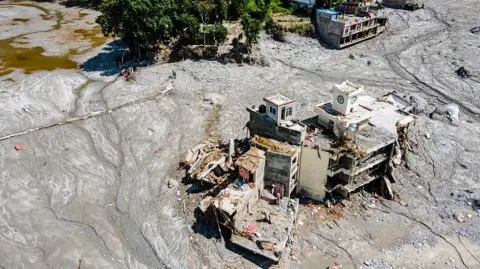
    Getty Images An aerial view shows the aftermath of flooding along the Bhotekoshi River on 26 August in Betrawati, on the border of Rasuwa and Nuwakot districts, Nepal, on August 31, 2026. Getty Images
    Hundreds of people were killed in the deadly flood that tore through the China-Nepal border in August

    But the initiative went nowhere, according to a scientist involved in the effort.

    “One meeting was held between us and the Chinese side and that was it, nothing came out of it,” said Dr DP Dobhal, a retired glaciologist who headed the glaciology programme at the Wadia Institute.

    “What happened after that no one knows,” he added.

    Since the early 2000s, India and China had agreements under which Beijing provided flood-season hydrological data on the Brahmaputra and Sutlej, two major rivers originating in Tibet.

    But in August 2025, India’s junior foreign minister Kirti Vardhan Singh told parliament that both agreements had expired. China had stopped sharing data on the Brahmaputra in June 2023, while India had received no data on the Sutlej since 2022.

    China has not publicly explained the latest interruption. But when it withheld similar information in 2017, amid a tense military stand-off with India, Beijing blamed technical problems at its hydrological monitoring stations in Tibet, Singh said.

    Some analysts see a glimmer of hope in the recent thaw between India and China, marked by high-level political engagement and moves to revive cross-border trade through Himalayan routes.

    “These developments suggest there might be more room for the three countries to explore climate-related co-operation,” says William Yang, senior analyst for North East Asia at the International Crisis Group.

    But he says Beijing is likely to remain cautious about any major agreement with India and Nepal, as border disputes remain unresolved.

    One major obstacle is that information vital for understanding climate risks can also have military value.

    “What climate scientists might see as essential research data might look like strategic intelligence to the national security establishment in an environment where two militaries face each other across a disputed frontier,” says Walter Ladwig, an associate fellow in the Indo-Pacific Programme at the Royal United Services Institute (RUSI), a UK-based defence and security think tank.
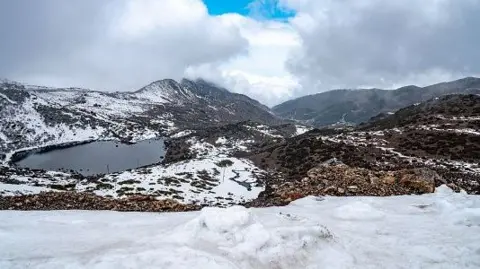
    Getty Images A temporary reservoirs form atop the snow-capped Himalayan mountains from melting snow on the way to Nathu La Pass in Phadamchen, Sikkim, India, on April 17, 2026. The Himalayas, known as Asia's ''Water Tower,'' are experiencing rapid snow melt, leading to a decrease in elevation over the past 23 years. This situation contributes to a water crisis potentially affecting two billion people in the region. A report by the International Centre for Integrated Mountain Development highlights that between November 2025 and March 2026, the rate of ''snow persistence'' was 27.8 percent below the historical average. The twelve major river basins in the Hindu Kush-Himalaya region depend on meltwater from the Himalayas, marking the fourth consecutive year of below-normal snow accumulation. (Photo by Soumyabrata Roy/NurPhoto via Getty Images)Getty Images
    Experts have raised concerns over climate-related risks as the Himalayan snow cover melts rapidly

    Such tensions have also hampered past efforts to tackle disasters that cross Himalayan borders.

    The Kathmandu-based International Centre for Integrated Mountain Development (ICIMOD) has spent more than three decades promoting regional co-operation, including on flood early-warning systems. But progress has been slow.

    “There are certain highly sensitive issues in transboundary matters like comprehensive data of river flows that countries might not want to share, particularly upstream countries,” says Arun Bhakta Shrestha, a former senior specialist at ICIMOD.

    He says countries should instead focus on sharing less sensitive information about disaster risks.

    Dr Uday Kala, head of the Centre for Climate Change and Disaster Management at India’s IIT Mandi, suggests starting with practical steps – jointly identifying high-risk glacial lakes and cross-border hazards, agreeing on basic data-sharing protocols and monitoring standards, and exchanging critical warnings without delay.

    “Climate change is moving the baseline itself; catching up with the previous disaster is no longer enough. We need to anticipate the next one,” he says.

    Whether India and China are willing to take even these steps remains uncertain.

    For Nepal, the challenge is to convince its two powerful neighbours to put aside their differences and work together to tackle a shared climate threat.

    The Himalayas
    India
    Nepal
    China
    Climate
    Asia
    Share. Facebook Twitter Pinterest LinkedIn Tumblr Email Telegram Copy Link
    Gulf News Week

    Related Posts

    Most Viewed News

    Toilet paper and secret recorders: What we know about the arrest of the Saudi OpenAI engineerAbdulrahman Alfozan had worked for the AI giant for more than a year before he was arrested by the FBI. 18 hrs agoTechnology

    October 15, 2026
    Most Viewed News

    LIVEAt least 28 killed in Pakistan school roof collapse as rescuers search for survivorsIn a statement, the office of Pakistan's President Asif Ali Zardari says "this heart-wrenching tragedy has plunged the entire nation into shock".

    October 15, 2026
    Most Viewed News

    Musk says US government may be behind slowdown of Ukraine drone speedsUkraine says Starlink access has improved but it is still facing speed limits which are disrupting its battlefield "missions".3 hrs agoEurope

    October 15, 2026
    Most Viewed News

    Retired US generals call on Pentagon to cancel 'barbaric' execution livestream Livestreaming the execution of Nidal Hasan "will taint the honor of the military that employs it, and a nation that allows it," 72 former officers said in a letter.4 hrs agoUS & Canada

    October 15, 2026
    Most Viewed News

    Hundreds of IDF investigations into killings without public outcome, BBC Verify findsBBC Verify has identified 254 incidents from the past three years the Israeli military said it is reviewing after being accused of harm.22 mins agoBBC Verify

    October 15, 2026
    Most Viewed News

    North Korea and China open new bridge after 12-year delayChina is the North's largest trading partner and a lifeline against the sanctions Pyongyang faces.1 hr agoAsia

    October 15, 2026
    Add A Comment
    Leave A Reply Cancel Reply

    Editors Picks

    Toilet paper and secret recorders: What we know about the arrest of the Saudi OpenAI engineerAbdulrahman Alfozan had worked for the AI giant for more than a year before he was arrested by the FBI. 18 hrs agoTechnology

    October 15, 2026

    India and China aren't friends – but Nepal wants to unite them against climate threatsCan Nepal bring the two regional giants together to confront a shared climate threat in the Himalayas?10 hrs agoAsia

    October 15, 2026

    LIVEAt least 28 killed in Pakistan school roof collapse as rescuers search for survivorsIn a statement, the office of Pakistan's President Asif Ali Zardari says "this heart-wrenching tragedy has plunged the entire nation into shock".

    October 15, 2026

    Musk says US government may be behind slowdown of Ukraine drone speedsUkraine says Starlink access has improved but it is still facing speed limits which are disrupting its battlefield "missions".3 hrs agoEurope

    October 15, 2026
    Latest Posts

    Toilet paper and secret recorders: What we know about the arrest of the Saudi OpenAI engineerAbdulrahman Alfozan had worked for the AI giant for more than a year before he was arrested by the FBI. 18 hrs agoTechnology

    October 15, 2026

    LIVEAt least 28 killed in Pakistan school roof collapse as rescuers search for survivorsIn a statement, the office of Pakistan's President Asif Ali Zardari says "this heart-wrenching tragedy has plunged the entire nation into shock".

    October 15, 2026

    Musk says US government may be behind slowdown of Ukraine drone speedsUkraine says Starlink access has improved but it is still facing speed limits which are disrupting its battlefield "missions".3 hrs agoEurope

    October 15, 2026

    Subscribe to News

    Get the latest sports news from NewsSite about world, sports and politics.

    Advertisement
    Demo
    Gulf News Week

    Your source for the serious news. This demo is crafted specifically to exhibit the use of the theme as a news site. Visit our main page for more demos.

    We're social. Connect with us:

    Facebook X (Twitter) Instagram Pinterest YouTube
    Latest Posts

    Toilet paper and secret recorders: What we know about the arrest of the Saudi OpenAI engineerAbdulrahman Alfozan had worked for the AI giant for more than a year before he was arrested by the FBI. 18 hrs agoTechnology

    October 15, 2026

    India and China aren't friends – but Nepal wants to unite them against climate threatsCan Nepal bring the two regional giants together to confront a shared climate threat in the Himalayas?10 hrs agoAsia

    October 15, 2026

    LIVEAt least 28 killed in Pakistan school roof collapse as rescuers search for survivorsIn a statement, the office of Pakistan's President Asif Ali Zardari says "this heart-wrenching tragedy has plunged the entire nation into shock".

    October 15, 2026

    Subscribe to Updates

    Get the latest creative news from FooBar about art, design and business.

    © 2026 Gulf News Week. Designed by HAM Digital Media.
    • Home
    • Politics
    • Economy
    • Sports

    Type above and press Enter to search. Press Esc to cancel.