
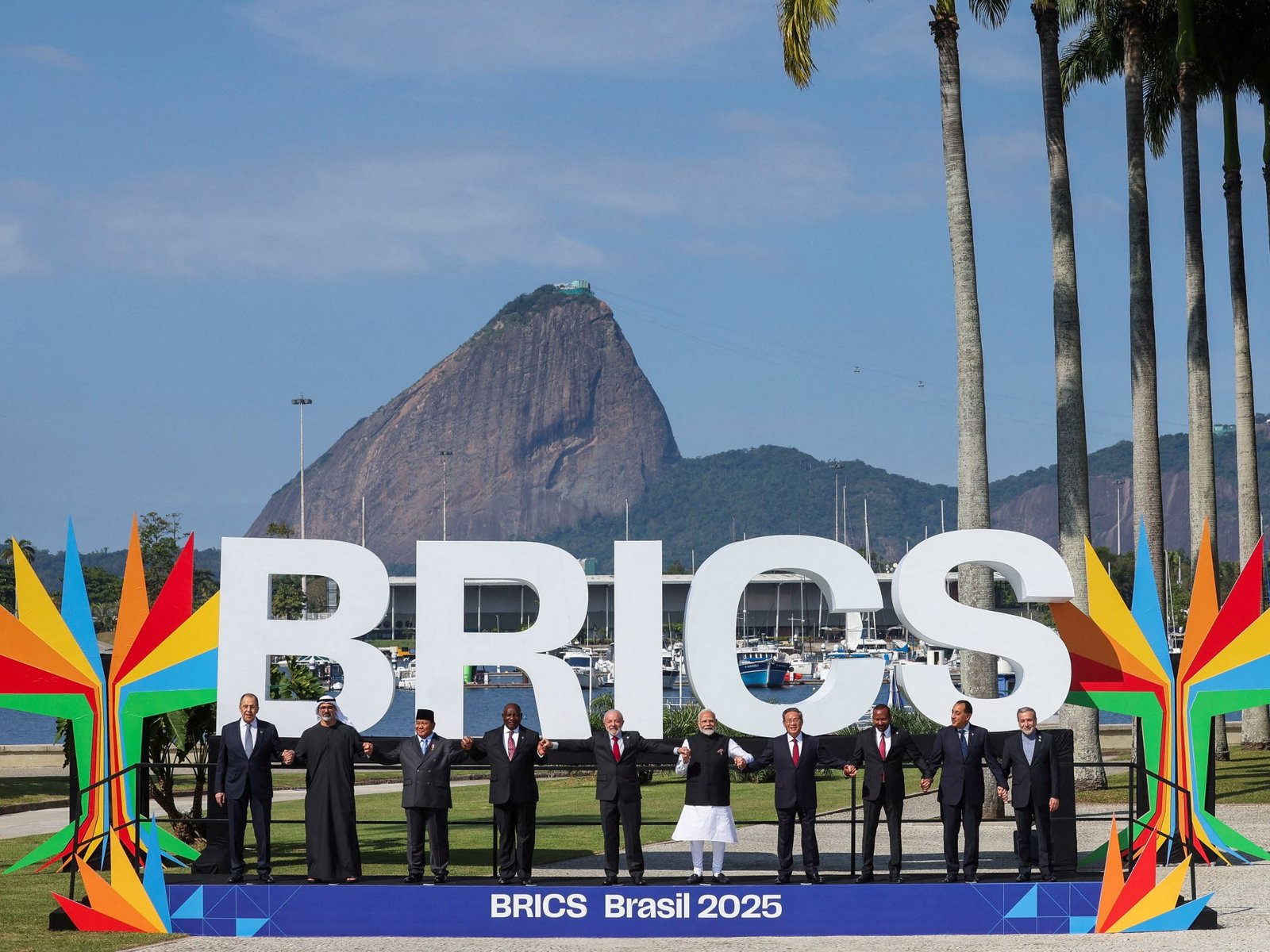
Bloc takes firm positions at summit on key global conflicts while avoiding criticism of Russia for the Ukraine war.
Leaders of the BRICS bloc have sharply rebuked the United States and Israeli bombardments of Iran in June, calling them a “blatant breach of international law” while voicing strong support for the creation of a Palestinian state.
But their joint declaration on Sunday, issued at a summit in the Brazilian city of Rio de Janeiro, was largely silent about another major war that is now in its fourth year and in which a founding BRICS member – Russia – is the aggressor: the conflict in Ukraine. Instead, it criticised Ukrainian attacks on Russian soil.
The carefully worded declaration, released amid escalating trade tensions with the US, condemned aggressive economic policies without directly naming US President Donald Trump. Almost all 10 members of BRICS, a bloc of emerging world economies, are currently engaged in sensitive trade talks with the US and are trying to assert their positions without provoking further tensions.
However, the BRICS statement did take aim at “unilateral tariff and non-tariff barriers” that “skew global trade and flout WTO [World Trade Organization] regulations”, a clear, though indirect critique of Trump’s protectionist agenda, before a deadline on Wednesday for new US tariffs to potentially kick in.
Trump responded to the BRICS declaration within hours, warning on his social media platform, Truth Social, that countries siding with what he termed “anti-American policies” would face added tariffs.
“Any Country aligning themselves with the Anti-American policies of BRICS, will be charged an ADDITIONAL 10% Tariff. There will be no exceptions to this policy,” he wrote.
Which countries are part of BRICS, and who attended the summit?
The first BRICS summit was held in 2009 with the leaders of Brazil, Russia, India and China coming together. South Africa joined in 2010, and the bloc has since become a major voice for the Global South.
Last year, Indonesia, Egypt, Ethiopia, Iran and the United Arab Emirates joined the group, expanding its influence further and turning the bloc into a 10-nation entity.
There is growing interest from emerging economies to join the bloc with more than 30 nations queueing up for membership. Argentina was expected to join but withdrew its application after ultra-conservative President Javier Milei, an ally of Trump, took office in December 2023.
The Rio summit was led by Brazilian President Luiz Inacio Lula da Silva. Most other member countries were represented by their leaders with three exceptions: Chinese President Xi Jinping, Russian President Vladimir Putin and Iranian President Masoud Pezeshkian were absent.
Xi had attended all previous BRICS summits since taking office in 2013 while Putin has avoided most international trips since the International Criminal Court (ICC) issued an arrest warrant against him over his role in the war on Ukraine in March 2023. Brazil is a member of the ICC and would have been required under the Rome Statute, which established the court, to arrest Putin if he visited.
Russia and Iran were represented by their foreign ministers and China by Premier Li Qiang.
This was the first summit attended by Indonesia after its induction into the bloc this year.
The BRICS statement also welcomed Belarus, Bolivia, Kazakhstan, Cuba, Nigeria, Malaysia, Thailand, Vietnam, Uganda and Uzbekistan as new BRICS partner countries – a status that places them on a perch below full membership and allows the bloc to increase cooperation with them.
Condemnation of US-Israel strikes on Iran
In their declaration, member states described the recent Israeli and American attacks on Iran as a “violation of international law”, expressing “grave concern” about the deteriorating security situation in the Middle East.
The conflict began on June 13 when Israel launched air strikes on Iranian military, nuclear and civilian sites, killing at least 935 people, including top military and scientific leaders. Iran’s Ministry of Health reported 5,332 people were injured.
Tehran retaliated with missile and drone strikes on Israel, killing at least 29 people and injuring hundreds more, according to figures from Israeli authorities.
A US-brokered ceasefire came into effect on June 24 although the US had supported Israeli strikes just days earlier by dropping bunker-buster bombs on Iranian nuclear facilities on June 21.
The BRICS statement underscored the importance of upholding “nuclear safeguards, safety, and security. … including in armed conflicts, to protect people and the environment from harm”.
Gaza war and Palestinian statehood
As Israel’s 21-month-long war on Gaza continues, BRICS denounced the use of starvation as a weapon of war and rejected the politicisation or militarisation of humanitarian aid.
The bloc threw its support behind UNRWA, the UN aid agency for Palestinian refugees, which has been banned by Israel.
In late May during its blockade on aid for Gaza, Israel allowed the Gaza Humanitarian Foundation (GHF), a private US organisation, to provide food to the people in the enclave. The move has been widely criticised by global rights bodies, especially since hundreds of Palestinians seeking aid have been shot and killed while approaching the GHF’s aid distribution sites.
BRICS also reaffirmed its position, one that is widely held globally, that Gaza and the occupied West Bank are both integral parts of a future Palestinian state with East Jerusalem as its capital.
On October 7, 2023, nearly 1,200 people were killed in Israel in Hamas attacks, during which Palestinian fighters also took more than 240 people captive. Since then, Israel has waged a war on Gaza, killing more than 57,000 Palestinians, the majority of them women and children, and destroying more than 70 percent of Gaza’s infrastructure. In that same period, Israel has also killed more than 1,000 people in the West Bank.
Opposition to unilateral sanctions
The BRICS declaration strongly condemned the imposition of “unilateral coercive measures”, such as economic sanctions, arguing that they violate international law and harm human rights.
BRICS members Iran and Russia have been targets of longstanding US sanctions.
After the 1979 Iranian Revolution and the attack on the US embassy in Tehran, Washington imposed a wide range of sanctions. Those were ramped up in the 2010s as the US under then-President Barack Obama tried to pressure Iran to negotiate a nuclear deal in exchange for sanctions relief. But two years after that deal came into effect, Trump, who succeeded Obama as president, pulled out of the agreement and slapped tough sanctions back on Iran. Since then, the US has imposed more sanctions on Iran, including a set of measures last week.
Russia, formerly the US’s Cold War rival, has also faced repeated waves of sanctions, particularly after its 2022 invasion of Ukraine.
Trump tariffs called a ‘threat’
With the global economy in turmoil over Trump’s trade policies, BRICS voiced concern over his tariffs regime.
Trump has set Wednesday as a deadline to finalise new trade agreements, after which countries failing to strike deals with Washington will face increased tariffs.
The BRICS bloc, a major force in the global economy, is projected to outpace global average gross domestic product growth in 2025.
According to April data from the International Monetary Fund, the economies of BRICS countries will collectively grow at 3.4 percent compared with a 2.8 percent global average.
The world’s top 10 economies by size include the wealthy Group of Seven nations – Canada, France, Germany, Italy, Japan, the United Kingdom and US – and three BRICS nations – Brazil, China and India.
The group warned that protectionist trade policies risk reducing global trade, disrupting supply chains and heightening economic uncertainty, undermining the world’s development goals.
Pahalgam attack condemned
Two months after the Pahalgam attack in India-administered Kashmir, in which gunmen killed 26 civilians, BRICS condemned the incident “in the strongest terms”.
But even with Indian Prime Minister Narendra Modi present, the statement did not mention Pakistan, which New Delhi has accused of supporting the attackers in April.
The two countries fought a four-day war in May after Indian strikes inside Pakistan and Pakistan-administered Kashmir. Pakistan has denied involvement in the Pahalgam attack and called for a “credible, transparent, independent” investigation.
The BRICS statement urged “zero tolerance” for “terrorism” and rejected any “double standards” in counterterrorism efforts.
Silence on Ukraine war
The lengthy statement made no direct mention of Russia’s war in Ukraine except to call for a “sustainable peace settlement”.
However, it did condemn Ukrainian strikes on Russian infrastructure in May and June, citing civilian casualties and expressing its “strongest” opposition to such actions.
