
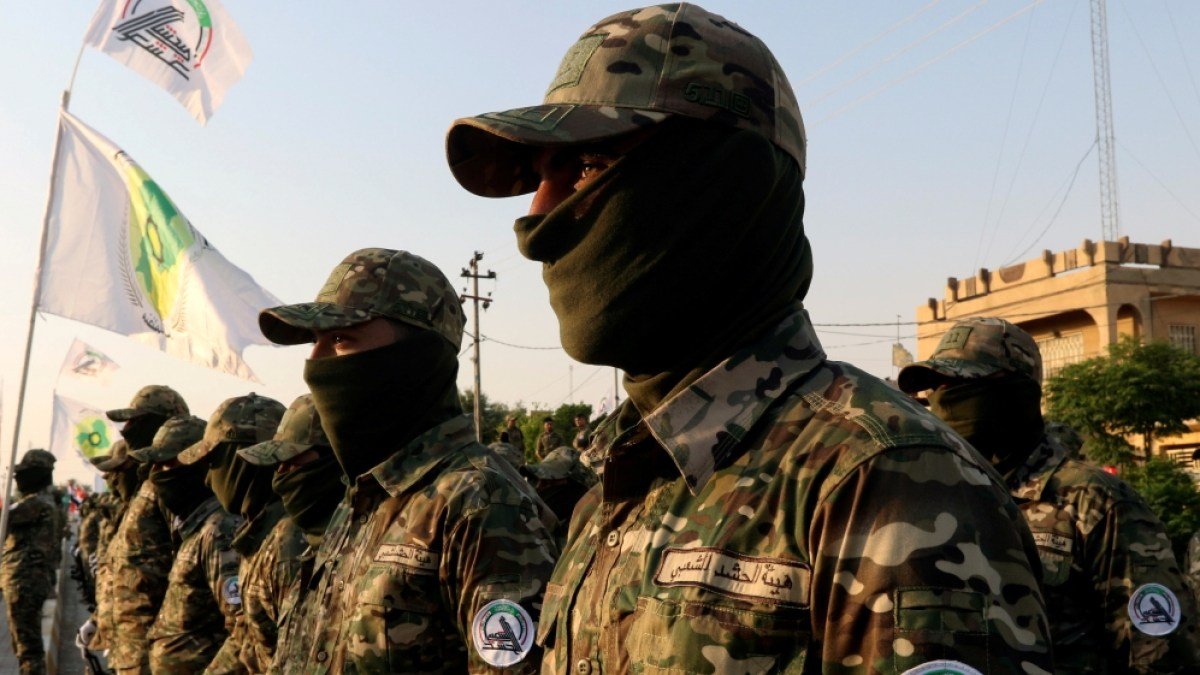
On July 27, two brigades from the mostly Shia Popular Mobilisation Forces (PMF) stormed the Iraqi Ministry of Agriculture, clashing with police.
While the incident could be seen as a power struggle for position, it also indicates a certain degree of daring on the part of the brigades, which ended up killing a police officer.
The brigades were called in by Ayad Kadhim Ali after he was dismissed as the head of the ministry’s office in Baghdad’s Karkh district, according to Mehmet Alaca, an expert on Iraq’s Shia militias. Ali is affiliated with Kataib Hezbollah, as are the brigades that attacked the ministry, analysts told media.
The incident is seen as a litmus test of whether the Iraqi state can hold PMF factions accountable for breaking the law.
Iraq’s government argues that passing a new legislation – which would fully integrate the PMF into the state – would help them do so. Proponents of the bill argue it would incentivise the PMF to act within the confines of the law, but detractors fear it would give legal cover to militias, which are already too strong.
The PMF
The PMF, also known as al-Hashd al-Shaabi, is an umbrella organisation of mostly Shia armed groups, some of whom have close ties to neighbouring Iran. A few of these groups first emerged during the Iraqi resistance to US occupation.
Asa’ib Ahl al-Haq, for instance, split from Jaish al-Mahdi, formerly the dominant arm of the Shia rebellion, in 2007. The group received Iranian support to become a major powerbroker in Iraq and later intervened in Syria’s civil war to support then-President Bashar al-Assad as he tried to crush a popular rebellion.
Kataib Imam Ali is another, albeit smaller, group in the PMF that reportedly received training from the Lebanese group Hezbollah in Iran and also dispatched fighters to Syria during the height of its war.
Like Kataib Imam Ali, most PMF factions were formed after Iraqi Grand Ayatollah Ali al-Sistani issued a fatwa in 2014, urging all able-bodied men to join the state to defend Iraq from ISIL (ISIS).
At the time, ISIL controlled large swaths of territory across Syria and Iraq, equivalent to the size of England. ISIL even captured the Iraqi city of Mosul and declared a “caliphate” from there.
By 2016, Iraq’s parliament had passed a law that recognised the PMF as a component of the state’s national security.
But the law lacks clarity around command and control and budgetary oversight, and it has failed to prevent some groups from taking unilateral action to attack United States assets and soldiers stationed in the country.
In 2024, for instance, the PMF was awarded a budget of $3.4bn, which exceeded the total budget of Lebanon.
While the figure is small relative to the $21.1bn allocated to Iraq’s Ministry of Defence that same year, it is a sizeable amount that the state allocated to a body that it did not even have an accurate membership list for.
Each registered PMF faction submits a list of names to be paid, and these lists are then reviewed by the Ministry of Finance. However, PMF leaders often intervene to push payments through unchallenged, according to a 2021 report by the Chatham House think tank.
Estimates suggested there are 238,000 PMF fighters.
Receiving a share of the state budget has helped the PMF in its quest to brand itself as a legitimate entity in Iraq.
“From the beginning, the PMF was adamant that it was part of the state and not a militia,” said Renad Mansour, an expert on Iraq with Chatham House.
Over the past 10 years, PMF factions have created political wings, run in parliamentary elections and gained access to lucrative state money after securing important administrative positions in key ministries.
Yet as they accrued power, some used their arms against the state to safeguard their patronage networks and influence over key ministries.
In 2021, PMF groups linked to Iran launched a drone at the home of then-Prime Minister Mustafa al-Kadhimi, reportedly an attempt to upend the government after losing many parliamentary seats and thus access to state money in the recent elections, said Alaca, the expert on Iraqi Shia militias.
The new law
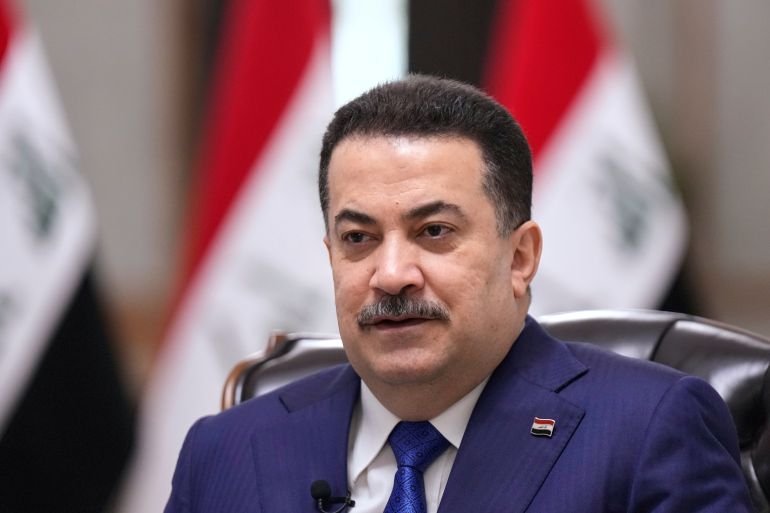
The Iraqi government drafted the new law in March. It would give all PMF factions official, stable employment and bring them under the control of Prime Minister Mohamed Shia al-Sudani as commander-in-chief
Proponents of the draft law mainly include a bloc of five Shia parties known as the Coordination Framework.
“The argument pushed by those advocating for the law is that by offering an institutional safe haven for armed factions under a reformed PMF, it would incentivise those to comply with the national chain of command – thereby diminishing their appetite to take action outside the state,” explained Inna Rudolf, an expert on the PMF and a senior research fellow at the Centre for Statecraft & National Security at King’s College London.
Most importantly to the PMF, the law offers it much-needed legal cover at a time when the US and Israel are threatening to target groups they consider Iranian proxies.
It would grant PMF members full access to intelligence, which some argue is a risky proposition because the intelligence could be passed to Iran.
Analysts have said, however, that many PMF factions would be more concerned about their power base and assets than about following Iranian interests.
During the 12-day Israel-Iran war in June, PMF groups did not attack US assets or personnel, likely out of fear of giving Israel a pretext to attack their command structure and resources as Israel did against Hezbollah, according to a report by the Royal United Services Institute.
“I would say that the stronger and more embedded PMF groups are the ones who have been practising restraint and telling the smaller [pro-Iran] factions not to get involved in the regional conflict [between Iran and Israel],” Mansour said.
The follow-up on the Ministry of Agriculture incident will test the willingness of PMF commanders to cooperate with the state to hold their own members accountable, as well as the state’s seriousness in holding PMF members accountable, according to Rudolf.
She said al-Sudani has shown “strong will” by referring all those involved in the raid to the judiciary and calling for the formation of a review committee to investigate “negligence in leadership and control duties” within the PMF.
“Sudani’s administration wants to demonstrate power over the PMF and [to prove] that everyone affiliated with it not only has the same privileges as members of the security forces but has to abide by the same code of conduct,” Rudolf told media.
Pressures against the new law
Not everybody in Iraq supports the PMF’s integration, said Zeidon al-Kinani, an expert on Iraq and adjunct instructor at Georgetown University in Qatar.
He said many PMF factions harmed and even killed hundreds of young protesters who were demonstrating against what they considered a corrupt political elite in 2019.
As a result, civil society is wary of seeing all PMF factions given the same privileges as Iraq’s army and police and would prefer the government absorb only those that do not have close ties with Iran, al-Kinani said.
US officials are also pressuring Iraq not to pass the law with Secretary of State Marco Rubio reportedly telling al-Sudani the law would “institutionalise Iranian influence and armed terrorist groups undermining Iraq’s sovereignty”.
Former and current Iraqi officials argued that the state cannot disband the PMF and any attempt to do so could trigger sectarian violence.
Al-Kinani warned that the US could trigger a conflict by making unreasonable demands without supporting Iraq to carry them out.
“When it comes to Iraq, the US makes drastic demands [without] supporting the Iraqi government or civil society to ensure their protection from any repercussions,” he told media.
