
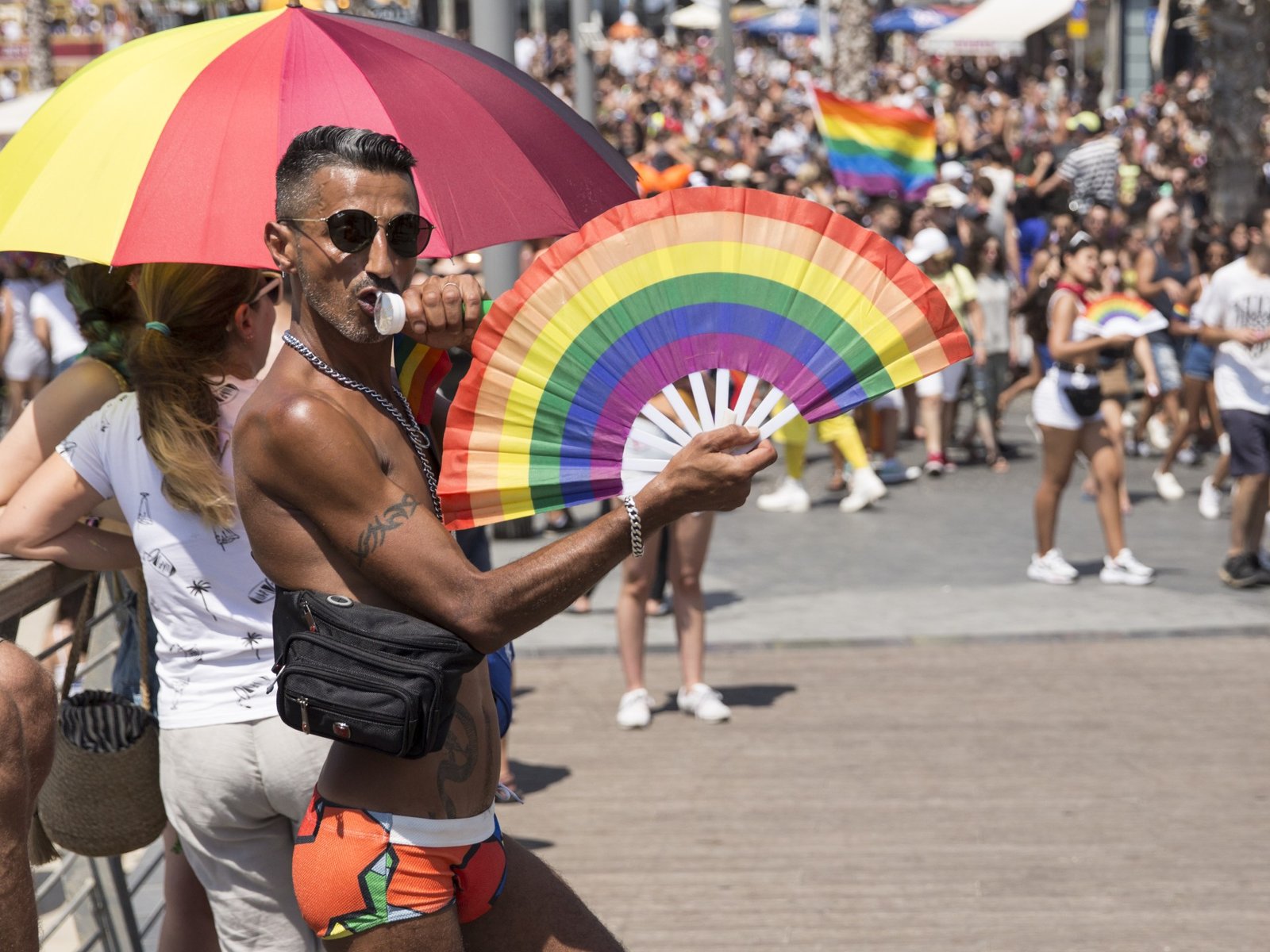
From Sun City under apartheid to Woodstock during Vietnam, colonial and imperial regimes have always used leisure to mask brutality. Today, Israel’s pride parades, travel culture and trance festivals do the same.
Some 4,000 miles (6,000km) away from Gaza, in the mangrove-thick hills of Goa, young Israelis stamp the earth to trance music. Here, you will not hear mothers wailing over white shrouds. The genocide is elsewhere, and that is the point.
Across backpacker trails, from Andean valleys to Thai beaches, a similar scene plays out. Israelis call it “tarmila’ut”: a post-military “rite of passage” and a chance, as DJ Zirkin puts it, to “go insane peacefully”.
It is not just for hippies, either. A 2018 Israeli study called it “practically institutionalised”, estimating that about 50,000 travel each year after service. For a few thousand dollars, agencies advertise all-inclusive amnesia: discounted flights, kosher kitchens, and five-star hotels where Palestinians do not exist.
Two years after the Nova music festival massacre, and amid genocide in Gaza, the idea of “escape” has taken on a different meaning. Israelis want to travel abroad to escape the ha’matzav, literally “the situation” – an absurd euphemism that reduces occupation to inconvenience. For Palestinians, there is no escape: Gaza’s seas, skies, and crossings are sealed. While Israelis “go insane peacefully”, Palestinians are driven insane without peace.
For three years, they stand at checkpoints in the occupied West Bank, their slight frames made lethal by the M16 across their chests. Then the state all but hands them a backpack and a one-way ticket. This pilgrimage is not only a reward for what they have done, but it hides their crimes in a zipped pocket, hoping they never return.
Fun for some
It is no wonder tarmila’ut has become almost an obligatory tradition in Israel; the state encourages it, just as it invests in other escapes such as Eurovision and Brand Israel.
In Aldous Huxley’s Brave New World, the state-controlled drug soma did not just induce feelings of relaxation and happiness; it helped the user forget. Israeli escapism works similarly; it recognises that pleasure is inherently political.
Israel’s own diplomats admitted as much, too. “We see culture as a propaganda tool of the first rank, and I do not differentiate between propaganda and culture,” said Nissim Ben-Shitrit of the Ministry of Foreign Affairs in 2005. Three years later, another Israeli diplomat, Ido Aharoni, put it more bluntly: “It is more important for Israel to be attractive than to be right.”
Exporting Israeli “culture” does what Israel’s military spokespeople cannot: it sells occupation as lifestyle and proves that violence can coexist with normalcy, even fun.
In Israel, it offers catharsis without confrontation, a chance to “lose yourself” while denying genocide. In these spaces, Palestinians are not just excluded; their very existence is seen as interrupting someone else’s peace.
Abroad, it depicts Israelis as carefree and liberal, a fantasy Western audiences can enjoy guilt-free. Israelis are introduced as “one of us”; Palestinians, as those who spoil the party.
Hasbara with glitter
Keeping this party going is, quite literally, a national project. For decades, Israel has pumped millions into projecting itself as a place of indulgence.
Take Brand Israel. Launched in 2006, it was a state-engineered rebrand, swapping checkpoints for bikinis and beaches.
It began when diplomat Ido Aharoni pulled together a top team, including representatives from PR firms like Burson-Marsteller, infamous for whitewashing the Argentinian junta and Union Carbide after the Bhopal disaster. As Aharoni admitted, the goal was not to make Israel right but to make it attractive. With the most ruthless of reputation launderers in charge, it is clear decency was not either.
One of Brand Israel’s first stunts was a Maxim spread for the American male gaze titled “Women of the Israeli Defence Forces”, featuring recently crowned “Miss Israel” Gal Gadot in lingerie. Had it appeared in 2025, we might have called it “settler colonialism does thirst traps”.
When that wore thin, Brand Israel swapped lingerie for pride parades. By 2011, the Israeli Tourism Board was spending about $100m to market Tel Aviv as a “gay vacation destination”.
Pinkwashing has since become state policy, and glitter still clings to Tel Aviv. It paints Israelis as desirable and Palestinians as backwards, selling the fantasy that Israel protects queer Palestinians. As Elias Jahshan writes, it is a neat colonial trick: bombs wrapped in rainbow paper, or, today, in the colours of whatever regional minority Israel champions to sow discord.
Dancing on bones
Strip away the parties, the parades and the festivals, and the truth emerges: Israel has turned the pursuit of happiness into a political weapon. And it is not the first – apartheid South Africa did the same, with its cricket tours and Sun City, turning leisure into cover for colonial rule.
Now in Goa, as elsewhere, locals are complaining about Israeli travellers, with entire Reddit threads dedicated to their sense of privilege. They say that Israelis treat their enjoyment as a birthright, just as they treat Palestine itself as something owed to them.
I witnessed it, too. While living near French Hill, an illegal Israeli settlement beside the Shu’fat refugee camp in occupied East Jerusalem, I heard Israelis, inconvenienced by the consequences of their own occupation, repeat the same phrase over and over: “Why can’t we just have fun?”
That phrase – more often than not petulantly delivered in a faux-American accent – captures the arrested development of Israeli society: craving peace while waging war, insisting on enjoyment while erasing others. Joy, like the country itself, becomes a system of apartheid. The indulgences of life are reserved for one people, withheld from another, and peddled to the world as harmless escapism.
Apartheid South Africa had Sun City. America had Woodstock while napalm fell on Vietnam. Israel has Goa and Tel Aviv Pride. They claim that their joy proves their innocence. But joy built on the bones of others was never joy and will not last.
The views expressed in this article are the author’s own and do not necessarily reflect media’s editorial stance.
