
A former political prisoner is facing calls for deportation while war criminals are welcomed with opened arms.
The intensity of the current backlash against Alaa Abdelfattah in Britain is striking – not because it reflects a renewed concern for justice, but because it exposes how selectively outrage is deployed.
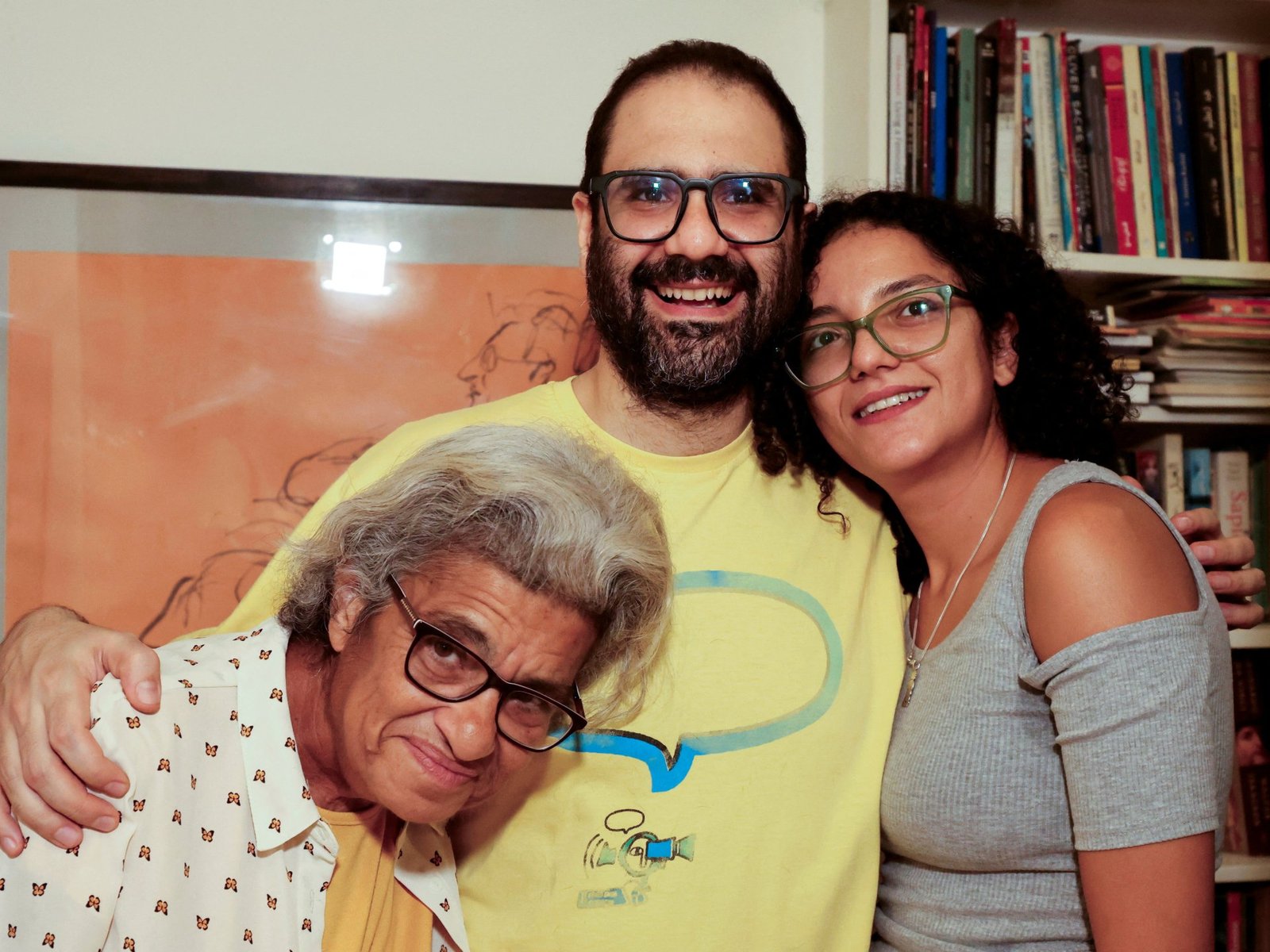
Alaa, an Egyptian-British writer and activist, spent more than a decade in and out of Egyptian prisons following the 2011 uprising that toppled President Hosni Mubarak. His detention was marked by prolonged hunger strikes, denial of basic rights and treatment that human rights organisations described as cruel and degrading. He was released on September 23 after a years-long campaign by his mother, sister and close friends. A travel ban on him was lifted only this month, and he was able to join his family in the UK on December 26.
Alaa left behind a decade of repression in Cairo only to be welcomed in London with public attacks and a call for the revocation of his British citizenship and his deportation. Public hostility was whipped up by the uncovering of a social media post from 2010 in which Alaa said he considered “killing any colonialists … heroic”, including Zionists.
The tweet has been widely condemned, referred to the counter-terrorism police for review, and seized upon by politicians calling for punitive measures.
The speed and intensity of this reaction stand in stark contrast to the silence surrounding far more consequential statements and actions that the UK not only tolerates but actively enables.
This is what selective outrage looks like.
While Alaa’s words are dissected and framed as a moral emergency, the UK continues to host and collaborate with senior Israeli officials who have been accused of participating in and inciting genocide.
In July, for example, Israel’s air force chief Tomer Bar – the man who has overseen the carpet bombing of Gaza, destruction of hospitals, schools and homes and the extermination of entire families – was granted special legal immunity to visit the UK. Reporting by Declassified UK showed that this immunity shielded him from arrest for war crimes while on British soil.
There has been no comparable outcry over this.
Israeli President Isaac Herzog was also able to pay a visit to the UK in September and hold high-level meetings. This is the same man who, at the start of the genocide, suggested that the “entire [Palestinian] nation” is responsible and that “This rhetoric about civilians not aware, not involved – it’s not true.” This and other statements by Herzog have been collected in a large database that currently supports the genocide case against Israel at the International Court of Justice (ICJ).
Yet, despite being accused of incitement to genocide, the Israeli president entered the UK without a problem and was welcomed by Prime Minister Keir Starmer. Those quarters concerned about Alaa’s tweet displayed no outrage over the visit of a potential war criminal.
They have also been silent about British citizens who have travelled to serve in the Israeli military, including during Israel’s offensives in Gaza and the ongoing genocide. These operations, documented by the United Nations, Amnesty International and Human Rights Watch, have resulted in tens of thousands of civilian deaths, the destruction of hospitals and universities, and the devastation of entire neighbourhoods.
Despite extensive documentation of war crimes and crimes against humanity, and the ICJ’s warning of a serious risk of genocide, there has been no systematic investigation into whether British nationals may have been involved in violations of international law.
Again, there is little sustained outrage.
At the same time, the UK continues to license arms exports to Israel and to engage in political, military and intelligence cooperation. These policies have persisted even as international bodies have warned of grave humanitarian consequences and potential violations of international law. All of this unfolds with relatively little political cost.
And yet it is a decade-old tweet – not mass killing, not siege, not the destruction of civilian life on a vast scale, not incitement to genocide – that triggers political panic in the UK.
This contrast is not incidental. It reveals a hierarchy of outrage in which dissenting voices are policed and punished, and state violence is not, and in which public hostility is directed downward at individuals rather than upward at power. Alaa’s case shows how moral language is deployed selectively – not to restrain impunity, but to manage discomfort.
This asymmetry corrodes the credibility of the principles the UK claims to uphold. When human rights are defended selectively, they become tools of convenience rather than universal norms. When outrage is loud but inconsistent, it becomes performative. And when accountability is withheld from powerful allies, impunity hardens into policy.
Those who defend this approach often invoke “quiet diplomacy”, arguing that restraint is more effective than confrontation. Yet there is little evidence that silence has delivered accountability – either for Alaa or for civilians subjected to mass violence in Gaza. In both cases, discretion has functioned less as a strategy than as permission.
The UK has the tools to act differently: Suspending arms exports, investigating potential crimes by its nationals, conditioning cooperation on respect for international law, restricting visits by officials implicated in serious abuses. That these tools remain largely unused is itself revealing.
Until that changes, outrage will remain selective, accountability conditional, and impunity intact – widening the gap between the values the UK professes and the violence it continues to enable.
The views expressed in this article are the author’s own and do not necessarily reflect media’s editorial stance.
