
Sanctions would.
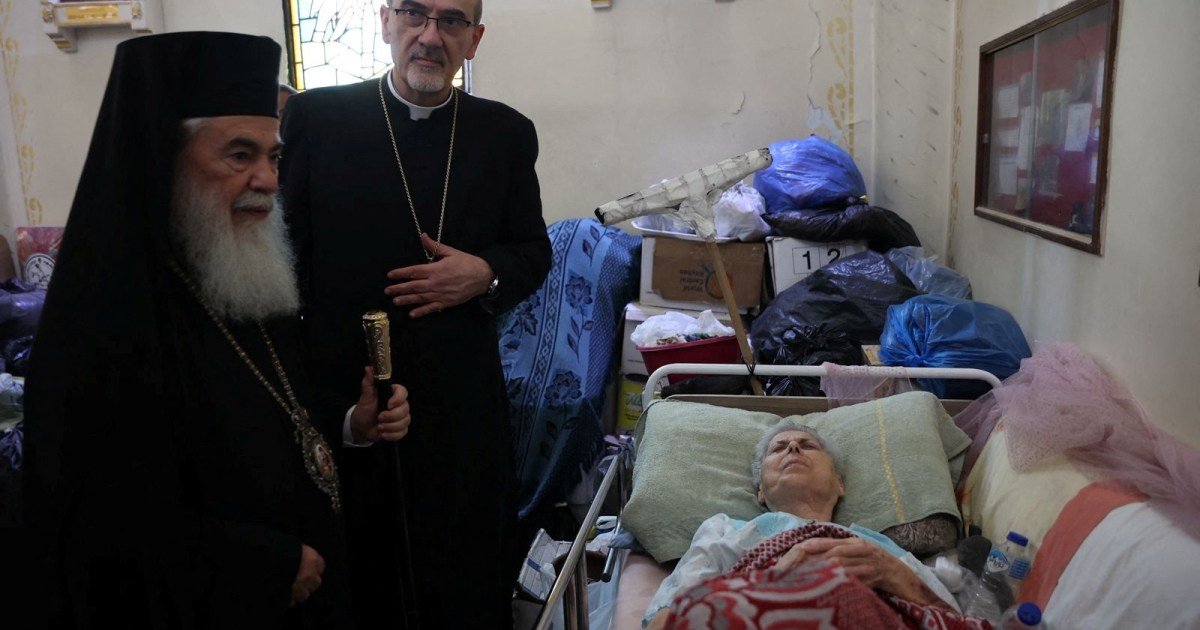
On July 17, the Israeli army bombed the sole Catholic church in Gaza, killing three people and injuring at least 10. The parish priest, Gabriele Romanelli, who used to have almost daily calls with the late Pope Francis, was among the wounded.
After the attack, there were statements of condemnation. Italian Prime Minister Giorgia Meloni called it “unacceptable”. Pope Leo said he was “deeply saddened” by it – a statement many saw as “vague” and “cowardly”.
The Israeli government was quick to declare it “regretted” the attack.
Amid the global outrage, the Latin Patriarchate of Jerusalem was able to negotiate for church officials to visit the Christian community, deliver limited food and medicine to both Christian and Muslim families, and evacuate some of the injured for treatment outside Gaza.
These humanitarian actions, while welcomed by those in dire need in Gaza, are yet another sign of international failure. Why must the delivery of food, water and medicine be “earned” through negotiation? Why are basic rights enshrined in international law subject to political bargaining?
Palestinians deeply appreciate the church leaders’ efforts. Their actions reflect compassion and moral clarity. But such steps should not be necessary. Under international humanitarian law, occupying powers have binding obligations to the people under their control. Securing access to food, water, medicine and critical services cannot be charitable favours – they are legal duties.
The 1949 Fourth Geneva Convention and the 1907 Hague Regulations clearly state that civilians in occupied territory must be protected and provided with essential services, especially when the occupying power controls access to borders, infrastructure and life-sustaining resources. Blocking or delaying aid isn’t just inhumane – it amounts to a war crime.
International law also forbids the occupying power from forcibly transferring the local population or settling its own citizens on occupied land – practices that Israel continues in Gaza and the West Bank with impunity. The occupier must ensure uninterrupted humanitarian access free from delay, political conditions or coercive trade-offs.
Israel has failed to comply on all these counts. But instead of facing consequences for its use of collective punishment, starvation tactics and attacks on civilian infrastructure – churches, hospitals, bakeries, schools – Israel receives concessions in exchange for promising to comply with basic legal norms. These “deals” are then spun as diplomatic “successes” by the powers that engage in them.
During a recent lecture in Amman, the European Union’s ambassador to Jordan, Pierre-Christophe Chatzisavas, revealed as much. According to him, EU “discussions” about taking action on Israel’s failure to comply with human rights provisions of the EU-Israel partnership agreement led to “effective political pressure”. As a result, Israel “agreed” to allow increased food and aid deliveries, fuel for electricity and desalination, infrastructure repairs, the reopening of humanitarian corridors through Egypt and Jordan, and access for UN aid workers and observers.
This agreement led to the shelving of 10 proposed sanctions by the EU. Amnesty International described the move as a “cruel and unlawful betrayal” of its stated principles.
The problem with this “deal” is that Israel is failing to implement it, just like with all others before it. According to EU sources quoted in the media, Israel allows just 80 trucks per day to go in, when Gaza needs more than 500. Whether 80 trucks indeed enter and how much of this aid actually reaches its intended recipients is unclear.
Gangs regularly attack aid convoys, and the Israeli army shoots at anyone trying to protect these trucks from looters.
Various agencies and organisations are ringing alarm bells about the epidemic of malnutrition killing children on a daily basis. Famine is real even if the UN, under pressure, is not yet willing to declare it.
Meanwhile, Israeli forces and foreign mercenaries continue to kill people seeking aid at distribution sites operated by the Israeli-backed Gaza Humanitarian Foundation (GHF), which was set up to take away the functions of United Nations agencies, most notably UNRWA, its aid agency for Palestinian refugees. Nearly 900 people have been killed at these sites since GHF’s operations began in late May.
If the EU as a whole will not act, individual member states still bear legal responsibility. At a minimum, European countries should suspend arms transfers, ban trade with illegal settlements and end cooperation with institutions complicit in the occupation and apartheid. These are not optional political stances. They are legal obligations. And this applies to the rest of the world.
The danger of appealing to Israel to allow in aid instead of forcing it to do so through sanctions is clear: When war crimes are overlooked in exchange for temporary relief, impunity becomes normalised. Starvation becomes an acceptable weapon of war. Civilian lives turn into bargaining chips.
The international community – including the EU, church institutions and world leaders – must continue to extend compassion and aid. But this must not replace justice. Mercy should be paired with resolve: Israel must be held to its legal and moral obligations. Palestinians – Christian and Muslim – must not be treated as pawns but as human beings entitled to dignity, safety and peace.
The views expressed in this article are the author’s own and do not necessarily reflect media’s editorial stance.
