
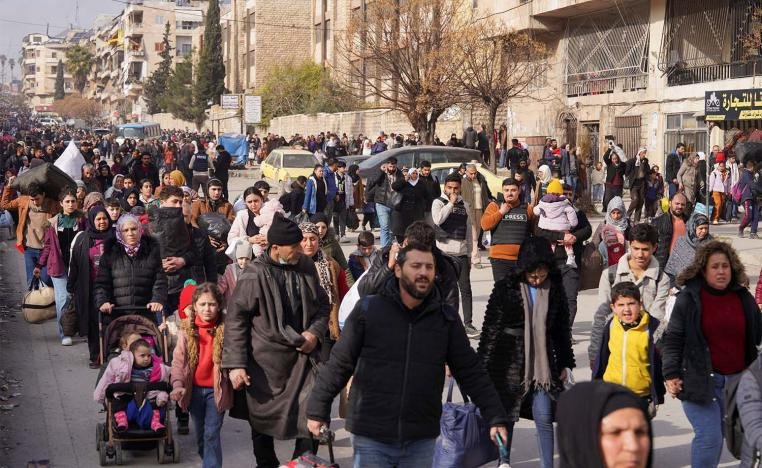
Clashes resume after Kurdish forces reject withdrawal ultimatum; over 140,000 displaced as international mediators seek to prevent wider conflict.
ALEPPO, Syria – Syrian military forces are advancing into the last Kurdish-held district of Aleppo after a government ceasefire ultimatum was rejected by Kurdish groups, security officials confirmed Friday.
The breakdown in talks marks a critical escalation in Syria’s protracted conflict, pitting President Ahmed Al-Sharaa’s government against Kurdish forces who have controlled several Aleppo neighborhoods since the early stages of the civil war.
A temporary ceasefire announced overnight by Damascus had demanded Kurdish fighters withdraw to northeastern Syria by 9 a.m. local time. Kurdish authorities in the Sheikh Maksoud and Ashrafiyah districts dismissed the order as “a call to surrender,” vowing instead to defend their areas.
“The ceasefire efforts have failed,” two Syrian security officials told Reuters. “The army will seize the neighborhood by force.”
Humanitarian Crisis Deepens
The renewed fighting has already displaced more than 140,000 residents and left at least nine civilians dead. Kurdish officials accused government forces of striking a hospital—a claim denied by Damascus, which said it targeted an arms depot. The Syrian defense ministry said Kurdish-led attacks killed three soldiers Friday.
International Response
France and the United States are leading diplomatic efforts to de-escalate the situation. French President Emmanuel Macron urged restraint in a call with Sharaa on Thursday, while U.S. envoy Tom Barrack—reportedly en route to Damascus—had earlier expressed hope for a lasting ceasefire.
The confrontation highlights unresolved tensions over Kurdish autonomy and military integration. Although a March 2025 agreement required the Kurdish-led Syrian Democratic Forces (SDF) to merge with the national army by year’s end, implementation has stalled.
Regional Stakes
Turkiye, which considers the SDF a terrorist group linked to the PKK, has warned of military intervention if the integration pact is not honored. Meanwhile, President Sharaa told Iraqi Kurdish leader Masoud Barzani that Kurds remain “a fundamental part of the Syrian national fabric”—a reassurance contrasted by Kurdish authorities’ declared distrust of Damascus.
The outcome in Aleppo could redefine power dynamics in northern Syria and test international diplomacy aimed at preserving a fragile postwar stability.
