
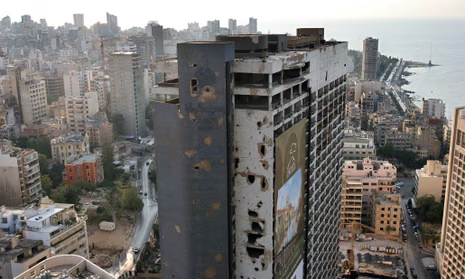
Iconic Hamra district hotel that served as a lifeline for journalists during Lebanon’s civil war shuts its doors amid ongoing economic crisis.
BEIRUT – The Commodore Hotel, whose bullet-scarred walls sheltered generations of foreign correspondents during Lebanon’s civil war and became synonymous with conflict journalism, has closed permanently, victims of Lebanon’s protracted economic collapse and regional instability.
Located in Beirut’s once-bustling Hamra district, the nine-story hotel’s gates were locked this week, ending its 81-year history. Management declined to comment on the closure, which coincides with a severe downturn in Lebanon’s tourism and hospitality sectors despite a fragile economic recovery.
For journalists who covered Lebanon’s 1975-1990 civil war, the Commodore was far more than lodging—it was a fortress, newsroom, and communications hub rolled into one. When shelling crippled Beirut’s infrastructure, the hotel maintained working landlines and Telex machines, while armed guards provided a semblance of security.
“On one occasion, [late Palestinian leader] Yasser Arafat himself dropped in to sip coffee,” recalled Tim Llewellyn, a former BBC Middle East correspondent who frequented the hotel. “The Commodore was a hub of information—various guerrilla leaders, diplomats, spies and of course scores of journalists circled the bars, cafes and lounges.”
A Sanctuary in Chaos
At the height of the war, the hotel’s lobby housed teleprinters feeding real-time reports from The Associated Press and Reuters—precious conduits to the outside world. The hotel’s manager, Yusuf Nazzal, cultivated its reputation by extending credit to cash-strapped journalists and ensuring communications remained operational even during the heaviest fighting.
“The friendly staff and the camaraderie among the journalist-guests made the Commodore seem more like a social club where you could unwind after a day in one of the world’s most dangerous cities,” said Robert H. Reid, AP’s former Middle East regional editor.
The hotel bore witness to history’s darker chapters as well. AP correspondent Terry Anderson—later kidnapped and held hostage for seven years—was a regular; his captors later released videos showing him wearing a Commodore Hotel T-shirt. The hotel itself was damaged in 1987 factional fighting and rebuilt in 1996, but never fully regained its wartime prominence.
Symbols and Legends
Perhaps the hotel’s most famous resident was Coco, a parrot whose cage stood near the bar and who unnerved patrons by perfectly mimicking the whistle of incoming shells. The bird disappeared during the 1987 fighting, allegedly taken by a militiaman.
While the parrot is gone, memories of the Commodore’s unique role endure. “It was a lifeline for the international media in West Beirut, where journalists filed, ate, drank, slept, and hid from air raids,” said former AP correspondent Scheherezade Faramarzi.
The closure reflects broader struggles facing Lebanon, where businesses grapple with daily power cuts, soaring generator costs, and the lingering impact of the 2024 Israel-Hezbollah conflict. Several historic hotels have shuttered in recent years as tourism dwindled.
For those who knew it in its heyday, the Commodore’s locked doors represent more than a business failure—they mark the end of an era in war reporting, when a quirky hotel with a noisy parrot became an unlikely pillar of global journalism.
