
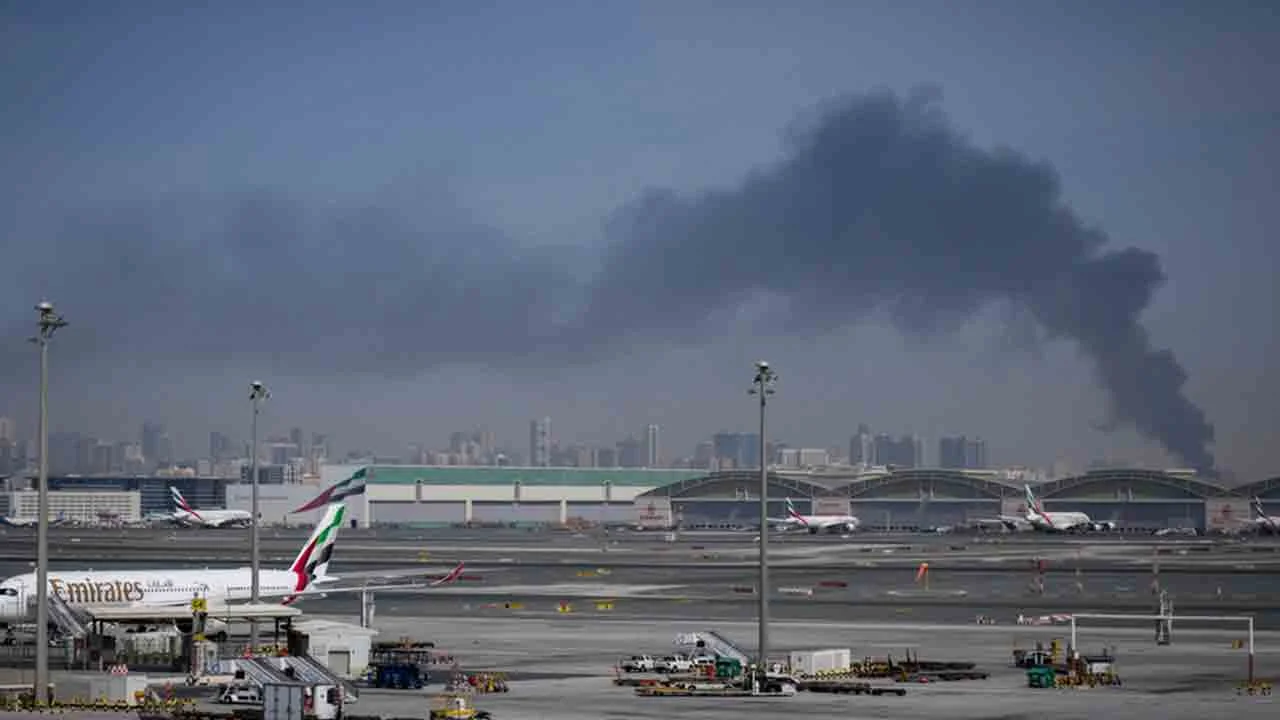
Dubai suspended all flight operations at its main international airport on Saturday after explosions were heard across the city and air defence systems were activated, underscoring how the expanding war between Iran, the United States and Israel is now disrupting one of the world’s most important aviation hubs.
Authorities halted operations at Dubai International Airport (DXB) — the world’s busiest airport for international passengers — citing safety concerns as missile threats and interceptions triggered emergency alerts across the emirate.
The suspension was ordered “for the safety of passengers, airport staff and airline crew,” the Dubai government said.
Air defence systems were activated as part of emergency protocols, while passengers inside the sprawling airport complex were escorted into underground train tunnels and other sheltered areas after warning alarms sounded.
Witnesses reported hearing multiple explosions over the city. One witness told AFP that a blast was heard above the airport followed by a plume of smoke in the sky, while several residents told The Associated Press they heard explosions across different parts of Dubai.
Emirates suspends flights
Dubai-based carrier Emirates confirmed that all flights to and from the emirate had been suspended until further notice.
“Due to the current situation, all flights to and from Dubai have been suspended until further notice,” the airline said in a travel advisory.
Passengers scheduled to travel between February 28 and March 31 have been offered options to rebook flights or request refunds as airlines scramble to adjust operations.
Confusion amid social media reports
Earlier in the day, the Dubai Media Office had dismissed circulating social media reports claiming there had been a direct incident at the airport.
Officials clarified that the airport itself had not been struck and said a minor incident in the city was linked to debris from an intercepted projectile.
“No injuries have been reported,” authorities said, adding that the situation had been quickly contained.
Airspace disruptions
Flight-tracking data from FlightRadar24 showed limited aircraft movements over Dubai during the incident, with several flights delayed or rerouted.
The airport’s website indicated average delays of 60 to 90 minutes, although some flights continued to appear as scheduled arrivals or departures as airlines assessed the situation.
Meanwhile, alternative regional hubs including Abu Dhabi’s Zayed International Airport, Sharjah Airport and Fujairah International Airport continued operating limited services, helping airlines move stranded passengers.
Special flights have also been arranged to return Indian nationals to cities including Delhi, Mumbai and Hyderabad.
Aviation hub under pressure
Dubai’s airport normally handles tens of millions of passengers annually and serves as the primary hub for Emirates, one of the world’s largest long-haul airlines.
The temporary shutdown highlights how the escalating regional conflict is beginning to affect global aviation networks.
The Middle East war entered its eighth day on Saturday, with missile exchanges spreading across several countries and forcing airlines to repeatedly reroute aircraft away from parts of the Gulf and neighbouring airspace.
City on high alert
The latest incident follows earlier attacks linked to the conflict.
Last week, four airport staff members were injured and part of a concourse was damaged when debris fell near the airport as the war erupted following US-Israeli strikes against Iran.
Iranian retaliatory attacks have also reportedly struck areas including Palm Jumeirah and the Burj Al Arab, while drone debris sparked a fire near the US consulate in Dubai earlier this week.
While authorities say the latest situation has been contained, the incident underscores the growing security risks facing Gulf cities as the conflict intensifies across the region.
