Close Menu
    What's Hot

    Iraq Jails Five for Life in Record Amphetamine Seizure in Anbar Province

    February 11, 2026

    Saudi Vision 2030: Equestrian Projects Take Centre Stage as Qiddiya Unveils New Racecourse

    February 11, 2026

    Weaker Rupee, Gift City Push NRIs in UAE Toward India Life Insurance

    February 11, 2026
    Facebook X (Twitter) Instagram
    • Politics
    • Economy
    Facebook X (Twitter) Instagram
    Gulf News Week
    Subscribe
    Wednesday, February 11
    • Home
    • Politics
      • Europe
      • Middle East
      • Russia
      • Social
      • Ukraine Conflict
      • US Politics
      • World
    • Region
      • Middle East News
    • World
    • Economy
      • Banking
      • Business
      • Markets
    • Real Estate
    • Science & Tech
      • AI & Tech
      • Climate
      • Computing
      • Science
      • Space Science
      • Tech
    • Sports

      Saudi Vision 2030: Equestrian Projects Take Centre Stage as Qiddiya Unveils New Racecourse

      February 11, 2026

      From Champion Mentor to Underdog Builder: Lalchand Rajput’s Mission to Elevate UAE Cricket

      February 10, 2026

      Ngidi’s Four-Wicket Haul Fires South Africa to Dominant World Cup Win Over Canada

      February 10, 2026

      Karim Benzema Seals Shock Move to Al Hilal from Rivals Al Ittihad

      February 5, 2026

      ‘Quiet Assassin’ Rybakina Seizes Australian Open, Sets Sights on World No. 1

      February 2, 2026
    • Health
    • Travel
    • Contact
    Gulf News Week
    Home»Politics»Middle East»From A for algebra to T for tariffs: Arabic words used in English speech
    Middle East

    From A for algebra to T for tariffs: Arabic words used in English speech

    Gulf News WeekBy Gulf News WeekDecember 18, 2025Updated:December 18, 2025No Comments4 Mins Read
    Share Facebook Twitter Pinterest Copy Link LinkedIn Tumblr Email VKontakte Telegram
    From A for algebra to T for tariffs: Arabic words used in English speech
    Share
    Facebook Twitter Pinterest Email Copy Link

    Arabic is spoken by more than 400 million people. Can you recognise these Arabic words that have made their way into English?

    Arabic is one of the world’s most widely spoken languages with at least 400 million speakers, including 200 million native speakers and 200 million to 250 million non-native speakers.

    Modern Standard Arabic (MSA) serves as the formal language for government, legal matters and education, and it is widely used in international and religious contexts. Additionally, more than 25 dialects are spoken primarily across the Middle East and North Africa.

    Every year on December 18, the United Nations commemorates World Arabic Language Day, celebrating Arabic as “the pillar of the cultural diversity of humanity”. The date was chosen to mark the day in 1973 on which the UN General Assembly adopted Arabic as one of its six official languages.

    In the following visual explainer, media lists some of the most common words in today’s English language that originated from Arabic or passed through Arabic before reaching English.

    (media)

    How Arabic words entered other languages

    As the most spoken of the Semitic languages, a group of languages that originated across Southwest Asia and Africa, Arabic has influenced societies and other languages for centuries.

    Linguists say the presence of Arabic words in other languages reflects long histories of contact through trade, scholarship and cultural exchange.

    English, Spanish, French, Turkish and many other languages across the globe have borrowed hundreds to thousands of words from Arabic that are used in everyday language.

    Muntasir Al Hamad, a linguist and professor of Arabic at Qatar University, says this type of borrowing is a “natural phenomenon” and languages have borrowed from one another for centuries.

    Advertisement

    “Arabic is no different in that sense. This is reflected in vocabulary, science, technology and civilisation,” he tells media.

    An alphabet with many forms

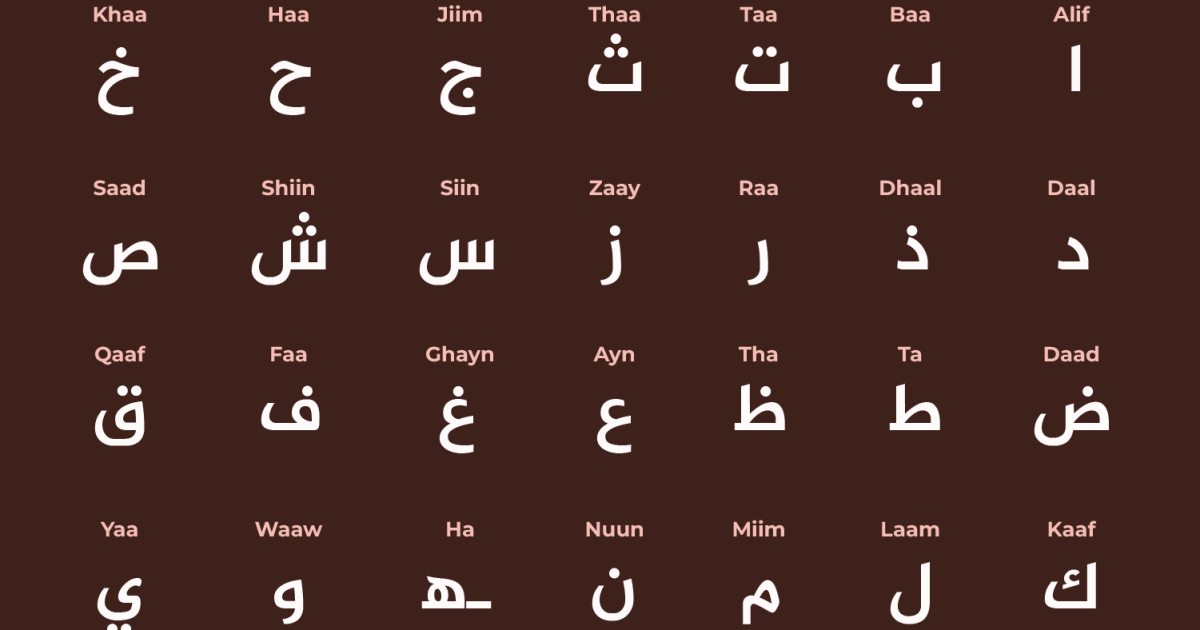
    Arabic uses an alphabet of 28 letters and is written from right to left. The script is cursive, and its letters change shape depending on their position in a word. Short vowels are typically omitted in everyday writing.
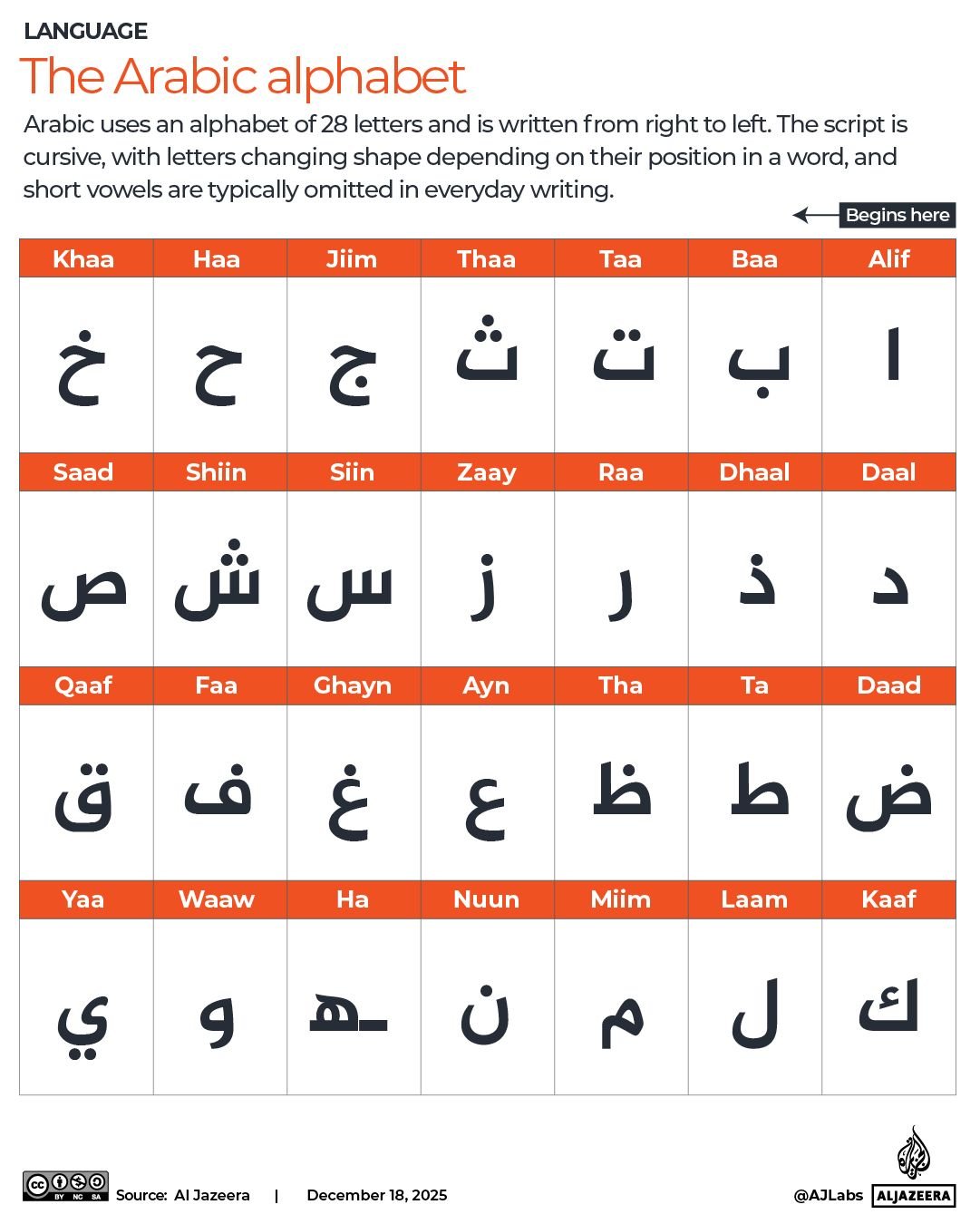
    INTERACTIVE - The Arabic alphabet - Arabic Language day-1765976624
    (media)

    These features, together with Arabic’s extensive vocabulary, have contributed to the perception that the language is difficult for non-native speakers to learn.

    However, Al Hamad says this perception is far from accurate for many people.

    “One of the biggest misconceptions about Arabic is that it is among the most difficult languages in the world,” he said. “In reality, it is simply a language with systems that differ from English or from many European languages.”

    He added that while the Arabic script may appear unfamiliar to some learners, it is “quite familiar” to speakers of other languages, such as Urdu and Farsi. Speakers of those languages, Al Hamad says, often find Arabic easier to read while Turkish speakers may find its vocabulary easier to memorise due to the thousands of Arabic words Turkish has absorbed.

    From A for algebra to T for tariffs

    One of the biggest contributions the Arabic language has made to the world is in the fields of mathematics and science.

    Over time, some of these words entered other languages in shortened or adapted forms, becoming so familiar that their origins are often forgotten.

    One example is algebra, a cornerstone of mathematics. The term comes from the Arabic word al-jabr, meaning “restoration” or “reunion”. It originally appeared in the title of a ninth-century work on solving equations by the Baghdad-based Persian scholar Muhammad ibn Musa al-Khwarizmi, after whom the word “algorithm” is derived.

    Other Arabic words underwent more dramatic transformations. Carat, the unit used to measure the weight of gemstones, traces its roots to the Arabic word qirat.
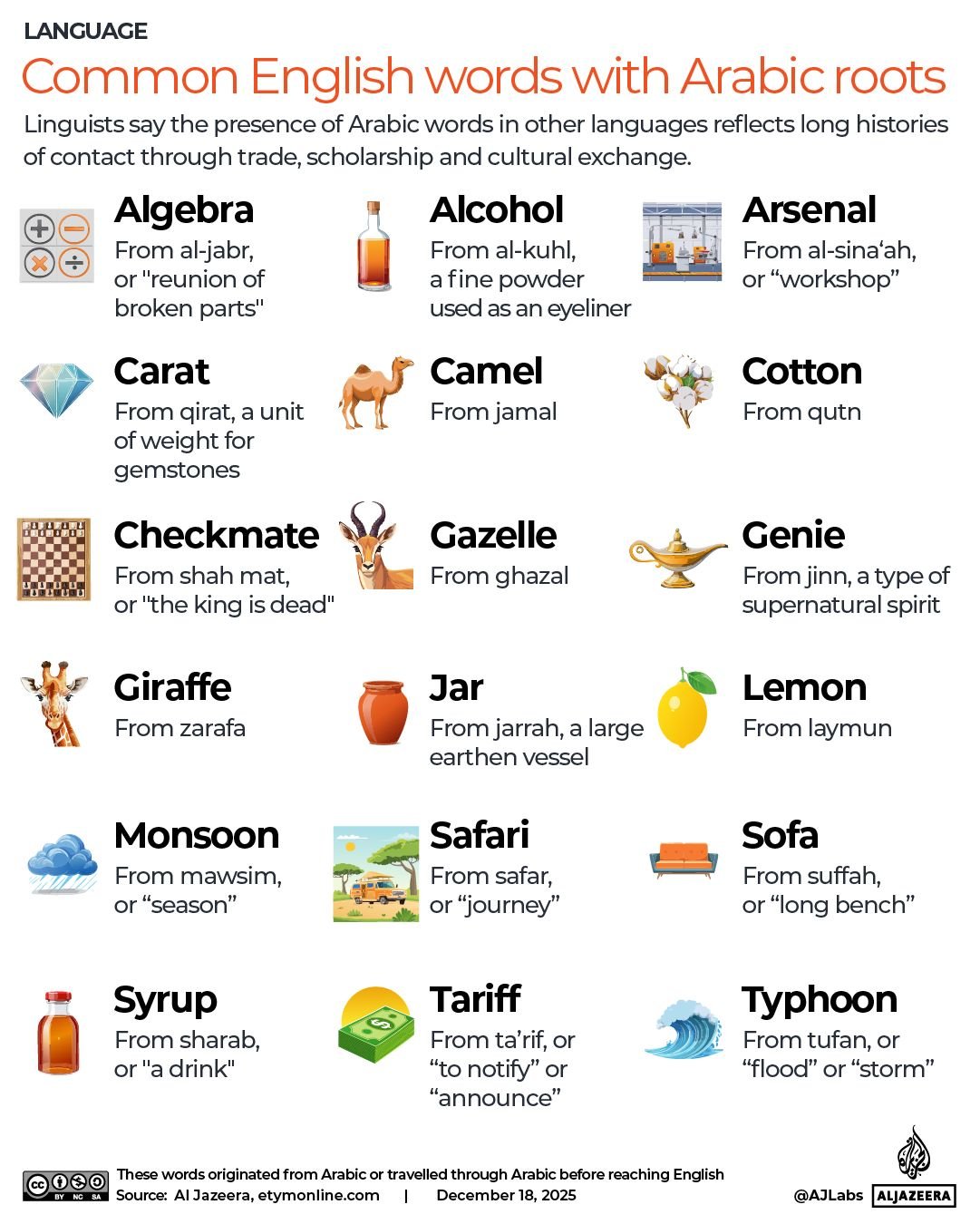
    INTERACTIVE - Common English words with Arabic roots-1765989016
    (media)

    According to Al Hamad, these changes reveal how English and other languages adapt unfamiliar sounds. “Because English has relatively few words beginning with Q,” he explains, “Arabic words such as qirat were reshaped using more familiar sounds like C, G or K, producing forms such as carat.”

    The same process can be seen in everyday vocabulary beyond science and mathematics. The word giraffe, for instance, comes from the Arabic zarafa, and went through a similar transformation as English and other European languages reshaped the original sounds to fit their own phonetic patterns, much as they did with words beginning with the Arabic letter Q.

    On the other hand, words such as tariff, which is derived from the Arabic word ta’rif, meaning “to notify” or “to announce”, entered English through contact with other languages involved in trade.

    Al Hamad says these words “most likely entered the English language via Romance languages” although not necessarily in the forms we recognise today. He adds that they also passed through Turkish, which “borrowed heavily from Arabic” and influenced the medieval world through trade and warfare. Later, during the British colonial era, English both borrowed from and contributed words directly to Arabic.

    Africa Arts and Culture Infographic Interactive Maps Middle East News
    Share. Facebook Twitter Pinterest LinkedIn Tumblr Email Telegram Copy Link
    Gulf News Week

    Related Posts

    Middle East News

    Iraq Jails Five for Life in Record Amphetamine Seizure in Anbar Province

    February 11, 2026
    Middle East News

    Iran Offers Uranium Deal in Bid to Ease US Sanctions

    February 10, 2026
    Middle East News

    UAE Assures Travel Continuity as Algeria Moves to Cancel Air Agreement

    February 9, 2026
    Middle East

    Settler violence stokes peak West Bank displacement since October 2023: UN

    February 6, 2026
    Middle East

    Armed militia members are serving as Israeli agents in Gaza: Investigation

    February 6, 2026
    Middle East

    Trump’s ‘maximalist demands’ for Iran put talks in Oman on uncertain ground

    February 6, 2026
    Add A Comment

    Comments are closed.

    Editors Picks

    Iraq Jails Five for Life in Record Amphetamine Seizure in Anbar Province

    February 11, 2026

    Saudi Vision 2030: Equestrian Projects Take Centre Stage as Qiddiya Unveils New Racecourse

    February 11, 2026

    Weaker Rupee, Gift City Push NRIs in UAE Toward India Life Insurance

    February 11, 2026

    U.S. Issues Stern Maritime Advisory for Strait of Hormuz Amid Heightened Iran Tensions

    February 11, 2026
    Latest Posts

    Iraq Jails Five for Life in Record Amphetamine Seizure in Anbar Province

    February 11, 2026

    Iran Offers Uranium Deal in Bid to Ease US Sanctions

    February 10, 2026

    UAE Assures Travel Continuity as Algeria Moves to Cancel Air Agreement

    February 9, 2026

    Subscribe to News

    Get the latest sports news from NewsSite about world, sports and politics.

    Advertisement
    Demo
    Gulf News Week

    Your source for the serious news. This demo is crafted specifically to exhibit the use of the theme as a news site. Visit our main page for more demos.

    We're social. Connect with us:

    Facebook X (Twitter) Instagram Pinterest YouTube
    Latest Posts

    Iraq Jails Five for Life in Record Amphetamine Seizure in Anbar Province

    February 11, 2026

    Saudi Vision 2030: Equestrian Projects Take Centre Stage as Qiddiya Unveils New Racecourse

    February 11, 2026

    Weaker Rupee, Gift City Push NRIs in UAE Toward India Life Insurance

    February 11, 2026

    Subscribe to Updates

    Get the latest creative news from FooBar about art, design and business.

    © 2026 Gulf News Week. Designed by HAM Digital Media.
    • Home
    • Politics
    • Economy
    • Sports

    Type above and press Enter to search. Press Esc to cancel.