
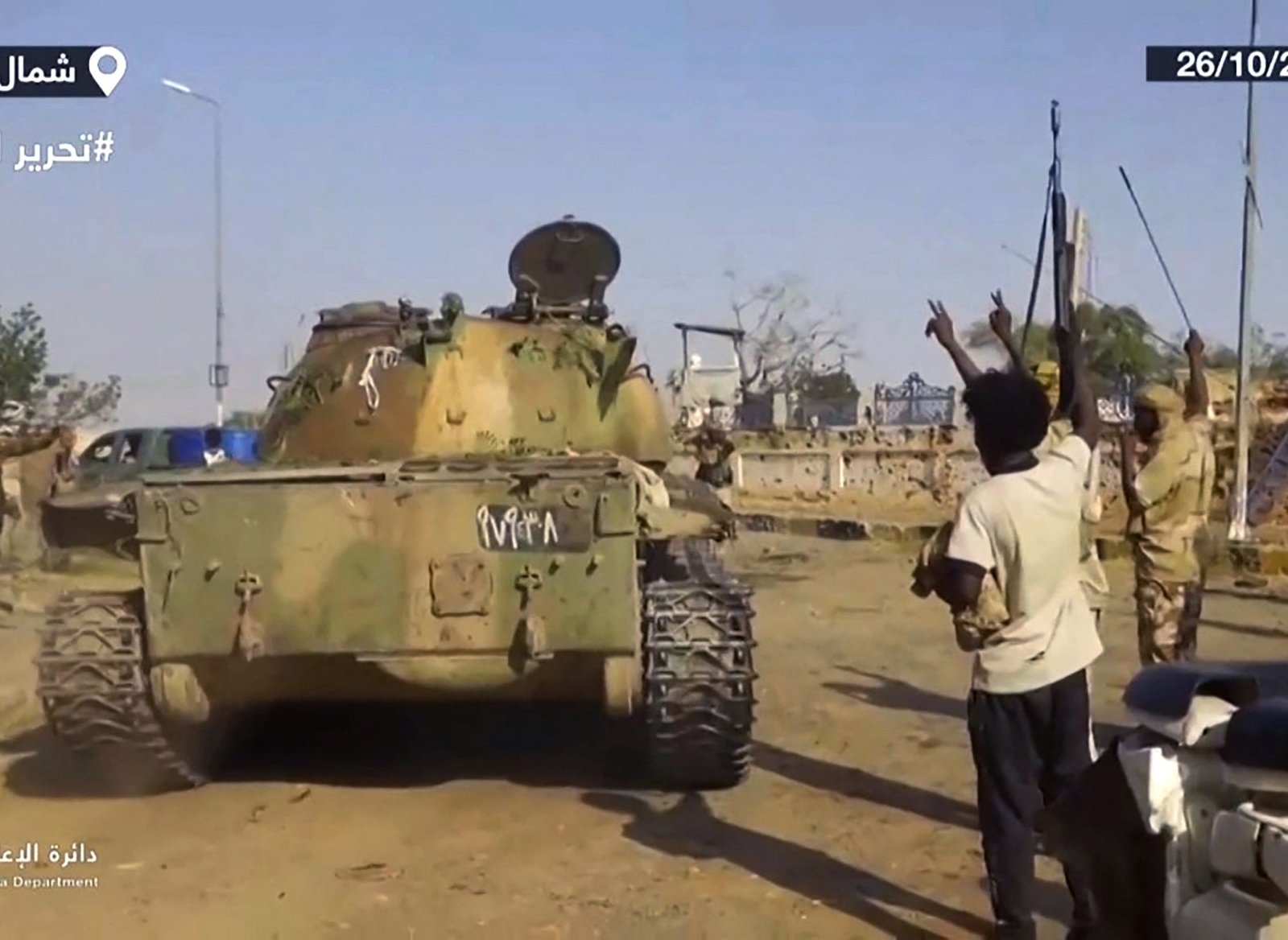
European funding aimed at curbing migration inadvertently strengthened Sudanese paramilitaries, while weak export oversight allowed the flow of weapons.
Sudan was teetering on the edge of crisis long before open war erupted in April 2023. Decades of authoritarian rule under Omar al-Bashir resulted in a fragile economy, fragmented security forces, and entrenched paramilitary structures.
Following the coup that overthrew al-Bashir in 2019, a fragile civilian-military transitional arrangement failed to unite competing factions. Political instability, localised rebellions, and a simmering rivalry between the Sudanese Armed Forces (SAF) and the Rapid Support Forces (RSF) – the successor to the Popular Defence Forces, government-backed militia known as the Janjaweed who committed war crimes in Darfur in the early 2000s – escalated into full-blown conflict.
By mid-2023, Sudan was effectively split into contested zones, with major urban centres, such as Khartoum and Omdurman, transformed into battlefields, and millions of civilians displaced internally or forced across borders as refugees.
Although geographically removed, the European Union played a consequential role in these developments. For nearly a decade, it pursued a strategy of “externalising” migration control, directing aid, training, and equipment to African states ostensibly to reduce irregular migration towards Europe.
In Sudan, this approach produced unintended and devastating consequences that the EU is yet to be held accountable for. Funding initially justified under “migration management” and “capacity building” intersected with opaque arms flows, Gulf intermediaries, and weak oversight. European money and materiel, intended to stabilise populations and impose border forces to buffer the migratory ambitions of Africans, may have indirectly reinforced the very actors now perpetrating war crimes in Sudan.
Between 2014 and 2018, the EU channelled more than 200 million euros ($232m at the current exchange rate) into Sudan via the EU Emergency Trust Fund for Africa (EUTF) and the Better Migration Management (BMM) initiative.
These programmes formally aimed to strengthen migration control, border security and anti-trafficking enforcement. In reality, they entrenched cooperation between the EU and Sudan’s security structures, including units that effectively merged into the RSF.
As early as 2017, the Enough Project, an advocacy group focused on conflict, corruption and human rights, published a report titled Border Control from Hell, warning that “the gravest concern about the EU’s new partnership with Sudan is that the Rapid Support Forces (RSF), one of the most abusive paramilitary groups in the country, stands to benefit from EU funding” and that “the equipment that enables identification and registration of migrants will also reinforce the surveillance capabilities of a Sudanese government that has violently suppressed Sudanese citizens for the past 28 years”.
Two years later, the EU had to suspend several migration-control activities in Sudan because there was a risk that resources could be “diverted for repressive aims”, according to an EU official document cited by German news outlet Deutsche Welle.
And yet, a factsheet titled What the EU really does in Sudan, published on the bloc’s website in 2018, claimed: “The EU does not provide any financial support to the Government of Sudan … The Rapid Support Forces of the Sudanese military do not benefit directly or indirectly from EU funding.”
All this raises an important question: If the EU knew of the risk of diversion, why did it still invest hundreds of millions into a context where control over the end use of training, equipment and funds was manifestly weak?
What is worse is that the EU’s role was not limited to supplying funds that could be misappropriated. It also provided weapons, albeit indirectly.
As the conflict deepened, investigators started uncovering foreign-manufactured weapons and ammunition circulating widely among the RSF and the SAF. Verified imagery, open-source analysis and serial number tracing have revealed European-manufactured systems on Sudan’s battlefields. In November 2024, Amnesty International released an investigation disclosing that Nimr Ajban armoured personnel carriers (APCs) were equipped with French-made Galix defensive systems. Amnesty’s analysts verified images and videos from multiple Sudanese locations and concluded that, if deployed in Darfur, their use would breach the longstanding United Nations arms embargo on the region.
In April, investigations by France24 and the Reuters news agency traced 81mm mortar shells found in an RSF convoy in North Darfur back to Bulgaria. The markings on this ammunition matched mortar bombs manufactured by a Bulgarian firm and exported legally to the United Arab Emirates in 2019. The Bulgarian government had not authorised the re-export of the shells from the UAE to Sudan.
In October, The Guardian reported that British military equipment, including small-arms target systems and engines for APCs, had been used by the RSF in Sudan, and they may have been supplied by the UAE.
Taken together, these findings illustrate a pattern: European-made arms and weapons systems, legally exported to third countries, have subsequently been diverted into Sudan’s conflict, despite embargoes and supposed safeguards.
Although the UAE denies it plays any role in the conflict, its position as an intermediary hub for re-exported weaponry has been repeatedly documented. Still, European suppliers, bound by end-user agreements and export-control frameworks, share responsibility for ensuring compliance.
Under the United Kingdom and EU regulations, governments must deny or revoke licences when there is a clear risk of diversion to conflict zones or human rights abusers. The use of European-made arms and weapons systems in Sudan, therefore, demands a rigorous reassessment of post-shipment monitoring and enforcement.
Despite this, European and British governments have continued to issue new export licences to potential violators, including the UAE. Recent reporting by Middle East Eye shows that the UK approved roughly $227m in military exports to the UAE between April and June this year, even after being informed that Emirati-supplied equipment had reached the RSF.
European countries are by far not an exception in failing to ensure that their weapons are not diverted to war zones under embargo.
My own country, South Africa, has also faced criticism over the lack of control over its arms shipments. In the mid-2010s, the National Conventional Arms Control Committee (NCACC) faced international and domestic scrutiny after South African-manufactured weapons and ammunition were reportedly used by Saudi and Emirati forces in Yemen.
As a result, in 2019, the NCACC delayed or withheld export approvals, especially for “the most lethal” items, amid disputes over updated inspection clauses and human rights concerns. The South African authorities demanded that they be granted access to facilities in importer countries to ensure compliance with the end-user agreement – something the UAE and Saudi Arabia, along with several other countries, refused to provide. By 2022, previously withheld consignments were eventually cleared under renegotiated terms.
Today, evidence suggests that South African weapons may have been diverted to Sudan as well. Investigators and open-source analysts claim to have identified munitions consistent with South African manufacture in Sudan.
The South African case illustrates that even when there is political will to ensure compliance with the end-user agreements for arms sales, enforcement can be challenging. And yet, it is a necessary and crucial part of peacebuilding efforts.
If democratic governments wish to reclaim credibility, end-use monitoring must be enforceable, not a bureaucratic concession. The NCACC in Pretoria and export control authorities in Brussels, Sofia, Paris and London must publish transparent audits of past licences, investigate credible diversion cases, and suspend new approvals where risk remains unmitigated.
In parallel, the EU must ensure migration management funding cannot be coopted by armed actors.
Without such measures, Europe’s migration policy and South Africa’s defence trade risk complicity in a grim paradox: initiatives justified in the name of security that foster insecurity.
The views expressed in this article are the author’s own and do not necessarily reflect media’s editorial policy.
