
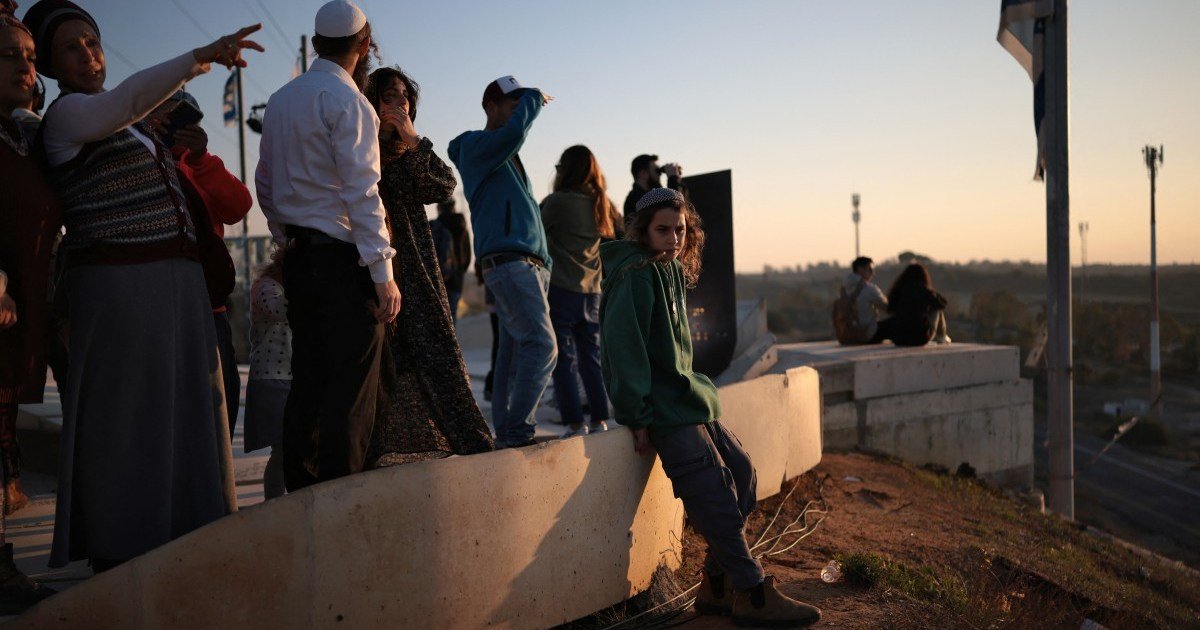
Israel’s approval of 19 new settlements stands to redraw the occupied West Bank, undermining prospect of two-state solution.
The Israeli security cabinet has approved 19 new settlement outposts in the occupied West Bank as the right-wing government headed by Prime Minister Benjamin Netanyahu moves to prevent the formation of a viable Palestinian state.
As Netanyahu’s government has made the annexation of occupied Palestinian territory a priority, the United Nations has said Israeli settlement expansions in 2025 have reached their highest level since 2017.
“These figures represent a sharp increase compared to previous years,” UN Secretary-General Antonio Guterres said, noting an average of 12,815 housing units were added annually from 2017 to 2022.
Under the current far-right government, the number of settlement and outposts in the West Bank and occupied East Jerusalem has risen by nearly 50 percent – from 141 in 2022 to 210 now. An outpost is built without government authorisation while a settlement is authorised by the Israeli government.
Nearly 10 percent of Israel’s Jewish population of 7.7 million people lives in these settlements, which are considered illegal under international law.
Here’s everything you need to know about the newly approved settlements and what they mean for the future of Palestinian statehood.
Where are the new settlements?
The new settlements are spread across the West Bank – home to more than three million Palestinians – from Jenin in the north to Hebron in the south.
Most of them are close to the densely populated Palestinian villages of Duma, Jalud, Qusra and al-Lubban Asharqiya in the Nablus governorate and Sinjil in the Ramallah and el-Bireh governorate, according to Peace Now, an antisettlement watchdog group based in Israel. Other locations identified by the watchdog for the new settlement areas are in the northwestern West Bank, in the Salfit governorate, near the Palestinian towns of Sa’ir and Beit Sahour, and other areas near Bethlehem and in the Jericho governorate.
Israel’s construction spree is entrenching the occupation and squeezing Palestinians out of their homeland. Settlements dot the West Bank and are often connected by Israeli-only highways while Palestinians face roadblocks and security checks, making their daily commutes harrowing experiences.
Israel has also built Separation Barrier that stretches for more than 700km (435 miles) through the West Bank restricting movement of Palestinians. Israel says the wall is for security purposes.
Under a dual legal system, Palestinians are tried in Israel’s military courts while crimes committed by settlers are referred to a civilian court.
Israel’s latest approval also includes settlements in Ganim and Kadim, two of the four West Bank settlements east of Jenin that were dismantled as part of Israel’s 2005 disengagement plan, a unilateral withdrawal ordered by then-Prime Minister Ariel Sharon.
Five of the 19 settlements already existed but had not previously been granted legal status under Israeli law, according to a statement from the office of Finance Minister Bezalel Smotrich.
Israel controls most of the West Bank and East Jerusalem, territory Palestinians want to be part of a future state along with Gaza. Israel captured East Jerusalem, the West Bank and the Gaza Strip in a 1967 war. It later annexed East Jerusalem, which Palestinians see as their future capital.
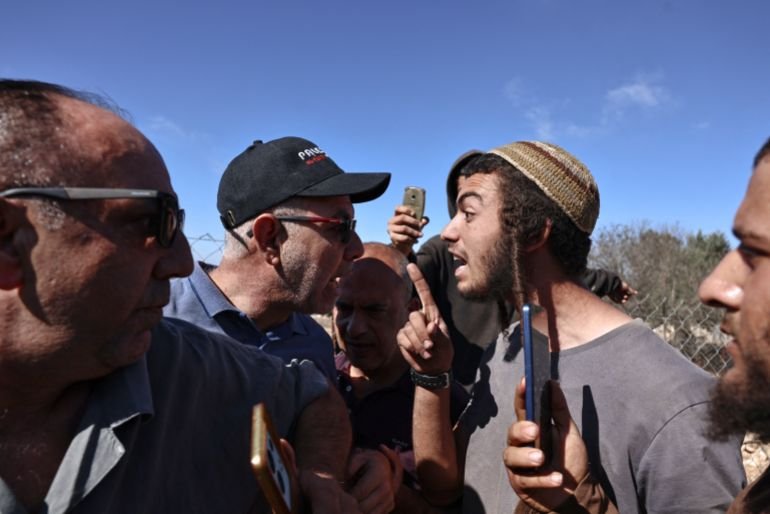
Israeli settlements and outposts are Jewish-only communities built on Palestinian land and they can range in size from a single dwelling to a collection of high-rises. About 700,000 settlers live in the West Bank and East Jerusalem, according to Peace Now.
The latest approval comes at a time when the United States has been working with Israel and Arab allies to move the Gaza ceasefire into a second phase. After a meeting on Friday of top officials from the US, Egypt, Turkiye and Qatar in the US city of Miami, Florida, Turkish Foreign Minister Hakan Fidan accused Israel of committing repeated violations of the ceasefire that began in October.
Israel still controls nearly half of Gaza’s territory since a ceasefire was announced on October 10 after more than two years of a genocidal war killed more than 70,000 Palestinians.
Has settlement construction spiked in recent years?
The new settlements bring the total number approved over the past three years to 69, according to a statement from the office of Smotrich, who is a vocal proponent of settlement expansion and a settler himself.
In May, Israel approved 22 new settlements in the West Bank, the biggest expansion in decades.
The UN chief has condemned what he described as Israel’s “relentless” expansion of settlements in occupied Palestinian territory. It “continues to fuel tensions, impede access by Palestinians to their land and threaten the viability of a fully independent, democratic, contiguous and sovereign Palestinian state”, Guterres said this month.
Palestinians have also been facing increasing settler violence since Israel’s war on Gaza began.
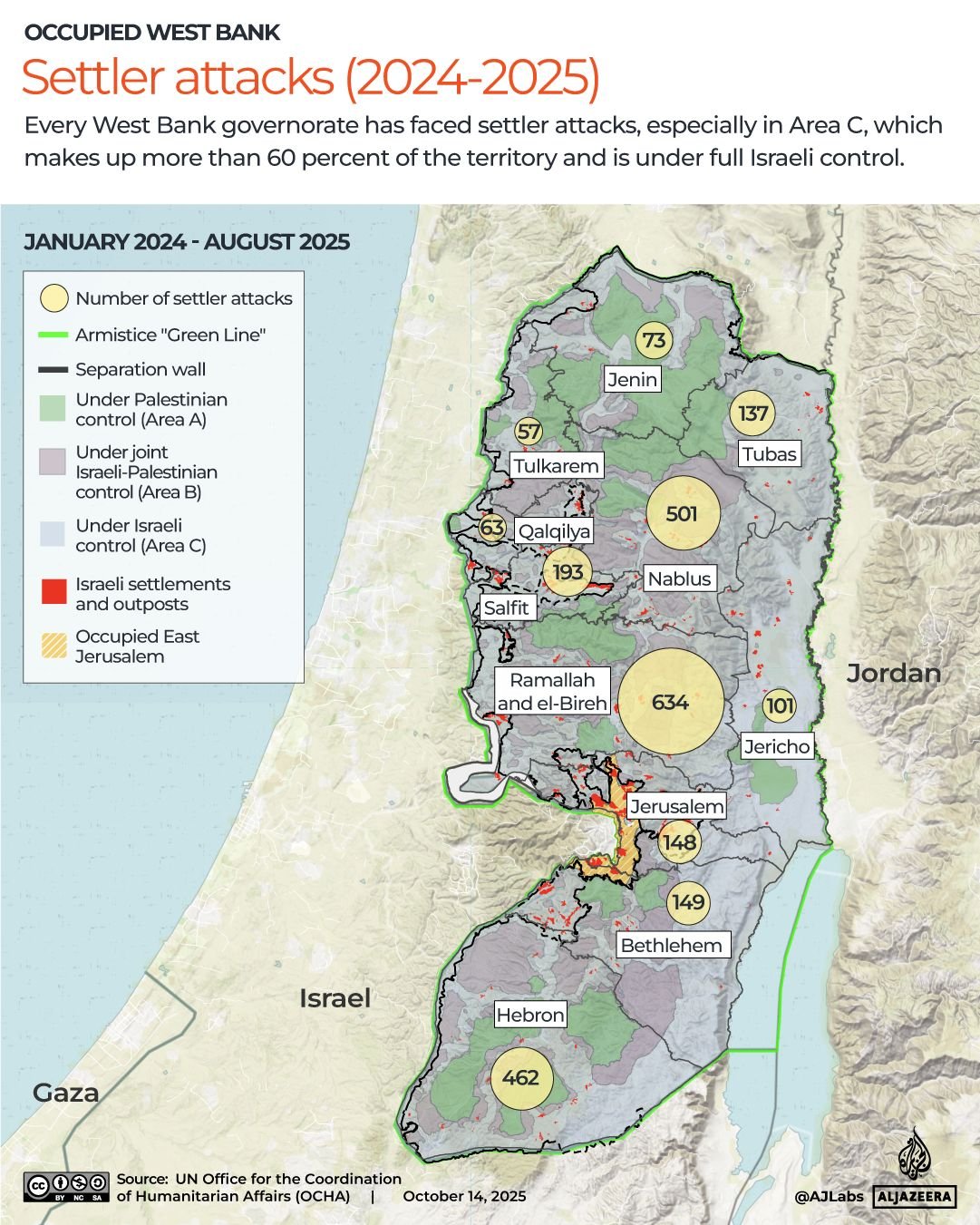
According to data from the UN Office for the Coordination of Humanitarian Affairs (OCHA), settlers have attacked Palestinians nearly 3,000 times over the past two years.
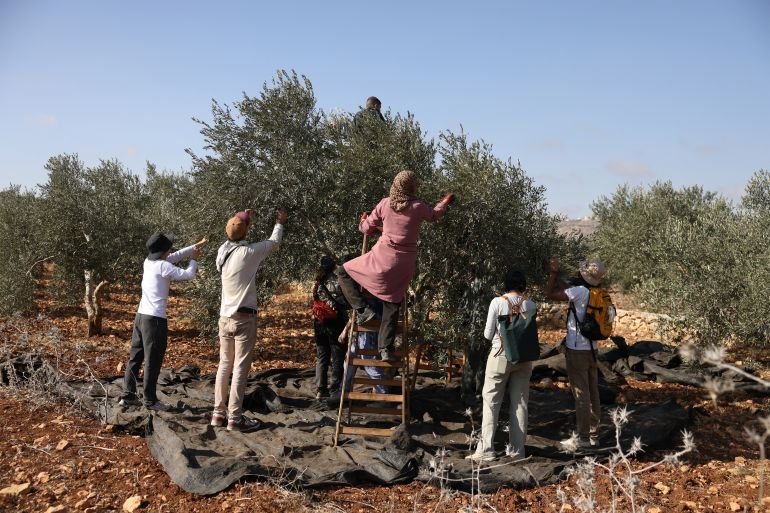
Settler attacks often escalate during the olive harvest from September to November, a vital time of year that provides a key source of income for many Palestinian families.
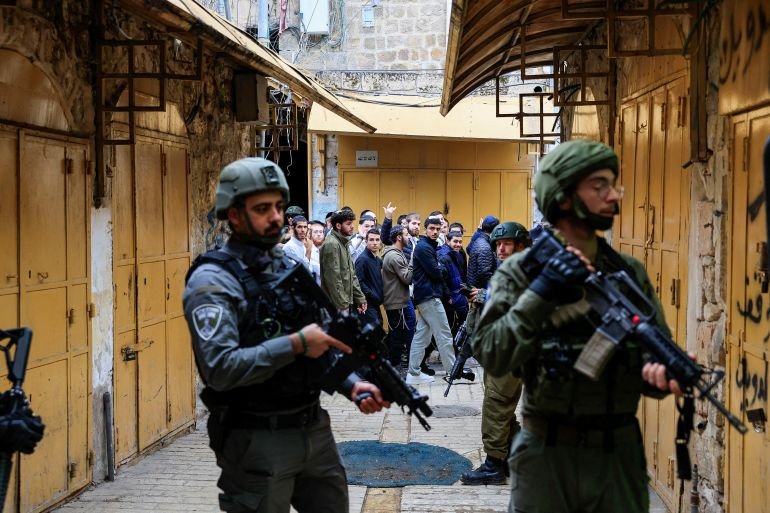
Settlers are often armed and frequently accompanied or protected by Israeli soldiers. In addition to destroying Palestinian property, they have carried out arson attacks and killed Palestinian residents.
Every West Bank governorate has faced settler attacks over the past two years, data from OCHA shows.
Are the settlements legal under international law?
No. The UN, the International Court of Justice (ICJ) and the International Committee of the Red Cross all consider Israeli settlements as a violation of the Fourth Geneva Convention, which outlaws settler activity.
In a landmark judgement in July 2024, the ICJ, the UN’s top court, found that Israel’s occupation, settlement activity and annexation measures are illegal. In its nonbinding advisory opinion, the ICJ ruled that Israel’s continued presence in occupied Palestinian territory is unlawful and should come to an end “as rapidly as possible”.
The judges pointed to a wide list of policies – including the building and expansion of Israeli settlements in the West Bank and East Jerusalem, use of the area’s natural resources, the annexation and imposition of permanent control over lands and discriminatory policies against Palestinians – all of which it said violated international law.
Two months later, the UN General Assembly adopted a resolution demanding that Israel end its occupation of Palestinian territory within a year.
But Israel has defied the resolution by the global body backed by its ally – the United States. Washington has extended diplomatic cover to Israel against numerous UN resolutions.
Since returning to power in January, US President Donald Trump has adopted a permissive stance towards Israeli settlement activity, breaking with longstanding US policy.
In 2019, he said Israeli settlements in the West Bank were not inherently illegal under international law. Trump also revoked his predecessor President Joe Biden’s sanctions on several settlers and groups accused of perpetrating violence against Palestinians in the West Bank.
US sanctions on settlers under Biden came under Washington’s long-held policy that settlements are the biggest impediments to the two-state solution to the conflict.
However, Trump and his officials have repeatedly said Israel cannot annex the West Bank. “It won’t happen because I gave my word to the Arab countries,” Trump told Time magazine in October. “Israel would lose all of its support from the United States if that happened.”
What will the new settlements mean for the future of a Palestinian state?
The growing settlements – together with other projects undertaken by Netanyahu’s government like the E1 settlement plan that will split the West Bank – are further squeezing Palestinians in occupied territory.
Settlement expansions have drawn criticism from the international community, including Israel’s European allies, who said the steps undermine prospects for a two-state solution.
But Netanyahu and his far-right cabinet, including Smotrich and National Security Minister Itamar Ben-Gvir, have doubled down on their rhetoric against a Palestinian state.
“On the ground, we are blocking the establishment of a Palestinian terror state,” Smotrich said in his statement on Sunday.
In June, the United Kingdom, Australia, Canada, New Zealand and Norway slapped sanctions on Smotrich and Ben-Gvir for inciting violence.
Several European nations, including the UK and France, as well as Australia recognised Palestinian statehood in September in a push for the two-state solution.
Israel condemned the move, and Netanyahu said he won’t allow a Palestinian state. He has previously boasted how he scuttled the 1993 and 1995 Oslo peace accords by boosting settlement expansion in occupied territory.
“It’s not going to happen. There will be no Palestinian state to the west of the Jordan River,” Netanyahu said in an address in September. “For years, I have prevented the creation of that terror state against tremendous pressure, both domestic and from abroad.”
