
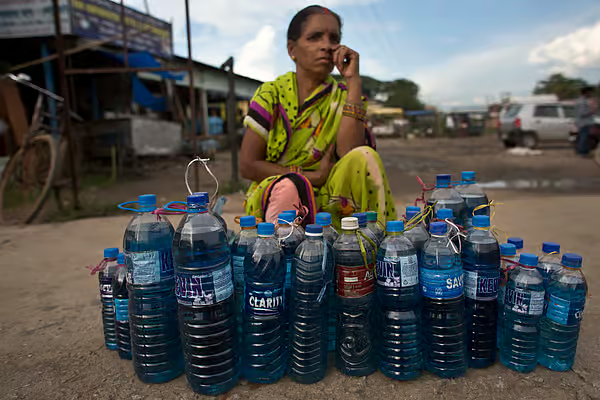
Government approves 60-day kerosene sale across 21 states amid fuel scarcity; urban households urged to switch to piped natural gas to ease demand.
NEW DELHI — Facing fuel scarcity triggered by the escalating US-Israel-Iran conflict, India has temporarily revived the distribution of kerosene through select petrol pumps across 21 states and union territories, marking a significant policy shift from its earlier phase-out of the fuel.
The Ministry of Petroleum and Natural Gas has directed state-owned oil marketing companies to supply superior kerosene oil (SKO)—widely known in India as “the common man’s fuel”—to designated retail outlets for a limited period. The move is aimed at bridging the gap created by a sharp decline in liquefied petroleum gas (LPG) imports amid ongoing geopolitical tensions in the Middle East.
Temporary Rollback of Phase-Out
Kerosene supply had previously been phased out in several parts of the country as part of a long-term strategy to promote cleaner fuels. Under the new directive, petrol pumps can now store and sell kerosene to households for cooking and lighting purposes.
Each outlet is permitted to stock up to 5,000 litres, allowing for faster distribution through existing retail networks. The relaxation will remain in effect for 60 days, according to a government spokesperson.
The decision was coordinated by the informal group of ministers (IGoM), established by the central government to monitor the impact of the Middle East crisis on essential commodity supplies.
LPG Shortages and Urban Rush
Officials attributed the move to a steep drop in LPG imports following the regional conflict. In many Indian cities, long queues for LPG refills have been reported, reflecting growing pressure on domestic supplies.
To ease demand, the government is actively encouraging urban consumers to switch to piped natural gas (PNG), which is supplied continuously through pipelines and does not require cylinder bookings.
Last week, the government issued an order stating that households with access to PNG networks will have their LPG connections discontinued after three months if they do not opt for PNG. The diverted LPG cylinders will be reallocated to rural and remote areas where PNG infrastructure is unavailable.
Push for PNG Gains Momentum
The government is simultaneously accelerating the expansion of natural gas pipelines, particularly in cities, to enable a broader shift from LPG to PNG.
Neeraj Mittal, India’s Petroleum Secretary, posted on his ‘X’ account on Sunday:
“6000 PNG consumers surrendered their LPG till yesterday! A big thanks to them!! Join this strong bold group of #DoGood citizens who have come forward to give up LPG to help those to get LPG who don’t have PNG. Give up yours today.”
The appeal reflects the government’s dual strategy: temporarily expanding kerosene access to address immediate shortages while accelerating the long-term transition to piped natural gas to reduce import dependency and buffer against global supply shocks.
