
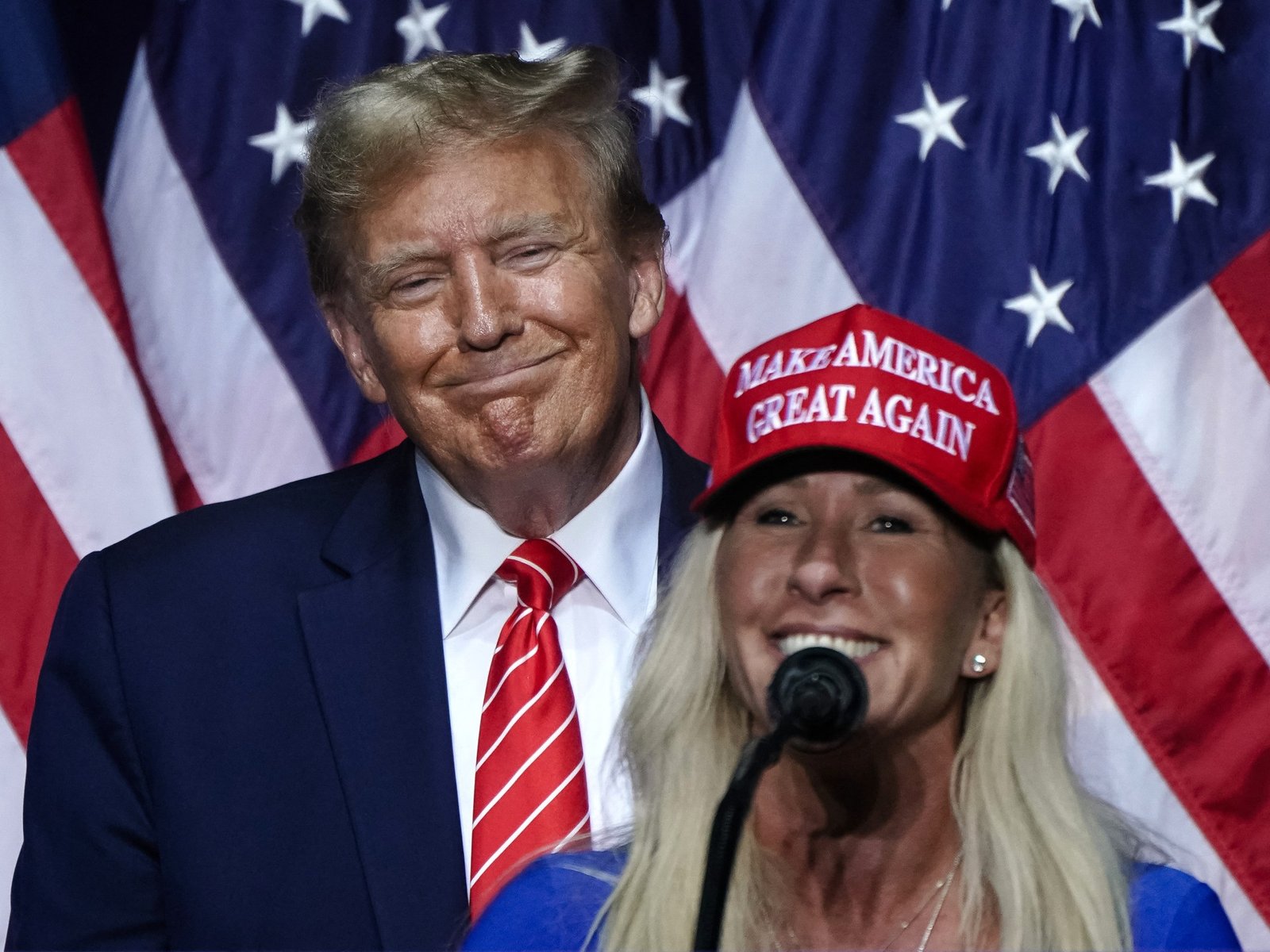
Trump’s break with Marjorie Taylor Greene exposes a deeper struggle inside the American right over what ‘America First’ truly means.
When Donald Trump withdrew his endorsement of Marjorie Taylor Greene, the far-right Georgia congresswoman who rose to prominence as one of his most loyal allies, on November 15, many dismissed it as just another episode of political theatre. But the moment marks something far more significant than a personal falling-out. It reveals a deepening civil war inside the Republican Party over who will lead the conservative movement after Trump, and over what “America First” should really mean.
The dividing issue is no longer simply immigration or the economy. It is foreign policy, and at the heart of it lies Israel. For the first time in recent decades, the Republican Party is publicly fighting over whether Washington’s unconditional support for Israel truly serves American interests. This fight is reshaping the American right and could redefine how the United States engages with the Middle East. For countries in the region, especially those seeking a just peace for Palestine, this split offers a rare opportunity to engage with a changing political landscape in Washington.
The post-Trump struggle: MAGA vs America First
Marjorie Taylor Greene’s career mirrors the trajectory of the movement she helped create. She rose to prominence as one of Trump’s most loyal supporters, a symbol of MAGA populism and anti-establishment anger. But as the movement matures, Greene has rebranded herself as an “America First” champion, positioning herself for a future beyond Trump’s personal shadow. Her break with Trump signals more than a political rivalry. It represents a deeper ideological battle between two emerging factions: the MAGA loyalists, who see Trump as the indispensable leader of the movement, and the America First nationalists, who want to build on his populist legacy but pursue a more independent, non-interventionist foreign policy.
The MAGA wing, driven by Christian nationalism and cultural resentment, remains closely tied to the pro-Israel establishment that has dominated Republican politics for decades. Its leaders, including Mike Johnson and Lindsey Graham, frame Israel not only as a strategic ally but as a sacred cause. Their rhetoric blends religion and geopolitics, viewing Israel’s survival as central to their understanding of Christian prophecy and Western civilisation. The America First camp, on the other hand, questions these assumptions. Figures like Tucker Carlson, Steve Bannon – and recently Greene – argue that the United States should end its role as the world’s policeman. They believe endless wars and foreign entanglements have drained America’s resources and undermined its moral credibility. For them, supporting Israel unconditionally contradicts the core nationalist principle that America’s interests come first. This disagreement is tearing at the foundations of the Republican Party. It is no longer a debate between “hawks” and “doves”, but between those who see American power as a tool for global domination and those who see it as a burden.
Israel as the fault line
For decades, support for Israel was the one issue that unified Republicans and Democrats alike. It was untouchable, protected by a powerful lobby and a bipartisan consensus. But the war on Gaza and the growing humanitarian outrage have begun to erode that unity, especially on the right. The America First faction views Israel as another example of Washington’s costly and one-sided alliances. They argue that sending billions in aid to Israel while American infrastructure crumbles violates the same logic that led them to oppose funding Ukraine. Their stance is not driven by sympathy for Palestinians so much as scepticism towards what they call the “foreign policy establishment” – a network of defence contractors, think tanks and lobbyists that profits from perpetual war.
MAGA conservatives, however, see Israel as part of their identity politics. Evangelical leaders and Christian Zionists exert enormous influence in Republican circles, framing support for Israel as a matter of faith. Their messaging to voters is moral and emotional, not strategic: to stand with Israel is to stand with God. This ideological clash is increasingly public. When figures like Greene or Carlson question the US–Israel alliance, they are condemned by fellow conservatives as traitors to the cause. And Greene’s recent decision to describe Israel’s assault on Gaza as a “genocide” – condemned by pro-Israel lobbyists as a “betrayal of American values” – shows how sharply these once-unthinkable critiques are now entering mainstream Republican discourse. Their message resonates with a younger, more sceptical generation of Republican voters who are tired of global wars and foreign aid. According to detailed findings from a March 2025 Pew survey, negative views of Israel among Republicans under 50 rose from 35 percent in 2022 to 50 percent in 2025 – a dramatic 15-point shift. This marks a historic transformation in a party once defined by its unconditional loyalty to the Israeli state.
The end of Republican foreign policy consensus
The Republican Party is no longer guided by the old neoconservative worldview that dominated under George W Bush. That doctrine, which justified endless wars in the name of democracy and security, has lost legitimacy among the conservative base. Trump’s rise in 2016 was the first major rebellion against it. But while Trump rhetorically attacked the “forever wars”, he remained personally loyal to Israel and the Christian Zionist base. His decision to move the US embassy to Jerusalem and recognise Israeli sovereignty over the Golan Heights cemented his standing among pro-Israel conservatives. Yet it also revealed the contradictions of his nationalism: America First in rhetoric, but still beholden to many of the same foreign lobbies in practice.
Now, as Trump’s influence wanes, those contradictions are coming to the surface. Figures like Greene and Bannon see themselves as the next generation of nationalist leadership – determined to separate America First from the personality cult of Trump and from the global commitments that defined previous Republican administrations. This struggle is already reshaping the party’s identity. The MAGA camp clings to Trump’s charisma and the evangelical base, while America First nationalists seek to ground the movement in anti-interventionism, economic protectionism, and scepticism towards Israel’s influence in Washington. For decades, Republican candidates competed to prove who was more loyal to Israel. In the post-Trump era, they may compete over who is less beholden to it.
What this means for the Middle East
For countries in the Middle East, this Republican divide presents both risk and opportunity. The risk lies in unpredictability: the United States could swing between isolationism and aggression depending on who controls the White House. But the opportunity lies in the growing number of American conservatives who are beginning to question unconditional military aid to Israel. This moment offers a strategic opening for Arabs and Muslims, both in the region and in the diaspora, to engage new voices on the American right. Historically, outreach to Republicans has been limited to formal diplomacy or lobbying focused on security and trade. Now, there is a chance to shape the conversation around values and interests. Engaging with the America First movement does not mean endorsing its broader nationalist agenda. It means recognising that a segment of the US right is finally questioning the logic of endless military aid and intervention in the Middle East. That scepticism can align, even if temporarily, with calls for justice and peace in Palestine. Middle Eastern countries, civil society groups and advocates should seize this opportunity to communicate directly with these emerging factions. They can highlight how ending unconditional support for Israel would benefit not only Palestinians but also American taxpayers and global stability. A discourse centred on shared interests, reducing conflict, ending endless wars and promoting fair diplomacy could resonate with voters across ideological lines.
A strategic moment for change
The Republican split over Israel is not just an internal power struggle. It reflects a broader rethinking of America’s global role. As the United States turns inward, the myths that sustained its foreign policy for decades are beginning to crumble. For the Middle East, this is a historic moment. The bipartisan consensus that protected Israel for generations is weakening. The cracks are appearing first inside the Republican Party, where nationalism and scepticism of foreign entanglements are reshaping political priorities. If Arabs, Muslims and pro-Palestinian advocates can understand and engage these shifts intelligently, they can help push US politics towards a more balanced and just approach to the region. The struggle between MAGA and America First may determine not only the future of the Republican Party but also the future of US foreign policy. The question is whether the Middle East will remain a passive observer of this transformation – or seek to use it to advance peace, justice and self-determination in the region.
The views expressed in this article are the author’s own and do not necessarily reflect media’s editorial policy.
