
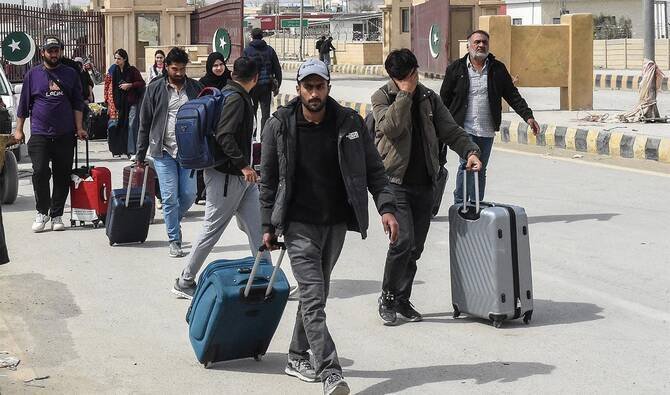
Thousands of students remain stranded as authorities set up 24/7 aid camps at Taftan border following Israeli, US strikes
SHARJAH – Pakistan has accelerated the repatriation of its citizens from Iran amid escalating regional tensions, with over 650 nationals evacuated in the last two days following sustained Israeli and US military strikes on Iranian cities.
The Federal Investigation Agency (FIA) has established round-the-clock immigration counters at the Taftan border crossing to process the influx of returnees, who face a grueling three-to-four-day journey covering nearly 1,800 km from the Iranian capital to the Pakistan border.
Emergency Response at the Border
Following directives from Balochistan Chief Minister Mir Sarfraz Bugti, authorities have arranged temporary accommodation, meals, and transport assistance for returnees. Naqeebullah Kakar, Deputy Commissioner of Gwadar, confirmed that more than 50 Pakistanis—including students, businessmen, and tourists—have already crossed into the country.
“Over 3,000 Pakistani students are currently enrolled in colleges across Iran,” Kakar said, highlighting the scale of the potential evacuation challenge.
In addition to the main Taftan crossing, over a hundred Pakistanis have been returning through the Gabd-Rimdan crossing near Gwadar port city. Officials noted that a Croatian national was also among those who crossed the border on Tuesday.
Diplomatic Efforts Intensify
Muhammad Mudassir Tipu, Pakistan’s Ambassador to Iran, detailed the operation on social media, describing it as a “complex and multi-tiered operation” executed with international cooperation.
“In the last two days, we have evacuated about 650 of our nationals across Iran, most of whom were students,” Ambassador Tipu posted on X. “We are guiding and facilitating every Pakistani national seeking our advice amidst a complex security environment.”
The ambassador specifically thanked Iranian border authorities and Azerbaijani officials for their cooperation, while expressing gratitude to the Balochistan government and Pakistani border authorities for their “24/7 cooperation.”
Government Directives and Travel Advisory
Prime Minister Shehbaz Sharif has personally directed officials to ensure the safe evacuation of all Pakistani nationals from Iran, prioritizing the return of students trapped in conflict zones.
Meanwhile, the Pakistan Foreign Office has issued a stern advisory urging nationals to avoid all non-mandatory travel to Iran. A spokesperson advised Pakistanis currently residing in Iran to “exercise caution, remain vigilant, minimise non-essential travel, and stay in regular contact with Pakistani missions.”
The development comes as regional tensions continue to spike following the recent wave of strikes, prompting neighboring countries to secure their citizens trapped in affected areas.
