Sudan’s conflict continues to reshape the nation of 50 million amid widespread displacement and a fight for resources.
Sudan’s civil war, now in its third year, has pitted the army against the paramilitary Rapid Support Forces (RSF) in a devastating struggle for power.
The conflict has unleashed the world’s largest displacement crisis, with more than 9.5 million people forced from their homes across Sudan’s 18 states and millions facing starvation.
Sudan has large natural resources, including oil, gold and agricultural land that could help feed its people, but the fighting and shifting control of these resources make that impossible.
Here are eight maps and charts to show you what resources Sudan has and who controls them:
Who controls what in Sudan?
The army holds much of the north and the east, including the capital, Khartoum, as well as other key cities along the Nile and the strategic Port Sudan on the Red Sea.
The RSF has consolidated its grip on the western region of Darfur, after it captured el-Fasher, the capital of North Darfur state, on October 26, having besieged it for nearly 18 months.
What are Sudan’s main exports?
Three sectors lead: Oil, gold, and agricultural products.
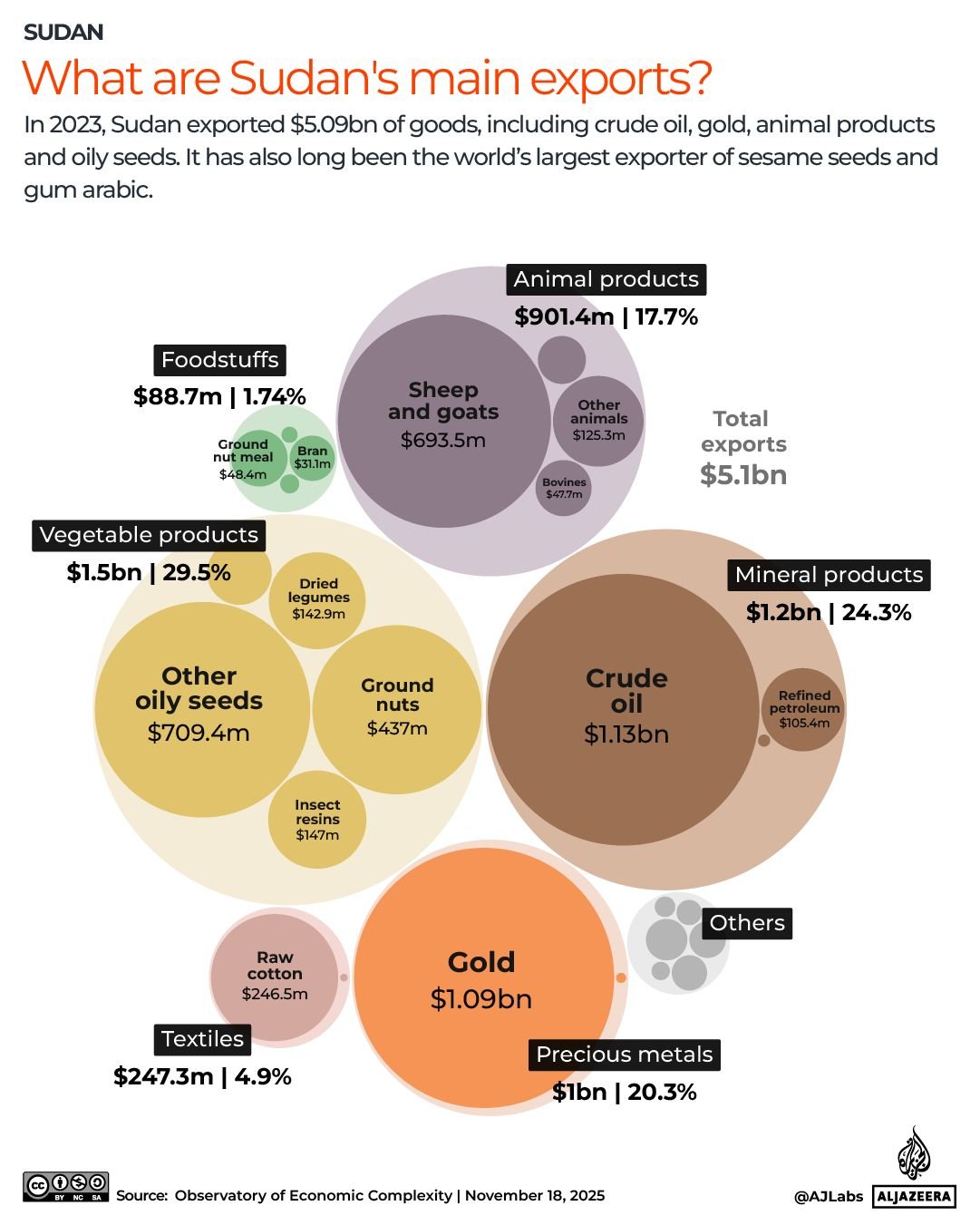
In 2023, Sudan’s exports worth $5.09bn were mainly crude oil ($1.13bn), gold ($1.03bn), animal products ($902m), oilseeds ($709m, of which $613m was sesame), and gum arabic ($141m).
Sudan is the world’s largest exporter of sesame seeds and gum arabic, which is used as a stabiliser and emulsifier by the global food and beverage industry and goes into pharmaceuticals, supplements, and cosmetics.
Who controls Sudan’s agricultural resources?
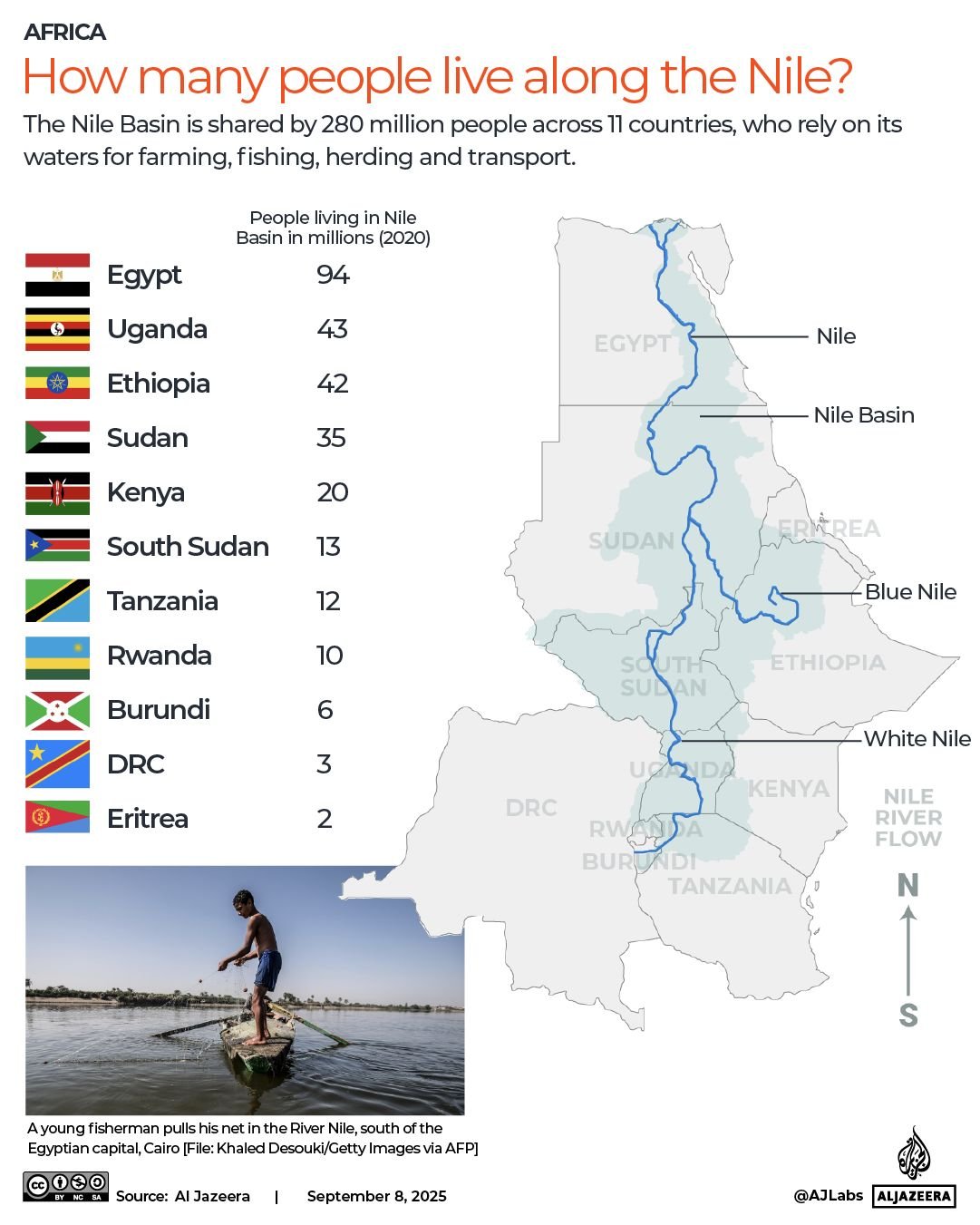
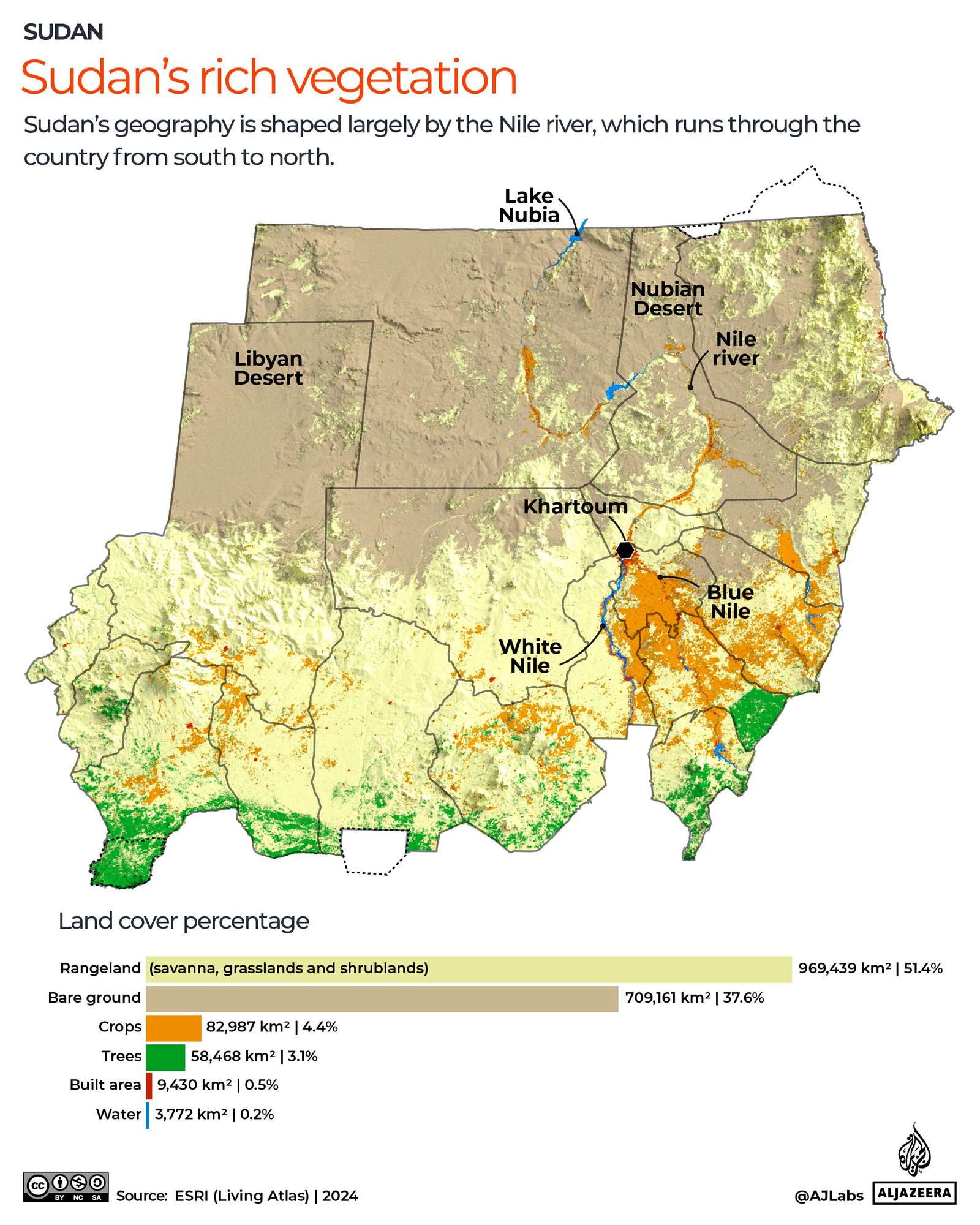
The country’s geography is shaped largely by the Nile River, which floods annually, watering the agricultural lands.
The White Nile meets the Blue Nile in Khartoum and continues northwards into Egypt as the Nile.
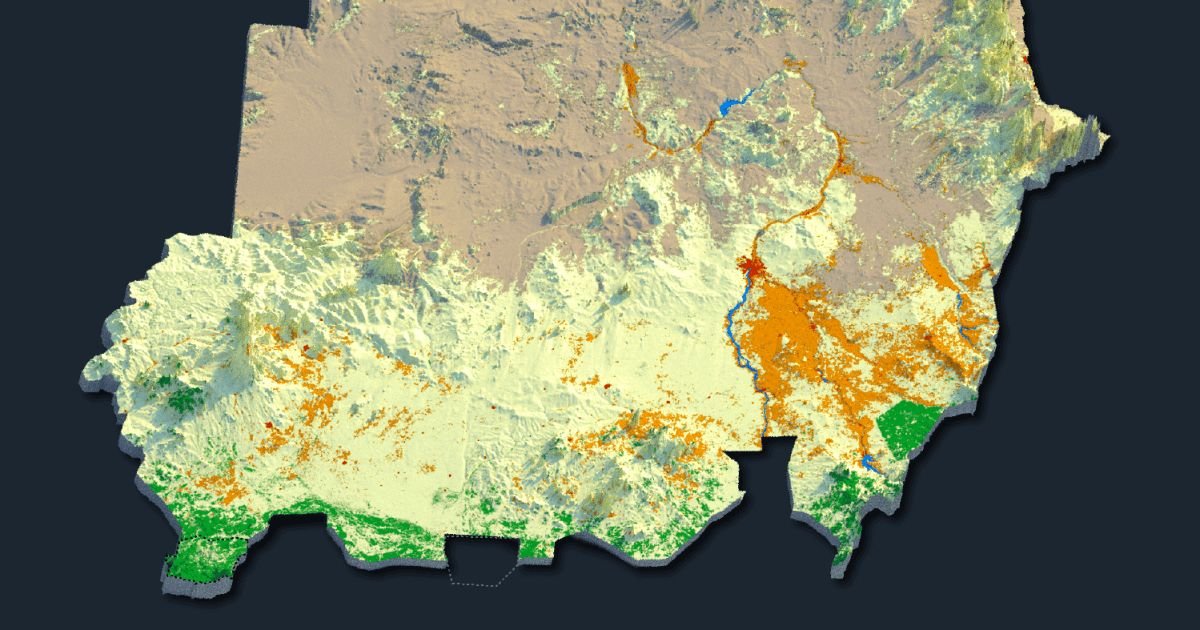
About half (51.4 percent) of Sudan is covered in grazing land, mostly across the southern part of the country, ending roughly at Khartoum.
Grazing lands, or rangelands, are coveted because they can support the herding and animal husbandry industries – control is divided roughly equally between the army and the RSF.
The northern sector of rangeland is a strip known as the “gum arabic belt” where the acacia trees that produce the valuable resin are planted.
Sudan’s croplands are mostly concentrated between the Blue and White Niles, where Gezira state lies, an area controlled by armed forces.
Who controls Sudan’s petroleum?
Oil exports are Sudan’s primary source of revenue.
Production expanded between 2001 and 2010, from 200,000 barrels per day to nearly 500,000bpd. In 2011, it collapsed when South Sudan seceded, taking 75 percent of Sudan’s oil reserves with it.
By 2023, output had fallen to 70,000bpd, according to the United States Energy Information Administration.
The Observatory of Economic Complexity estimated that crude oil remained one of Sudan’s top exports that year, valued at $1.13bn, making it the world’s 40th-largest crude exporter.
Its top buyers were Malaysia ($468m), Italy ($299m), Germany ($125m), China ($105m), Singapore ($80.3m) and India ($51.4m).
As of 2024, Sudan’s oil reserves were estimated at 1.25 billion barrels, while natural gas reserves stood at 3 trillion cubic feet. Sudan, however, neither produces nor consumes gas in significant quantities.
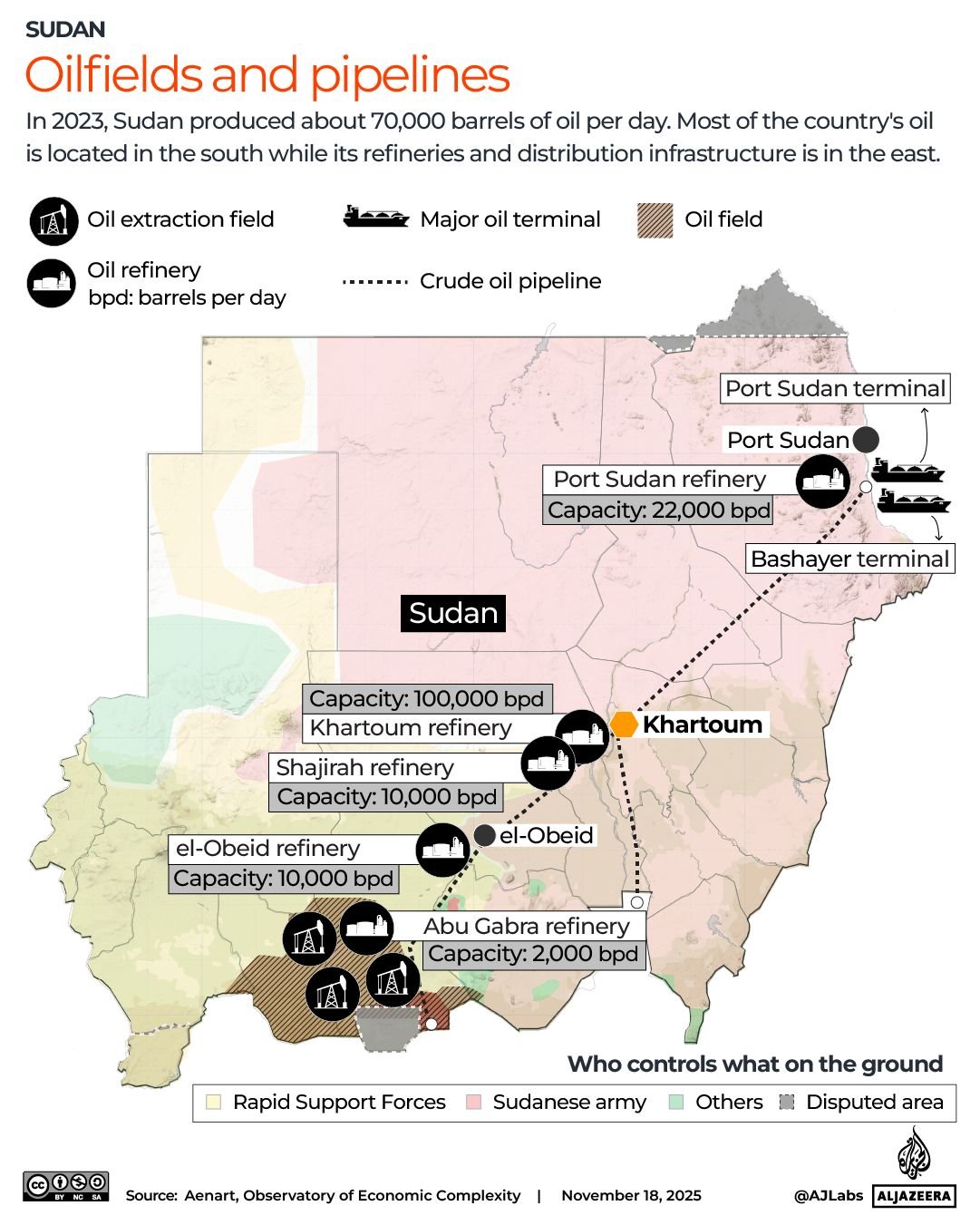
Most of Sudan’s oilfields are in the south near the South Sudan border, and the two countries’ oil sectors remain closely linked. Many of these fields are currently under RSF control.
The industry is supported by five refineries in the central and northern regions. The largest is the Khartoum refinery, which can process 100,000bpd and, as of late January 2025, is held by SAF.
The army also controls the smaller Port Sudan refinery.
Pipelines carry crude from the southern fields to the Bashayer export terminal south of Port Sudan, a crucial route for Sudanese and South Sudanese oil. The line from el-Obeid to Port Sudan remains mostly under army control.
Who controls Sudan’s gold?
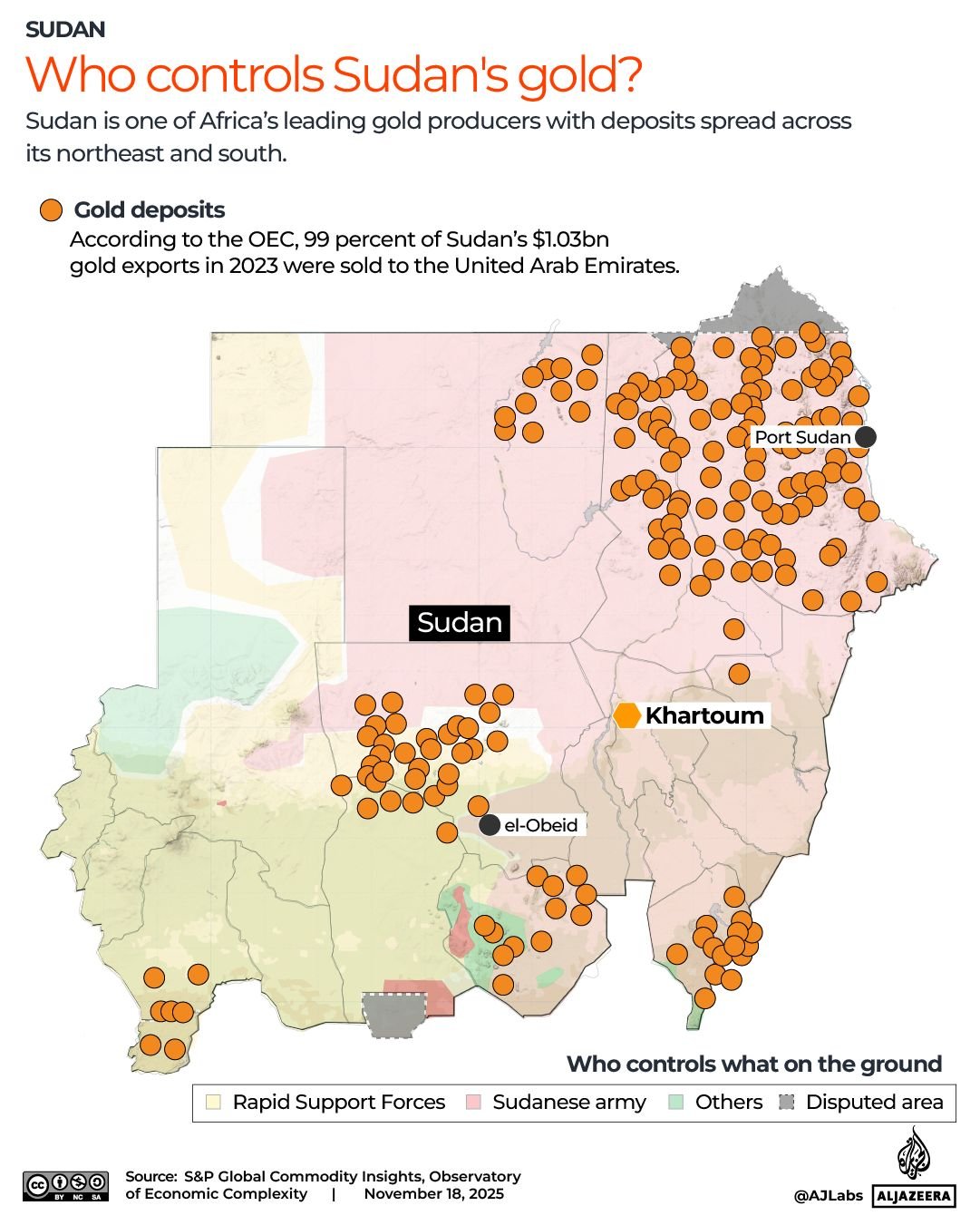
Sudan is one of Africa’s leading gold producers, with deposits across the northeast, centre and the south.
Most of the deposits in eastern Sudan are controlled by the Sudanese army, while the central and southwestern goldfields are largely under RSF control.
Much of the gold is extracted through artisanal and small-scale mining, which employs hundreds of thousands of people but operates largely outside government regulation.
Since the war began in 2023, control over gold mines and trade routes has become a critical source of funding for both sides in the conflict.
Local news agencies reported in July that, despite the conflict, Sudan’s gold production surged to 64 tonnes in 2024, up 53 percent from 41.8 tonnes in 2022, generating $1.57bn in legal export revenues. An unquantified black-market trade continues, fuelled by the instability.
According to the Observatory of Economic Complexity, the United Arab Emirates bought more than 99 percent of the $1.03bn in Sudanese gold exports in 2023.
Who are Sudan’s main trading partners?
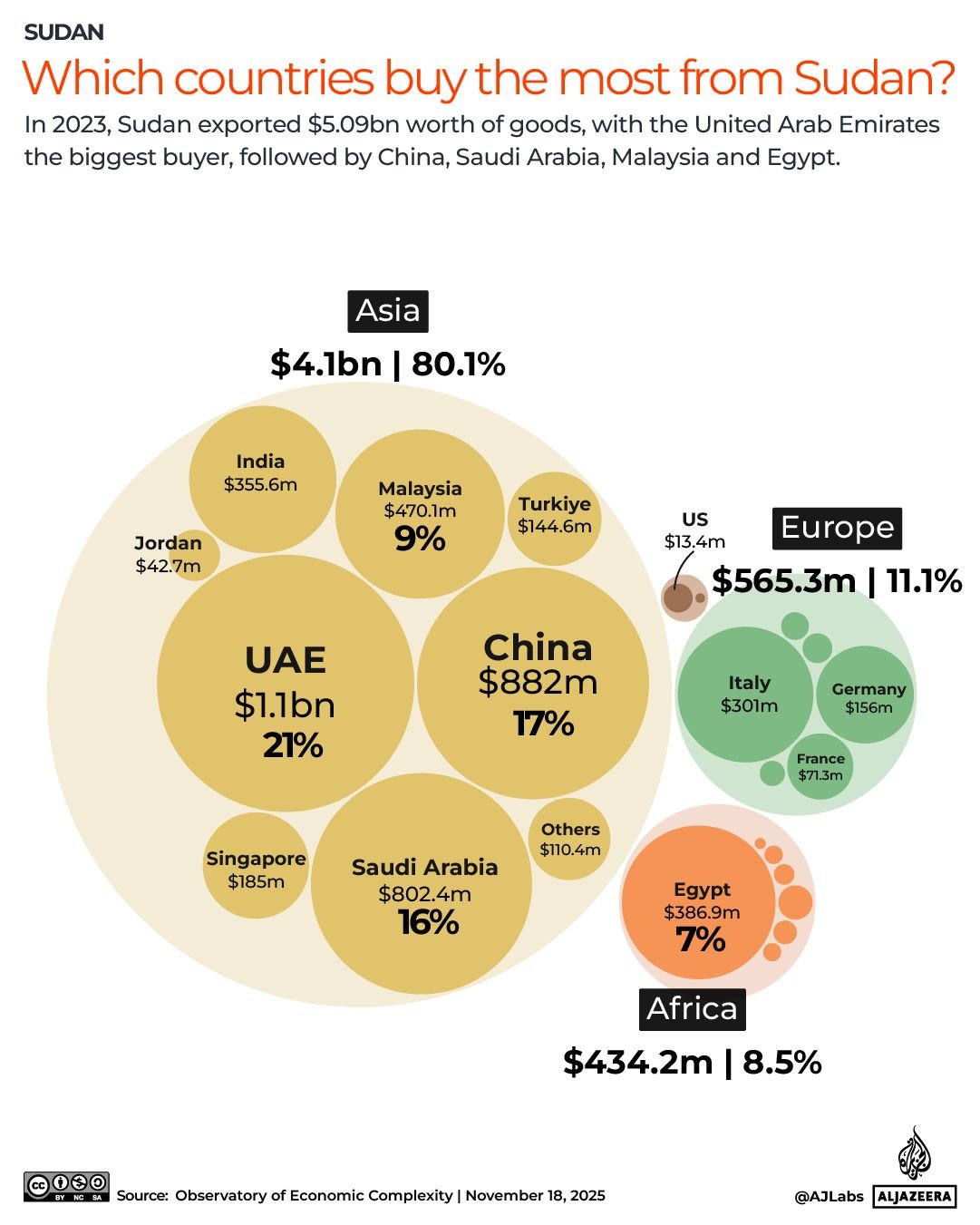
Some 80 percent of Sudan’s exports are to Asia, followed by 11 percent to Europe and 8.5 percent to Africa.
In 2023, the UAE was Sudan’s top trade partner, importing $1.09bn, or 21 percent of Sudan’s total exports, almost entirely in gold. China ranked second, importing $882m (17 percent), primarily in vegetable products.
It was followed by Saudi Arabia, with $802m (16 percent) worth of mostly livestock; Malaysia, with $470m (9 percent) of primarily crude petroleum; and Egypt, with $387m (7.6 percent) of a mix of goods.
These five countries account for more than two-thirds of Sudan’s exports.
Sudan at a glance
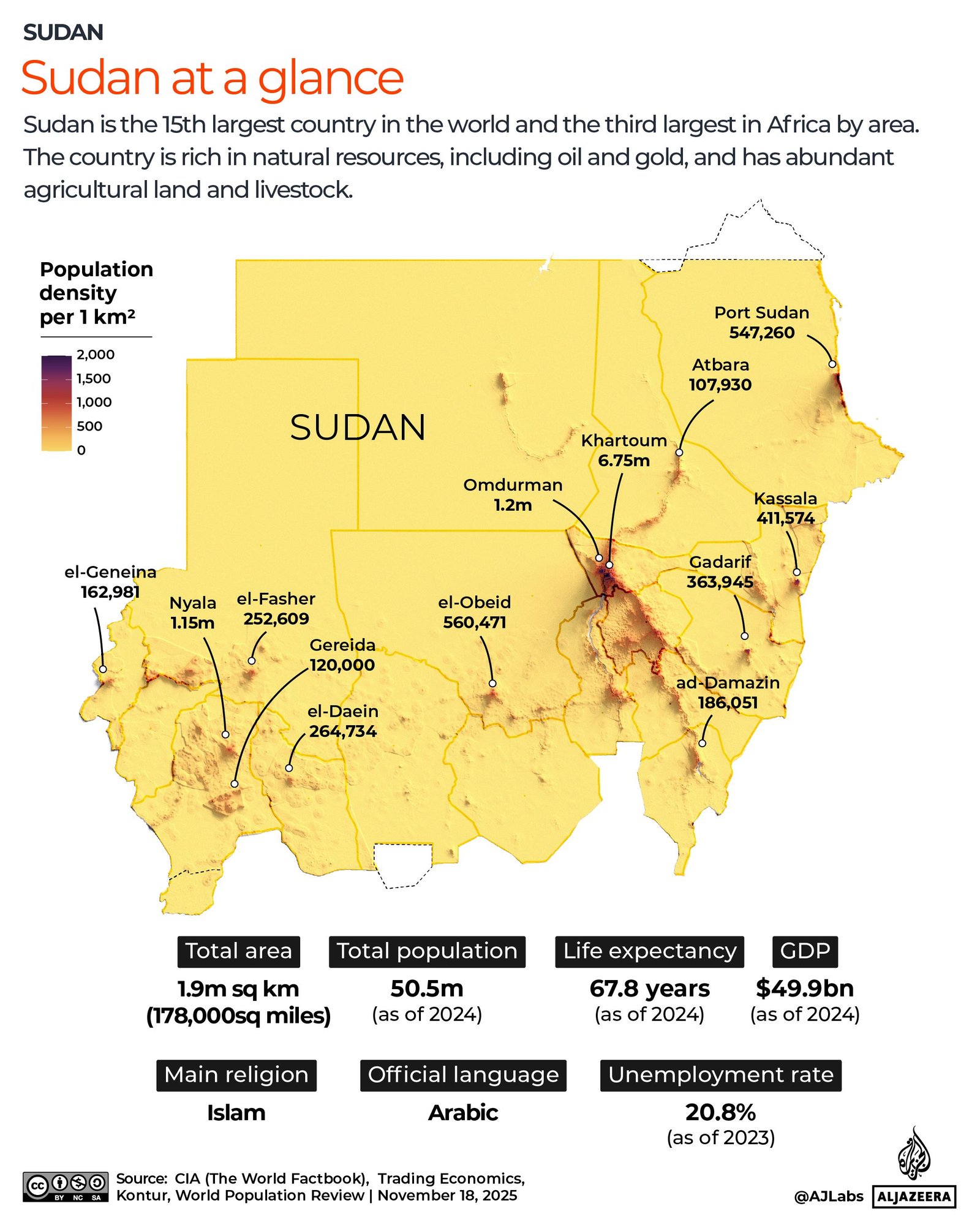
Sudan is the third-largest country in Africa, about 1.9 million sq km (718,000sq miles).
As of 2024, its population was 50.5 million, with most residents concentrated along the Nile River and in urban centres. The Greater Khartoum area has a population of about seven million, and Nyala in South Darfur has almost 1.15 million people.
Other main cities are el-Obeid (560,000), Port Sudan (547,000), Kassala (411,000), Gadarif (364,000), el-Daein (265,000), el-Fasher (253,000), ad-Damazin (186,000), Geneina (163,000), Gereida (120,000), and Atbara (108,000).